

Come noto i BRICS di cui tanto si parla rappresentano un soggetto geopolitico polimorfico individuato da un acronimo coniato nel 2001 ed utilizzato dagli economisti per indicare un nucleo di cinque grandi Paesi in rapida crescita economica o comunque dotati di una significativa influenza politica: Brasile, Russia, India, Cina e Sudafrica.
Il sodalizio, nato nel 2006 per volere dei primi 4 Paesi menzionati come progetto di coordinamento diplomatico, nel 2009 acquisì la forma di club strutturato che il 16 Giugno 2009, in occasione del primo summit dei Capi di Stato, formalizzò il proprio intento di operare al fine di instaurare un nuovo e più equo ordine mondiale multipolare. Nel 2010 –e per l’esattezza il 24 Dicembre– venne decisa l’ammissione del Sudafrica che contribuì con la sua presenza a dare corpo ad una realtà che nel 2014 rappresentava circa il 42% della popolazione mondiale e il 22% dell’economia globale.
Le ambizioni dei BRICS sono cresciute via via nel tempo grazie alla globalizzazione ed al conseguente mutamento del clima economico e politico internazionale cosicché dall’aspirazione a esprimere posizioni unitarie nelle maggiori organizzazioni multilaterali del pianeta (così da conferire maggiore forza alle proprie esigenze, desiderata ed progettualità) e a intensificare le relazioni tra gli Stati affiliati, i BRICS sono passati al tentativo vero e proprio di modificare l’architettura del sistema finanziario internazionale, allo scopo di ridurre il ruolo che vi ha sempre svolto lo USD e di consolidare la capacità dei Paesi aderenti di resistere a fughe di capitali più o meno improvvise, innescate tanto da processi economici, come il riflusso degli investimenti diretti esteri (il cosiddetto reshoring) e la fine della stimolazione monetaria negli Stati Uniti (tapering), quanto dal varo eventuale di strategie sanzionatorie esterne.
Tanto per porre in evidenza che se per un verso è vero che la NATO ed i BRICS sono due entità, due strutture alquanto differenti, alla luce degli sviluppi correnti, così come della profonda evoluzione del concetto stesso di guerra, entrambe condividono al loro interno caratteristiche di stampo militare con l’unica differenza riguardante l’assenza, nel caso dei BRICS, di un centro unico di comando facente capo ad un Paese leader per antonomasia come nel caso della NATO.
Di tutte queste tendenze la prima concreta manifestazione è stata la decisione di creare (2014) una Nuova Banca di Sviluppo avente quale suo precipuo scopo quello di finanziare progetti infrastrutturali nei Paesi emergenti, nonché, alla bisogna, grazie ad un opportuno fondo, il CRA (Contingent Reserves Arrangement), quello di fronteggiare improvvise crisi di liquidità con un’ulteriore vera e propria linea di difesa: la concorrenzialità di tali scelte con tutto quanto ha caratterizzato le istituzioni di Bretton Woods, quali la World Bank e l’IMF, risulta evidente e come tale non è dato capire come mai l’Occidente sia stato di fatto colto di sorpresa da tutto quanto occorso dal 2022 ad oggi fino al punto di non comprendere le ragioni e le finalità vere dell’attacco sferrato agli inizi del 2022 dalla Federazione Russa all’Ucraina.
Il fatto che la “potenza di fuoco” dei nuovi strumenti allestiti dai BRICS sia apparsa da subito, mi riferisco al 2014, ancora insufficiente a garantirne la stabilità finanziaria in caso di gravi turbolenze ha sicuramente tratto in inganno l’Occidente, un inganno che non poco ha contribuito a far sottovalutare le potenzialità del tutto a causa di una sovrastima in senso negativo della notevole eterogeneità e della scarsa coesione mostrata dal raggruppamento: tutti fattori che hanno fatto erroneamente ritenere decisamente improbabile che i BRICS potessero proporsi come un polo alternativo a quello che si riconosceva nel Washington consensus.
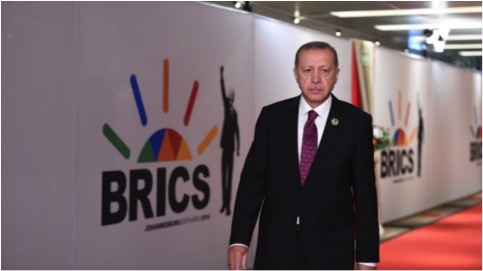
L’occhio attento rivolto da Ankara ai BRICS ha, in questi giorni, complice l’emersione in tutta la sua gravità della crisi sociale e politica che affligge l’intero Occidente, Stati Uniti in testa, ha fatto sì che venisse giustamente colto al volo il momento propizio per la formalizzazione della richiesta di ammissione del Paese levantino al sodalizio: una richiesta che, prontamente accolta con favore da Mosca, pare aver creato delle tensioni in seno ai BRICS, tensioni che ritengo siano la conseguenza del fastidio con cui Beijing ha letto i potenziali sviluppi di un più forte partenariato tra una potenza militare di tutto rispetto, quale la Turchia, ed una Federazione Russa che da tutto ciò trarrebbe non poca forza per emanciparsi in qualche modo da una Beijing che evidentemente a torto ha ritenuto di avere oramai acquisito il pieno controllo di un Cremlino che da sempre la Cina vuole poter considerare ad essa subalterna.
Quello dell’ammissione della Turchia nei BRICS, a poco più di una decina di giorni dalla diffusione della notizia della richiesta avanzata in tal senso da Ankara, in queste ore sembra proprio essersi mutato in un tema di politica internazionale che si sta via via tingendo sempre più di giallo in quanto la giornata del 13 Settembre 2024 è stata caratterizzata dall’uscita di diversi articoli decisamente significativi tra i quali oltremodo esplicito è risultato essere stato quello pubblicato da Il Fatto Quotidiano che ha letteralmente titolato un suo pezzo come segue: “Turchia, altro schiaffo per Erdogan: la richiesta di adesione ai BRICS viene messa in sospeso da Russia, Cina e India”.
A quanto pare qualcosa deve essere andato storto se dopo i toni a tratti enfatici usati nei giorni scorsi da diversi esponenti russi di spicco, le cui parole sono state riprese e riportate anche dalla stampa turca, —a tale proposito si legga quanto riferito dal quotidiano levantino BoluTakip che il 5 Settembre 2024 ha titolato “Rusya duyurdu: Erdogan BRICS zirvesine katılacak” (trad. La Russia ha annunciato: Erdogan parteciperà al vertice dei BRICS) sottotitolando “Dopo la presunta richiesta di adesione della Turchia ai BRICS, dalla Russia è arrivata una dichiarazione degna di nota. Il Cremlino ha annunciato che Erdogan parteciperà al vertice dei BRICS”—, ecco che improvvisamente ci giunge notizia di un significativo abbassamento dei toni che impone la ricerca di un inveramento di quanto sta evidentemente accadendo nel backstage di quei BRICS che sono meno coesi e forti di quanto gli stessi vogliano far credere (detto per inciso occorre tenere presente che essere i Nuovi Stati Uniti del XXI secolo non è, a conti fatti, una cosa che possa essere prendere forma e corpo in due e due quattro per quanta buona volontà ed impegno si profonda: un conto è parlare di certe cose, altro è tradurlo in qualcosa di reale e soprattutto stabile).
Tornando a noi vi è da dire che, ad onor del vero, nell’articolo del BoluTakip testé menzionato l’estensore dello stesso aveva riportato che “Il Cremlino ha dichiarato che la Turchia ha mostrato interesse per i BRICS, ma non è arrivata alcuna dichiarazione ufficiale da parte del Ministero degli Affari Esteri” anche se più oltre aveva aggiunto:
“Secondo l’agenzia statunitense Bloomberg, alcuni mesi fa la Turchia ha presentato domanda di adesione ai BRICS. Questa affermazione è stata presto ripresa dai media russi, con l’account ufficiale dei BRICS sulla piattaforma X che ha postato che la Turchia aveva presentato una domanda ufficiale all’organizzazione” ed ancora che “Il portavoce del Cremlino Dmitry Peskov, rispondendo alle domande sull’intenzione della Turchia di aderire ai BRICS, ha dichiarato: ‘Sì, in effetti la Turchia è interessata ad aderire ai BRICS, lo hanno annunciato da tempo’” puntualizzando, tuttavia, che il Ministero degli Esteri non aveva ancora rilasciato una dichiarazione sulle affermazioni secondo cui la Turchia aveva presentato domanda di adesione ai BRICS.
Peccato che il 4 Settembre 2024 l’Associated Press abbia diramato un comunicato nel quale si legge, a cura della redazione moscovita, quanto segue:
“Un alto funzionario del Cremlino ha dichiarato mercoledì che la Turchia, membro della NATO, ha presentato domanda di adesione al blocco di economie in via di sviluppo BRICS, mentre Russia e Cina cercano di contrastare l’influenza globale dell’Occidente” ed ancora che “Yuri Ushakov, assistente del Presidente Vladimir Putin per gli affari esteri, ha dichiarato ai giornalisti che la Turchia ha presentato una domanda “per l’adesione a pieno titolo” al blocco che la Russia presiede da quest’anno, e che sarà presa in considerazione“ anche se nella stessa settimana Omer Celik, portavoce del partito al governo di Erdogan, non aveva confermato che la Turchia aveva presentato una formale domanda.
Per cercare di capire cosa stia accadendo –come si conviene prima di formulare qualsivoglia ipotesi–, credo si debba osservare il diverso clima instauratosi da qualche tempo tra i due principali attori dei BRICS, ovverosia tra la Federazione Russa e la Repubblica Popolare Cinese, che a partire dalla metà di Agosto 2024 hanno preso a regolare per contanti le loro transazioni commerciali utilizzando un diverso rapporto di cambio tra la divisa cinese, il Renmimbi (CNY), ed il Rublo (RUB). Una scelta che al momento sembrerebbe rendere conto del fatto che i due ‘alleati’ siano entrati in una sorta di contenzioso esplicitato da una decisione che Newsweek ha resa nota con un articolo dal titolo alquanto graffiante: “China corners Russia with exchange rate hikes” (trad. La Cina mette alle strette la Russia con aumenti del tasso di cambio)
In altri termini nei giorni immediatamente precedenti il 15 Agosto (ma difficoltà si erano manifestate pure a Giugno) le aziende russe che avevano fatto affari con la Cina avevano dovuto fronteggiare l’aumento del tasso di cambio CNY–RUB, come riportato anche dal Moscow Times, un tasso passato dai 12,07 RUB per 1 CNY fissato dalla Banca Centrale Russa a quello di 13 RUB per 1 CNY praticato dalle banche cinesi: e poco importa che le banche cinesi fossero di grandi o di piccole dimensioni.

Nello specifico al 15 Agosto 2024 la Banca di Cina, di proprietà statale, aveva aumentato il tasso di cambio a 13,09 RUB per 1 CNY, rispetto ai 12,3 della fine della settimana precedente ed a fine Luglio sempre la Banca di Cina aveva ripreso a elaborare i pagamenti provenienti dalla Russia, dopo averli sospesi a Giugno a causa del timore delle sanzioni secondarie degli Stati Uniti sul commercio con le industrie russe.
Purtroppo per Mosca la guerra con l’Ucraina ha comportato non tanto un danno economico significativo quanto, piuttosto, un indebolimento strategico di non poco conto, di fatto non preventivato, nei confronti di una Beijing (ma a quanto pare non solo nei confronti di Beijing) con la quale, almeno in apparenza, tutto sembrerebbe aver lasciato intendere (se non altro fino a qualche mese fa) a Putin di non dover fare i conti, o per lo meno di non doverli fare così presto come tutto quanto sta accadendo in questi giorni sembra lasciar in qualche modo trasparire.
Tanto, ovviamente, a causa del fatto che, date le circostanze, la Federazione Russa si è trovata costretta a dover fare molto affidamento sul Renminbi per tutto quello che riguarda gli accordi transfrontalieri con la oltremodo affatto empatica ‘partnership senza limiti’ della Cina e con Paesi terzi tra i quali troviamo da diverso tempo anche la Mongolia e, alquanto stranamente in questo particolare momento, la Turchia.
Non è infatti un caso che da diverso tempo le banche turche hanno preso a convertire il RUB in CNY adoperando un tasso di cambio caratterizzato da diversi punti percentuali al di sopra dei tassi di mercato: un qualcosa che ha indotto un analista della società di investment banking Sberbank CIB, con sede a Mosca, a dichiarare che “Tutti approfittano dell’opportunità di fare soldi nella nostra difficile situazione“—ed a tale proposito è interessante notare come tanto il Ministero degli Esteri Cinese quanto quello della Federazione Russa non hanno al momento fornito alcun commento, il che non poco ha sconcertato gli addetti ai lavori di Ankara.
In questo senso le ripetute dichiarazioni di matrice russa, come pure le fughe di notizie riguardanti la richiesta ufficiale inoltrata della Turchia per essere ammessa tra i BRICS registrate dalla stampa a partire dallo scorso Giugno, il tutto servito in una ambigua ‘salsa’ di smentite, potrebbero essere parte integrante di un ben architettato piano —ovvero di una sovrapposizione forse non voluta (?) di più piani indipendenti— avente per fine vari scopi tra i quali gli osservatori di Ankara hanno inserito quello rispondente ad un bisogno di aumentare la confusione.
Un bisogno cui io aggiungo: 1) la necessità di testare le possibili reazioni in ambito BRICS ed extra–BRICS; 2) la necessità di dilatare i tempi a tutto vantaggio di Beijing per le ragioni che un funzionario turco restato anonimo ha esplicitato a Newsweek con le seguenti parole: “Siamo anche propensi a credere che la Russia giochi con questa questione per segnare qualche goal in Occidente e al contempo aiuti la Cina a tenerci in sospeso per non affrontare la questione della persecuzione degli Uygury“; come pure 3) la necessità forzare la mano della Turchia affinché l’establishment di Ankara abbandoni negli affari internazionali, gli piaccia o non gli piaccia, la tendenza a seguire i propri ritmi adottando un modus operandi che non consenta più a chicchessia di scrivere “L’Est è Est, l’Ovest è Ovest e la Turchia sta cercando di tracciare il proprio percorso BRICS tra i due”.
Per meglio comprendere quest’ultimo punto si consideri quanto avvenuto alle Nazioni Unite il 14 Dicembre 2022 allorché l’Assemblea Generale dell’organismo approvò una significativa risoluzione a favore di un Nuovo Ordine Economico Internazionale. Ebbene in quella sede circa 123 stati membri, in gran parte i Paesi di Africa, Asia e America Latina, votarono a favore; 50 votarono contro, mentre la Turchia, unica tra tutti i partecipanti alla votazione, si astenne esplicitando così ancora una volta la sua politica estera che è stata sempre quella di un Paese che attraversa il divario tra Europa e Asia, Est e Ovest, Nord e Sud: una posizione fin troppo tollerata dall’Occidente, ma evidentemente inaccettabile se adottata da un Paese membro dei BRICS –e ciò per ovvie ragioni.

In questo senso il gioco delle parti cui qui abbiamo accennato e consistente di ripetute dichiarazioni contraddittorie e smentite non–smentite sarebbe più facilmente interpretabile come dettato da due esigenze fondamentali:
- incrinare la NATO la cui stabilità, per altro, risulta di fatto già compromessa dalla sola formalizzazione da parte della Turchia della domanda di adesione ai BRICS a prescindere dal buon esito della candidatura. Non è un caso, infatti, che molti altri membri dei BRICS, oltre ai Russi, sostengano l’adesione della Turchia solo perché questa soluzione può ostacolare la NATO. In particolare i Russi auspicano che l’ingresso di Ankara possa favorirli sul versante ucraino, visto che Ankara è ancora mediatrice almeno per quanto riguarda l’esportazione di grano attraverso il Mar Nero.
- far comprendere ad Ankara che il tempo dei giochi di prestigio è finito e solo una scelta di campo vera e definitiva le può, a questo punto, guadagnare quel supporto geopolitico e strategico di cui abbisogna per portare avanti il suo progetto politico. In questo senso assume una particolare rilevanza il fatto che il Ministro degli Esteri della Federazione Russa Sergey Lavrov continui a insinuare che le regole e i valori dei BRICS potrebbero impedire ai Paesi membri di far parte di altre associazioni o blocchi, come la NATO. A conti fatti possiamo aggiungere che stando così le cose i segnali contrastanti di Lavrov hanno fatto crescere non poco i sospetti che la Federazione Russa stia di fatto ricattando alquanto subdolamente il Presidente turco, a sua volta maestro assoluto dell’arte dei ricatti e del doppiogiochismo. E già che ci siamo credo di non discostarmi troppo dal vero ipotizzando che tutto questo puntualizzare e precisare di Lavrov potrebbe essere riguardato come un monito del Cremlino rivolti alla stessa Beijing affinché anch’essa capisca che alla lunga il suo doppiogiochismo rischia di compromettere tutta la sua politica per il troppo volere, ovverosia per quel suo palese puntare alla realizzazione di un duopolio sino–americano mascherato da progetto multicentrico solo per attrarre a sé quanti possono contribuire a darle la forza contrattuale necessaria per confrontarsi con la NATO e gli Stati Uniti. Quella forza che trae la sua ragion d’essere anche e soprattutto dalla alleanza con una Federazione Russa non disposta ad accettare oltre ricatti di sorta (vedi il caso dei rapporti di cambio valutari di cui sopra) e collocamenti in secondo piano. Saprà Beijing ravvedersi per tempo? Non resta che attendere.
In conclusione merita sottolineare che a mettere i bastoni tra le ruote di Erdogan ci si è messa anche l’India del premier ultranazionalista, industriale e anti-musulmano Nahrendra Modi che, ad onor del vero, ha buoni motivi per diffidare di Erdogan.
La questione relativa ai rapporti intercorrenti tra l’India e la Turchia è oltremodo articolata e complessa e merita per certo un approfondimento dettagliato in altra sede, tuttavia, per completezza, ritengo sia bastevole per ora prendere in esame quanto emerso da alcuni verbali trapelati grazie al Nordic Research Monitoring Network (Nordic Monitor), un’organizzazione che si occupa di terrorismo, sicurezza e questioni militari, relativi ad una riunione della Commissione Esteri della Turchia, riunione tenutasi il 10 Luglio 2024, nel corso della quale Mustafa Murat Şeker, numero due della Presidenza dell’Industria della Difesa – SSB (la principale agenzia turca che controlla la produzione e il rifornimento di armi) avrebbe detto:

Per dirla con altre parole l’India è stata inserita nella blacklist turca dei Paesi ai quali la Turchia non intende vendere armi né qualsiasi articolo militare, e questo a causa non soltanto del sostegno turco, che dura da anni, all’islamico Pakistan, nemico numero uno dell’India di Modi, ma anche a causa della politica dell’hindutva, giudicata fortemente anti-musulmana, del governo indiano.
Il contrasto tra i due Paesi membri del G20 si è ampliato nel corso degli anni e, come ha riportato Asia News in un articolo datato 18 Luglio 2024, da un precedente rapporto Nordic Monitor ha attinto informazioni che dimostrato “come la Turchia abbia segretamente aiutato il Pakistan in vari campi: dalla creazione di un esercito informatico finalizzato a plasmare l’opinione pubblica e influenzare i musulmani del sud-est asiatico al lancio di attacchi contro gli Stati Uniti e l’India e alla censura delle critiche al Pakistan“, aggiungendo che “La proposta di istituire un’unità cibernetica è stata avanzata per la prima volta durante i colloqui privati a Islamabad tra l’allora ministro dell’Interno turco Suleyman Soylu e il suo omologo pakistano Shehryar Khan Afridi il 17 dicembre 2018. La questione è stata poi discussa a un livello superiore e tenuta riservata dalla maggior parte del personale del Ministero dell’Interno pakistano a Islamabad.Il piano è stato approvato anche da Imran Khan, allora primo ministro e ministro degli Interni, durante un incontro con Soylu lo stesso giorno”.
Il contenzioso tra Ankara e Delhi , però, è molto più ampio e tocca anche scelte strategiche nel commercio globale, a cominciare dal disaccordo sulla proposta avanzata da India, Stati Uniti e Unione Europea al vertice del G20 di Nuova Delhi di creare un corridoio economico che colleghi l’Europa all’India, attraversando il Medio Oriente per ferrovia e via mare che, come tale, escludendo la Turchia ha indotto Ankara a manifestare la sua totale opposizione ad una iniziativa che mina il suo ruolo di hub commerciale e favorisce la Grecia e altri concorrenti regionali: una circostanza che fa si che la Turchia sostenga i piani di sviluppo della Cina nell’ambito della Belt and Road Initiative, ossia della cosiddetta “nuova Via della Seta”.
In questo senso sono molti gli aspetti che promettono di giocare un ruolo attivo nel processo di inserimento di Ankara tra i BRICS, un processo che sarà oltremodo utile monitorare per comprendere quali sono i fattori principali di tenuta dei BRICS, quali i fattori di debolezza, nonché il peso delle diverse leadership alla guida dei Paesi membri nell’ambito del gruppo.
Sic stantibus rebus risulta particolarmente interessante il rilievo fatto da Ozgur Unluhisarcikli, analista del think tank German Marshall Fund, per il quale “Sebbene i Brics siano un importante raggruppamento internazionale, non riescono a essere una forza coesa e unita come l’UE” ed “In quanto tale, non può fungere da alternativa all’UE per la Turchia, almeno per ora“.
Certo è che la questione della domanda potrebbe mettere la Turchia in una posizione difficile, soprattutto se i BRICS dovessero farla aspettare per molti anni per l’adesione completa come già avvenuto per l’adesione alla EU che Ankara attende dagli anni ’60.
Al fine di approfondire la questione delle possibili conseguenze dell’ingresso di Ankara nei BRICS quanto segue ne propone una disamina che ritengo, per quanto non esaustiva, meriti una, se non altro, attenta riflessione.
Allorché ho proposto le mie considerazioni in un recente articolo pubblicato sul Nuovo Giornale Nazionale con il titolo “La Turchia nei BRICS: il ‘Cavallo di Troia’ di Beijing nella Rocca della NATO” tra i vari commenti raccolti ve ne stato uno che mi ha particolarmente colpito che voglio qui condividere in quanto offre lo spunto per una riflessione storiografica che reputo possa tornare alquanto utile.
Testualmente il commento recitava: “È una buona notizia, come lo sarebbe se le grandi economie asiatiche musulmane e i Paesi del Golfo si unissero anche loro ai BRICS. ‘Sarebbe un bene perché finché non ci sarà una rivoluzione cognitiva in Occidente sui paradigmi distruttivi e nichilisti che porta avanti, andremo dritti verso una WWIII nucleare’. I paradigmi di Wall Street e Hollywood, cioè della supremazia totalizzante del valore di mercato e finanza virtuale su valori intrinsechi ed economia reale, non solo hanno fallito nel loro tentativo maldestro di esportarli e imporli nelle galassie Islam, Africa e Cina, ma hanno dentro i semi della distruttivitá e del nichilismo nella eliminazione della storia e la diminuzione all’ininfluenza di atavismo, culture, tradizioni, estetica, valori, storicismo”.
Personalmente ritengo che questo sarebbe vero se è solo se i BRICS fossero ciò che tutti credono che siano: un qualcosa di realmente innovativo.
Purtroppo tra la narrativa dei BRICS ed il mondo reale passa la stessa differenza intercorrente tra l’Illuminismo e la Rivoluzione Francese, che rivoluzione non fu bensì lo strumento con cui la grossa borghesia imprenditoriale riuscì ad abbattere l’Ancien Regime clerico-nobiliare per riedificarlo, con l’aiuto delle illuse masse popolari, in forma tripartita di tipo clerico-nobiliare-alto borghese.
In questo senso oggi l’idea BRICS è ciò che permette di stimolare i Paesi del Sud del mondo affinché con la loro fattiva partecipazione permettano alla Cina di abbattere il Vecchio Ordine Mondiale bipolare (o quel che ne resta) per riedificarlo esattamente come quello con l’unica differenza che non sarà russo-statunitense bensì sino-statunitense!
Alla Russia credo che la Cina abbia destinato lo stesso ruolo (resta da vedere quanto attuabile) che la grossa borghesia imprenditoriale riservò alla piccola e media borghesia dei tempi che seguirono la Rivoluzione Francese: un ruolo di comprimario non paritetico.
I BRICS in questo senso sono altro dalla filosofia BRICS… molto altro, con tutto ciò che questo potenzialmente può implicare ed al momento implica ed ha implicato.
Una domanda sorge spontanea: “A quando la richiesta di ammissione ai BRICS da parte di Budapest?”.
TURKEY IN THE BRICS: THE PLAN IS TINGED WITH YELLOW
As is well known, the much talked-about BRICS represents a polymorphic geopolitical entity identified by an acronym coined in 2001 and used by economists to denote a core group of five major countries experiencing rapid economic growth or otherwise endowed with significant political influence-Brazil, Russia, India, China and South Africa.
The coalition, which came into being in 2006 at the behest of the first four countries mentioned as a diplomatic coordination project, in 2009 acquired the form of a structured club that on June 16, 2009, at the first summit of heads of state, formalized its intent to work toward establishing a new and more equitable multipolar world order. In 2010 -and to be exact on December 24- it was decided to admit South Africa, which contributed with its presence to flesh out a reality that in 2014 represented about 42 percent of the world’s population and 22 percent of the global economy.
The ambitions of the BRICS have gradually grown over time thanks to globalization and the consequent change in the international economic and political climate so that from the aspiration to express unified positions in the planet’s major multilateral organizations (so as to give greater force to their own needs, desires and projects) and to intensify relations among affiliated states the BRICS have moved on to the actual attempt to modify the architecture of the international financial system, with the aim of reducing the role that the USD has always played in it and consolidating the capacity of the member countries to resist more or less sudden capital flight, triggered as much by economic processes, such as the ebb of foreign direct investment (so-called reshoring) and the end of monetary stimulation in the United States (tapering), as by the eventual launching of external sanctioning strategies.
So much to highlight that while on the one hand it is true that NATO and the BRICS are two entities, two somewhat different structures, in light of current developments, as well as the profound evolution of the concept of warfare itself, both share internally military-like characteristics with the only difference concerning the absence, in the case of the BRICS, of a single command center headed by a leading country par excellence as in the case of NATO.
Of all these trends, the first concrete manifestation was the decision to create (2014) a New Development Bank having as its main purpose to finance infrastructure projects in emerging countries, as well as, when necessary, thanks to an appropriate fund, the Contingent Reserves Arrangement (CRA), to cope with sudden liquidity crises with an additional real line of defense: the competitiveness of such choices with everything that has characterized the Bretton Woods institutions, such as the World Bank and the IMF, is apparent, and as such it is not apparent why the West was in fact taken by surprise by everything that has occurred since 2022 to the point of not understanding the true reasons and purposes of the attack launched in early 2022 by the Russian Federation on Ukraine.
The fact that the “firepower” of the new instruments set up by the BRICS appeared from the outset, I am referring to 2014, still insufficient to guarantee its financial stability in the event of serious turbulence has certainly misled the West, a deception that has contributed in no small part to underestimating the potential of the whole due to an overestimation in a negative sense of the considerable heterogeneity and lack of cohesion shown by the grouping: all factors that led to the erroneous assumption that it was decidedly unlikely that the BRICS could offer itself as an alternative pole to that which recognized itself in the Washington consensus.
Ankara’s watchful eye on the BRICS has, in recent days, abetted by the emergence in all its severity of the social and political crisis afflicting the entire West, the United States in the lead, meant that the propitious moment was rightly seized upon for the formalization of the Levantine country’s request for admission to the sodality: a request that, promptly welcomed by Moscow, seems to have created tensions within the BRICS, tensions that I believe are the consequence of the annoyance with which Beijing has read the potential developments of a stronger partnership between a respectable military power such as Turkey and a Russian Federation that would derive no small amount of strength from all this to emancipate itself in some way from a Beijing that evidently wrongly felt that it had now acquired full control of a Kremlin that China has always wanted to be able to consider subordinate to it.
That of Turkey’s admission into the BRICS, little more than a dozen days after the news of Ankara’s request to that effect spread, in recent hours seems to have changed into an international political issue that is gradually becoming more and more tinged with yellow as the day of September 13, 2024 was marked by the release of several decidedly significant articles among which exceedingly explicit was the one published by Il Fatto Quotidiano, which literally titled one of its pieces as follows: “Turkey, another slap in the face for Erdogan: BRICS membership application gets put on hold by Russia, China and India.”
Apparently something must have gone wrong if after the at times emphatic tones used in recent days by several prominent Russian figures, whose words were also taken up and reported in the Turkish press,-in this regard, read what was reported by the Levantine daily BoluTakip, which on September 5, 2024 headlined “Rusya duyurdu: Erdogan BRICS zirvesine katılacak” (transl. Russia announced: Erdogan will attend BRICS summit) subtitled “After Turkey’s alleged application for BRICS membership, a noteworthy statement came from Russia. The Kremlin has announced that Erdogan will attend the BRICS summit”-, here we suddenly get news of a significant lowering of the tone that necessitates the search for a reversal of what is evidently going on backstage in those BRICS that are less cohesive and strong than they themselves would like to make believe (said incidentally it must be kept in mind that being the New United States of the 21st century is not, on balance, something that can be take shape and body in two and two fours no matter how much good will and commitment one may deepen: it is one thing to talk about certain things, quite another to translate it into something real and above all stable).
Coming back to us there is to say that, to be fair, in the BoluTakip article mentioned above the writer of the same had reported that “The Kremlin has stated that Turkey has shown interest in the BRICS, but no official statement has come from the Ministry of Foreign Affairs” although further on he had added:
“According to the U.S. Bloomberg news agency, a few months ago Turkey submitted an application to join BRICS. This claim was soon picked up by Russian media, with the official BRICS account on Platform X posting that Turkey had submitted an official application to the organization.” and further that “Kremlin spokesman Dmitry Peskov, responding to questions about Turkey’s intention to join BRICS, said: ‘Yes, indeed Turkey is interested in joining BRICS, they have been announcing it for some time'” pointing out, however, that the Foreign Ministry had not yet issued a statement on the claims that Turkey had applied to join BRICS.
Too bad that on September 4, 2024, the Associated Press issued a statement in which the Moscow editorial board read as follows:
“A senior Kremlin official said Wednesday that Turkey, a NATO member, has applied for membership in the BRICS bloc of developing economies as Russia and China seek to counter the West’s global influence,” and further that “Yuri Ushakov, President Vladimir Putin’s assistant for foreign affairs, told reporters that Turkey has submitted an application “for full membership” in the bloc that Russia has presided over since this year, and that it will be considered” even though in the same week Omer Celik, spokesman for Erdogan’s ruling party, had not confirmed that Turkey had submitted a formal application.
In order to try to understand what is happening-as is appropriate before making any assumptions-I think we need to look at the different climate that has been established for some time now between the two main BRICS players, namely between the Russian Federation and the People’s Republic of China, which as of mid-August 2024 have taken to settling their trade transactions for cash using a different exchange rate between the Chinese currency, the Renmimbi (CNY), and the Ruble (RUB). A choice that at the moment would seem to account for the fact that the two ‘allies’ have entered into a kind of dispute made explicit by a decision that Newsweek made public in an article with the rather scathing title, “China corners Russia with exchange rate hikes”
In other words, in the days immediately preceding August 15 (but difficulties had manifested themselves in June as well) Russian companies that had done business with China had had to cope with the increase in the CNY-RUB exchange rate, as also reported by the Moscow Times, a rate that went from the RUB 12.07 per 1 CNY set by the Russian Central Bank to the RUB 13 per 1 CNY rate practiced by Chinese banks: and it matters little whether the Chinese banks were large or small
Specifically, as of August 15, 2024, the state-owned Bank of China had raised the exchange rate to 13.09 RUB per 1 CNY, up from 12.3 at the end of the previous week, and by the end of July, again the Bank of China had resumed processing payments from Russia, after suspending them in June due to fears of secondary U.S. sanctions on trade with Russian industries.
Unfortunately for Moscow, the war with Ukraine has entailed not so much significant economic damage as, rather, a strategic weakening of no small magnitude, in fact unanticipated, vis-à-vis a Beijing (but apparently not only vis-à-vis Beijing) with which, at least on the surface, everything would seem to have suggested (if only until a few months ago) to Putin that he would not have to reckon, or at least that he would not have to reckon so soon as everything that is happening these days seems to somehow suggest.
So much, of course, because of the fact that, under the circumstances, the Russian Federation has found itself forced to rely heavily on the Renminbi for everything related to cross-border agreements with the exceedingly not at all empathetic ‘partnership without limits’ of China and with third countries among which we have for some time now also found Mongolia and, somewhat strangely at this particular time, Turkey.
Indeed, it is no coincidence that for quite some time Turkish banks have taken to convert RUB into CNY using an exchange rate characterized by several percentage points above market rates: something that prompted an analyst at Moscow-based investment banking firm Sberbank CIB to declare that “Everyone is taking advantage of the opportunity to make money in our difficult situation”-and in this regard it is interesting to note that both the Chinese Foreign Ministry and the Ministry of the Russian Federation have not provided any comment at the moment, which has not a little puzzled insiders in Ankara.
In this sense, the repeated Russian-originated statements, as well as the leaks concerning Turkey’s forwarded official application to be admitted among the BRICS recorded in the press since last June, all served in an ambiguous ‘sauce’ of denials, could be part and parcel of a well-conceived plan-that is, of a perhaps unintended (?) overlapping of several independent plans- having for its end various purposes among which Ankara observers have included that responding to a need to increase confusion.
A need to which I would add: 1) the need to test possible reactions in the BRICS and extra-BRICS spheres; 2) the need to dilute the time frame to Beijing’s advantage for the reasons that a Turkish official who remained anonymous made explicit to Newsweek in the following words: “We are also inclined to believe that Russia is playing with this issue in order to score some goals in the West and at the same time help China to keep us in suspense in order not to deal with the issue of persecution of the Uygury.” as well as 3) the need to force Turkey’s hand so that the Ankara establishment abandons in international affairs, whether it likes it or not, the tendency to follow its own pace by adopting a modus operandi that no longer allows anyone to write “East is East, West is West, and Turkey is trying to chart its own BRICS path between the two.”
To better understand this last point consider what happened at the United Nations on December 14, 2022 when the body’s General Assembly passed a significant resolution in favor of a New International Economic Order. Well, at that forum some 123 member states, mostly the countries of Africa, Asia and Latin America, voted in favor; 50 voted against, while Turkey, the only one among all the participants in the vote, abstained, thus once again making explicit its foreign policy, which has always been that of a country that crosses the divide between Europe and Asia, East and West, North and South: a position all too tolerated by the West, but clearly unacceptable when adopted by a BRICS member country-and this for obvious reasons.
In this sense, the partisan game we have alluded to here and consisting of repeated contradictory statements and untruthful denials would be more easily interpreted as dictated by two basic needs:
- to undermine NATO whose stability, by the way, is in fact already compromised by Turkey’s formalization of its application for BRICS membership alone regardless of the success of the application. It is no coincidence, in fact, that many other BRICS members, besides the Russians, support Turkey’s membership only because this solution may hinder NATO. In particular, the Russians hope that Ankara’s entry may favor them on the Ukrainian side, since Ankara is still a mediator at least as far as grain exports through the Black Sea are concerned.
- to make Ankara understand that the time for sleight of hand is over and only a real and definitive field choice can, at this point, earn it the geopolitical and strategic support it needs to pursue its political project. Particularly relevant in this sense is the fact that the Foreign Minister of the Russian Federation Sergey Lavrov keeps insinuating that BRICS rules and values could prevent member countries from joining other associations or blocs, such as NATO. On balance, we may add that this being the case, Lavrov’s mixed signals have raised no small amount of suspicion that the Russian Federation is in fact rather underhandedly blackmailing the Turkish president, himself an absolute master of the art of blackmail and double-dealing. And while we are at it, I think I am not departing too far from the truth by speculating that all this pointing and pointing out by Lavrov could be regarded as a Kremlin warning addressed to Beijing itself so that it too understands that in the long run its double-dealing risks undermining its entire policy by too much wanting, that is, for its blatant aiming at the realization of a Sino-U.S. duopoly masquerading as a multi-center project only to attract to itself those who can help give it the bargaining strength it needs to confront NATO and the United States. That strength that derives its raison d’être also and above all from its alliance with a Russian Federation unwilling to accept beyond blackmail of any kind (see the case of currency exchange ratios mentioned above) and secondary placements. Will Beijing know how to come to its senses in time? All that remains is to wait.
In conclusion, it is worth pointing out that putting a spoke in Erdogan’s wheels has also been put in by the India of the ultranationalist, industrialist and anti-Muslim premier Nahrendra Modi who, to be fair, has good reason to distrust Erdogan.
The issue regarding the intercurrent relations between India and Turkey is beyond articulate and complex and certainly deserves detailed study elsewhere, however, for the sake of completeness, I think it is sufficient for now to examine what has emerged from some leaked minutes thanks to the Nordic Research Monitoring Network (Nordic Monitor), an organization that deals with terrorism, security and military issues, related to a meeting of Turkey’s Foreign Commission, a meeting held on July 10, 2024, at which Mustafa Murat Şeker, number two in the Defense Industry Bureau-SSB (Turkey’s main agency that controls the production and supply of weapons) reportedly said:
“India, for example, is one of the top five arms importers in the world, a huge market, importing about 100 Bn USD. However, because of our political situation and friendship with Pakistan, our Ministry of Foreign Affairs does not give us positive feedback on exporting products to India and, as a result, we do not grant any permits to our companies in this regard.”
To put it another way, India has been placed on Turkey’s blacklist of countries to which Turkey does not intend to sell arms or any military items, and this is not only because of Turkey’s years-long support for Islamist Pakistan, Modi’s India’s number one enemy, but also because of the Indian government’s Hindutva policy, which is judged to be strongly anti-Muslim.
The contrast between the two G20 member countries has widened over the years and, as Asia News reported in an article dated July 18, 2024, from an earlier Nordic Monitor report drew information showing “how Turkey has secretly aided Pakistan in various fields: from creating a cyber army aimed at shaping public opinion and influencing Southeast Asian Muslims to launching attacks against the U.S. and India and censoring criticism of Pakistan,” adding that “The proposal to establish a cyber unit was first put forward during private talks in Islamabad between then-Turkish Interior Minister Suleyman Soylu and his Pakistani counterpart Shehryar Khan Afridi on Dec. 17, 2018. The matter was then discussed at a higher level and kept confidential by most Pakistani Interior Ministry staff in Islamabad.The plan was also approved by Imran Khan, then prime minister and interior minister, during a meeting with Soylu the same day.”
The dispute between Ankara and Delhi , however, is much broader and also touches on strategic choices in global trade, starting with the disagreement over the proposal made by India, the United States and the European Union at the G20 summit in New Delhi to create an economic corridor linking Europe to India, crossing the Middle East by rail and sea, which, as such, excluding Turkey has led Ankara to express its total opposition to an initiative that undermines its role as a trade hub and favors Greece and other regional competitors: a circumstance that makes Turkey support China’s development plans under the Belt and Road Initiative, or the so-called “new Silk Road.”
In this sense, there are many aspects that promise to play an active role in the process of Ankara’s inclusion among the BRICS, a process that will be exceedingly useful to monitor in order to understand what are the main factors holding the BRICS together, what are the factors of weakness, as well as the weight of the different leaderships leading the member countries within the group.
Sic stantibus rebus the point made by Ozgur Unluhisarcikli, an analyst at the German Marshall Fund think tank, that “Although the Brics is an important international grouping, it fails to be a cohesive and united force like the EU” and “As such, it cannot serve as an alternative to the EU for Turkey, at least for now.”
Certainly, the question of demand could put Turkey in a difficult position, especially if the BRICS were to make it wait for many years for full membership as has already been the case with EU membership, which Ankara has been waiting for since the 1960s.
In order to further explore the issue of the possible consequences of Ankara’s entry into the BRICS what follows offers an examination of it which I believe, though not exhaustive, deserves, if nothing else, careful consideration.
When I offered my considerations in a recent article published in the New National Newspaper under the title “Turkey in the BRICS: Beijing’s ‘Trojan Horse’ in the NATO Rock” among the various comments collected there was one that particularly struck me that I want to share here as it offers the cue for a historiographical reflection that I believe may come in quite useful.
Textually the comment read, “This is good news, as it would be if the big Asian Muslim economies and the Gulf countries also joined the BRICS. ‘It would be good because until there is a cognitive revolution in the West on the destructive and nihilistic paradigms it carries, we will be heading straight for a nuclear WWIII.’ The paradigms of Wall Street and Hollywood, that is, of the totalizing supremacy of market value and virtual finance over intrinsic values and real economics, have not only failed in their misguided attempt to export and impose them in the Islam, Africa and China galaxies, but have within them the seeds of destructiveness and nihilism in the elimination of history and the diminution to irrelevance of atavism, cultures, traditions, aesthetics, values, historicism.”
I personally believe that this would be true if it is only if BRICS is what everyone believes it is: something truly innovative.
Unfortunately, the same difference passes between the BRICS narrative and the real world as between the Enlightenment and the French Revolution, which revolution was not but rather the instrument by which the big business bourgeoisie succeeded in tearing down the clerical-noble Ancien Regime in order to rebuild it, with the help of the deluded popular masses, in a tripartite clerical-noble-upper bourgeois form.
In this sense today, the BRICS idea is what makes it possible to stimulate the countries of the Global South so that with their active participation they will enable China to bring down the bipolar Old World Order (or what remains of it) to rebuild it exactly like that with the only difference being that it will not be Russian-US but Sino-US!
For Russia I believe that China has earmarked the same role (it remains to be seen how viable) that the big business bourgeoisie reserved for the small and middle bourgeoisie of the times following the French Revolution: an unequal comprimario role.
BRICS in this sense is other than the BRICS philosophy–very other, with all that this potentially implies and at the moment implies and has implied.
One question arises, “When will Budapest apply for admission to BRICS?”