

Toward a New European Balance: Social Security Sustainability, Employment, and Social Responsibility
The analysis presented in the previous chapters leads to a fundamental conclusion: the issue of European social security cannot be addressed solely as a matter of the financial stability of pension systems.
Demographic aging, the transformation of the economic structure, the fragmentation of work careers, and the artificial intelligence revolution are simultaneously altering the economic conditions upon which the European social security model was built.
The transition toward greater individual participation through supplemental pension plans represents an understandable response to the challenges facing public systems.
However, it cannot be considered a solution in isolation from the profound transformations of the labor market and the economic structure.
A system based on individual capitalization, in fact, requires a prerequisite: a society capable of generating incomes that are sufficiently stable, widespread, and adequate so that citizens can accumulate savings over the course of their working lives.
For this reason, the future of European social security will depend not only on the financial markets’ ability to generate returns, but also on the real economy’s ability to create skilled jobs, boost productivity, and ensure a sustainable distribution of wealth.
The Need for a New Pact Between Social Security, Employment, and Growth
The European model for the coming decades cannot be limited to choosing between public and private pensions. The real challenge will be to strike a balance in which individual responsibility and collective protection are not viewed as alternatives, but as complementary components.
Greater individual accountability can be a positive development only if accompanied by conditions that make it actually possible to exercise that responsibility.
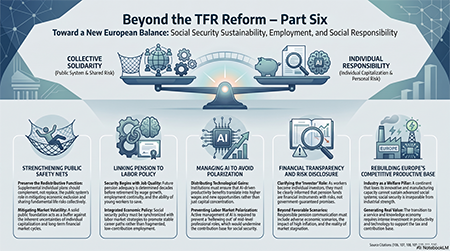
This implies at least five fundamental guidelines.
1.Strengthen the safety net function of public social security
The growth of supplemental pension plans should not lead to a gradual abandonment of the redistributive function of the public pension system.
Public pension systems will continue to play an essential role in guaranteeing a minimum level of protection and in mitigating the risk that changes in the labor market will lead to new forms of economic exclusion in old age.
The challenge for the future will not be to eliminate intergenerational solidarity, but to make it compatible with new demographic and economic conditions.
2. Linking Social Security Policy to Labor Policy
The ability to build an adequate retirement pension begins long before retirement age.
It depends on the quality of employment, consistent contribution history, wage growth, and workers’ ability to accumulate savings during their working lives.
A social security policy isolated from economic policy therefore risks addressing only the final effects of problems that arise decades earlier.
The central issue, then, becomes the creation of a labor market capable of offering not only employment but also sustainable career paths.
3. Managing Technological Transformation While Avoiding Social Polarization
Artificial intelligence could be one of the main drivers of productivity growth in the coming decades. However, the social impact of this transformation will not be determined solely by technology, but by the institutions that will shape the change.
The key issue is not to hinder innovation, but to ensure that the benefits of increased productivity translate into higher wages, new career opportunities, and greater economic security.
Continuing education, professional retraining, and the adaptation of educational systems will be decisive factors.
An economy capable of harnessing artificial intelligence without an adequate human capital policy risks, in fact, producing greater efficiency but also greater inequality.
4. Making the Relationship Between Returns and Pension Risk More Transparent
The expansion of supplemental pension plans requires a higher level of economic and financial information.
Citizens must understand that a pension fund is an important tool, but it is not equivalent to a government guarantee.
Future pension policy should therefore combine incentives for individual savings with balanced communication that clearly explains both the potential benefits and the risks associated with economic and financial cycles.
A more financially literate society is not one that is simply asked to invest more, but one that is provided with the tools to truly understand the consequences of its choices.
5. Rebuilding a Competitive European Productive Base
The sustainability of social security will also depend on Europe’s ability to maintain an economic structure capable of generating value.
The transition to an economy more heavily based on services and knowledge can represent an opportunity, but it requires investment in productivity, technology, training, and strategic sectors.
The issue of social security is therefore inseparable from the issue of industry.
A continent that loses its productive, innovative, and technological capacity risks compromising, in the long term, its ability to sustain advanced social systems.
Conclusion: Who will bear the risk of the future?
The transformation of European social security systems represents one of the most important steps in the new economic and social phase.
The gradual shift toward greater individual responsibility should not be interpreted simply as a technical transfer of resources from public systems to financial markets.
It is a more profound change, because it alters the way in which society distributes economic risk among individuals, institutions, and generations.
The central issue is not to determine whether the public or individual model is superior in absolute terms.
No social security system can completely eliminate risk.
The real question is who is called upon to bear that risk when economic conditions change.
If the future is characterized by limited growth, rapid technological change, and greater job instability, simply placing greater responsibility on individuals may not be enough.
The European model will therefore need to find a new balance: a society in which citizens are more aware and engaged, but in which individual responsibility does not become the means by which vulnerabilities generated by collective transformations are shifted onto individuals.
The decisive question for the coming decades will not merely be: “How will we finance future pensions?”
It will be an even broader question: “What kind of economy, labor market, and society will we build so that future generations can truly secure their own economic well-being?”
Because the sustainability of social security, even before being a financial issue, is a matter of productive capacity, social cohesion, and the quality of Europe’s economic future.
A society that persists in pretending that the generational pact of the past has not ended forever – and that, consequently, the fundamental question today is not merely who will manage future pension savings, but rather who, within just a few decades, will bear the risk when employment, economic growth, and Europe’s social structure have been profoundly transformed.
Policy Recommendations
In light of the analysis conducted, this paper identifies six priorities for strengthening the long-term sustainability of European social security systems:
1. Preserve a solid foundation of public social security capable of ensuring universal protection and social cohesion.
2. Integrate social security policies with labor market policies, promoting stable employment, adequate wages, and continuous contribution history.
3. Invest in lifelong learning and human capital to support workers’ adaptation to technological change.
4. Manage the transition to artificial intelligence by promoting innovation without shifting the full costs of automation onto workers.
5. Strengthen transparency and financial education so that supplemental retirement plans are accompanied by a full understanding of the risks and opportunities.
6. Support European competitiveness and productive capacity, an essential condition for ensuring long-term growth, employment, and the sustainability of the welfare system.
Selected Bibliography and Data Sources
Data Sources Used for Figures
Demography
• Eurostat Population Statistics
• OECD Demographic Indicators
Employment and Wages
• Eurostat Labour Force Survey
• OECD Employment Database
Productivity
• OECD Productivity Statistics
• ECB Economic Data
Financial Markets and Debt
• BIS Statistics
• IMF Global Debt Database
• World Bank Global Economic Indicators
Pension Funds
• OECD Pension Markets in Focus
• COVIP Annual Reports
Methodological Note:
All figures are based on publicly available data from international institutions. Where projections are presented, they should be interpreted as scenarios rather than forecasts, given the uncertainty associated with demographic, economic and technological developments.