

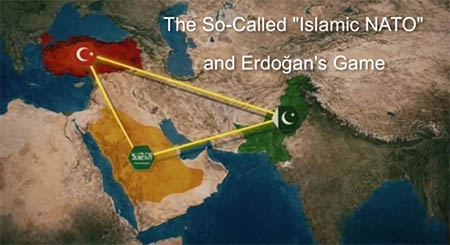
The Struggle for Leadership in the Muslim World
The mutual defense agreement signed by Turkey, Saudi Arabia, and Pakistan in Mecca on August 7, 2026, is presented as a defensive pact.
But behind the diplomatic rhetoric, something more ambitious can be glimpsed: the possible emergence of an autonomous security architecture within the Islamic world.
It would be a mistake, however, to view it simply as an “Islamic NATO” or as the emergence of a new anti-Western front. The real stakes may lie in the race for leadership of the Muslim world and, more broadly, for the geopolitical representation of a portion of the so-called Global South.
And this is where a contradiction emerges that is bound to weigh heavily: Ankara and Riyadh may be tactical allies, but they remain strategic competitors.
It is not yet an “Islamic NATO”
The reference to Article 5 of the NATO Treaty is inevitable: an armed attack against one of the three countries is considered an attack against all of them. But to stop at the formal similarity would be misleading.
Turkey is not leaving NATO, and Ankara presents the new agreement as complementary to – not an alternative to – the Atlantic Alliance. The point, therefore, is not the immediate emergence of a military bloc opposed to Washington.
The point is more subtle: a security architecture is taking shape in which the United States is not necessarily at the center.
The reasons are manifold and do not concern only the desire of regional powers to increase their autonomy.
In recent years, Washington has had to contend with a series of crises in which Western military superiority did not automatically translate into a corresponding ability to exert political control over events.
The asymmetric and hybrid confrontation with Tehran was a significant example of this, as was Iran’s ability to exploit the media narrative that developed around the Gaza conflict, with significant effects on Western public opinion and on the political cohesion of several NATO countries, particularly European ones.
This is not to argue that Iran has “defeated” NATO – which would be a baseless oversimplification – but rather to acknowledge – as we have repeatedly stated and emphasized – that Western power can no longer be measured solely by the balance of conventional military arsenals and capabilities.
The political, communicative, and social dimensions of conflicts are now an integral part of strategic competition.
And it is this that, not so much in the short term as in the medium term, may become problematic for American hegemony.
The decisive question, therefore – at least for the moment – is not whether Erdoğan wants to leave NATO, from which he aims to obtain the F-35s, but rather to what extent an increasingly autonomous Turkey can leverage its membership in the Alliance while simultaneously building strategic relationships with powers that do not belong to the Western system.
This is something Ankara has already sought to do in the context of the BRICS as well, attempting to draw closer to an organization within which it has failed to find the space it evidently hoped to secure. But this in no way justifies interpreting the Mecca agreement as an indirect attack on the BRICS. That would be a stretch.
Interpreting the new triangle as an anti-BRICS move effectively reduces a far more complex strategic landscape to a simple opposition between blocs.
The emerging dynamic, however, is that of an intermediate strategic space in which regional powers seek to increase their autonomy without definitively choosing between Washington, Moscow, and Beijing.
Riyadh, too, has shown in the past that it is interested in keeping multiple channels open simultaneously, using its relationship with the BRICS as a potential tool for strategic diversification without, however, turning it into a definitive alternative to its relationship with the United States.
Ultimately, it is precisely the uncertainty of U.S. policy – often perceived as vacillating and not always predictable in its handling of international crises – that makes it even more important for these powers not to depend exclusively on a single center of power that is at times inclined to act in a manner that is a bit too moralistic for those who tend to plan their actions well in advance and with resilience.
Ultimately, however, it remains true that in assessing this recent initiative, we must not forget that Turkey, Saudi Arabia, and Pakistan have interests that differ greatly from those of Washington, as well as from those of Moscow or Beijing.
These interests can be temporarily set aside when strategic convergence requires it, but they are not thereby eliminated. And it is precisely this ambiguity that makes the new triangle particularly interesting.
What is at stake could be the creation of a power center capable of negotiating simultaneously with the United States, China, Russia, and the European Union without accepting permanent subordination to any of them.
The real protagonist is Ankara
If there is one country that can derive a particular strategic advantage from this situation, it is Turkey. Ankara possesses a combination that is difficult to replicate: a large military apparatus, a growing defense industry, a geographical location straddling Europe, the Caucasus, the Middle East, and Asia, a network of relationships extending as far as Africa and Central Asia, and, above all, the ability to operate simultaneously both within and outside Western frameworks.
Erdoğan does not seem to simply want to “unite the Islamic world”. The problem, if anything, is that he seems intent on making Turkey one of his main centers of power.
And this is where the issue becomes much more delicate, because such an ambition cannot be separated from the need to contend with the other major power in the triangle: Saudi Arabia.
Ankara and Riyadh: allies, but to what extent?
The alliance with Saudi Arabia, in fact, contains a structural contradiction. For years, Ankara and Riyadh have represented two nearly opposite political models.
On the one hand, Erdoğan, the AKP, political Islam, and closeness to the Muslim Brotherhood; on the other, the Saudi monarchy, the pursuit of stability in state institutions, and above all, fierce hostility toward the Muslim Brotherhood, which Riyadh and Abu Dhabi perceive as a direct threat to the region’s political order.
During the Arab Spring – whose origins I believe must now be investigated more than ever, moving beyond facile explanations that portray it as the result of a spontaneity that is as romantic as it is – rightly – unlikely – this rift became evident.
Turkey supported forces aligned with political Islam and the government of Mohamed Morsi in Egypt; Saudi Arabia and the UAE moved in the opposite direction. Ankara and Riyadh were not simply two countries with differing interests. They were the bearers of two competing visions of the Sunni order.
And that contradiction has not disappeared. It has been put on hold.
In conclusion, I would like to point out that the strange policy of welcoming the Syrian al–Joulani adopted by the West (the U.S. and the EU) seems today far less surprising than it did to most people until recently: a reception that we once interpreted as the West’s attempt to insert itself into that power struggle within the Islamic world, where the support given to al- Joulani could be seen as dictated by the need to introduce a divisive factor – not only to pit the Sunni leader in Damascus against Shiite Tehran, but also within the Sunni world itself, given al-Joulani’s proximity to the Muslim Brotherhood.
An attempt that this pragmatic agreement seems to have thwarted long before it took shape and substance.
Mohammed bin Salman’s Realpolitik
The shift in recent years lies in the fact that Mohammed bin Salman seems to have decided that Saudi Arabia’s strategic interests take precedence over old ideological divisions.
Riyadh needs security, military technology, investment, and deterrence capabilities. Ankara can offer a significant portion of all of this. Erdoğan, for his part, needs Saudi capital, Riyadh’s political clout in the Arab world, and the opportunity to consolidate a strategic network that extends beyond the traditional boundaries of Turkish foreign policy.
It is therefore entirely possible that two profoundly different powers might pragmatically say: we don’t agree on everything, but we need each other. This is realpolitik in its simplest and, at the same time, most effective form.
The problem will arise when tactical cooperation turns into a genuine political hierarchy. Because Mohammed bin Salman may accept Erdoğan as a partner. It is far from certain that he would accept Erdoğan as a leader.
The third vertex of the triangle: Pakistan
And this is where Islamabad comes into play. The strength of the new framework stems precisely from the complementary nature of the three countries. Turkey brings military capabilities, technology, and the defense industry.
Saudi Arabia brings capital, energy, influence in the Arab world, and above all, the symbolic and religious significance of the holy cities.
Pakistan brings a massive military apparatus, strategic experience, and, above all, the only nuclear deterrent belonging to a Muslim power.
It is therefore not merely an ideological alliance. It is a potential functional division of strategic capabilities. And this is likely precisely why the contradictions between Ankara and Riyadh can be, at least temporarily, set aside.
Each of the three countries possesses something the others lack and that can prove useful within a strategy aimed at greater autonomy.
But this complementarity does not eliminate competition. On the contrary, it may make it more sophisticated.
The real risk for Erdoğan
If Ankara wants to turn this network into a tool for leadership in the Islamic world, sooner or later it will have to confront Riyadh. This is because there are two different forms of legitimacy.
Riyadh controls Mecca and Medina, possesses financial clout, energy resources, and enormous influence over the Arab world.
Ankara, on the other hand, possesses military strength, industry, technological capabilities, an imperial history to be reinterpreted, and a political reach that extends far beyond the Middle East. These are two distinct centers of power, founded on different resources and forms of legitimacy.
And it is by no means certain that one is willing to acknowledge the other’s subordinate position.
This is, probably, the most significant limitation of any Turkish project for regional leadership. Erdoğan can build alliances, offer technology, leverage his country’s geographic position, and use Turkey’s NATO membership as leverage against Washington.
But it is one thing to build a network of relationships in which Turkey is indispensable; it is quite another to convince other Muslim powers to accept Ankara as a key political hub.
The Brotherhood Remains the Fault Line
That is why the issue of the Muslim Brotherhood is far from secondary. If the Turkish-Saudi project remains limited to military and strategic cooperation, the contradiction can be managed. But if Erdoğan were to try to transform this agreement into a genuine political project for leadership of the Sunni world, the issue of political Islam would inevitably return to the table.
Riyadh has no interest in seeing Turkey use a military alliance to gain political leadership over the Sunni world. And Abu Dhabi would likely have even less interest in allowing that to happen.
The strategic reconciliation between Ankara and Riyadh does not, therefore, mean that their differences have been resolved. It means that, for the time being, both sides have decided that their common interests are more important than their differences.
What appears today as a reconciliation could therefore contain within it the seeds of future competition. The Muslim Brotherhood is the point where the difference between the two models becomes most clearly visible: on the one hand, a political Islam that Ankara has historically regarded as a tool for projecting its influence; on the other, a Saudi order that views the organization and its political networks as a threat to the stability of states and monarchies.
In short, the contradiction has not been resolved. It has been put on hold by shared interests. And precisely for this reason, it could resurface should military cooperation evolve into a more ambitious political project.
Not an “Islamic NATO”, but a new sphere of influence
It is therefore premature to speak of an “Islamic NATO”. We may be facing something more fluid and, for that very reason, more interesting: the gradual construction of a security system in which Muslim powers seek to free themselves from exclusive dependence on Washington without necessarily coming under the tutelage of Beijing or Moscow.
If this process continues, Turkey could find itself in an extraordinarily favorable position. Ankara could tell Washington: You need Turkey to maintain a privileged relationship with the Islamic world.
It could tell Riyadh: You need our technology and our military capabilities. It could tell Islamabad: “We can offer you industrial and strategic cooperation”. And at the same time, it could tell Russia and China: I am not your ally, but I am not merely an American pawn either.
This could be Erdoğan’s true strategy: not to leave the West, but to become indispensable to the West without fully belonging to it. Not to definitively choose a side, but to increase the strategic value of his position precisely through his ability to engage in dialogue with different camps.
And this is where the new agreement takes on a dimension that goes far beyond mutual defense. The game isn’t just about who will defend whom in the event of war.
The game is about who will succeed in building the greatest capacity for influence within an increasingly fragmented Muslim world and, more generally, within that global South where old geopolitical allegiances now matter less than the ability to negotiate simultaneously with multiple centers of power.
From this perspective, Ankara and Riyadh may be allies today and competitors tomorrow. They may need one another without necessarily sharing the same vision of the regional order.
And above all, they can collaborate to build a new space of autonomy without having yet decided who, within it, will wield the greatest influence.
For this reason, rather than an “Islamic NATO”, the Mecca agreement could mark the beginning of a much broader game. A game in which Erdoğan seems to have a specific goal: to make Turkey not the country that definitively chooses which side to take, but the one that everyone else needs – precisely because no one can afford to consider it completely on their own side
Essential Bibliography
The Mecca Agreement and the New Security Framework
• Reuters, Saudi Arabia, Turkey and Pakistan pledge mutual defence as Middle East turmoil escalates, 7 agosto 2026. http://www.reuters.com/world/asia-pacific/saudi-arabia-turkey-and-pakistan-sign-joint-defence-deal-amid-regional-turmoil-2026-08-07/
• Reuters, Turkey, Pakistan, Saudi Arabia defence pact technically same as NATO’s Article 5, Turkish minister says, 8 agosto 2026. http://www.reuters.com/world/middle-east/turkey-pakistan-saudi-arabia-defence-pact-technically-same-natos-article-5-turkish-minister-says-2026-08-08/
• IISS – International Institute for Strategic Studies, Pakistan, Saudi Arabia and Türkiye: a new defence pact, 14 agosto 2026. http://www.iiss.org/online-analysis/online-analysis/2026/08/pakistan-saudi-arabia-and-turkiye-a-new-defence-pact/
• Associated Press, Pakistan says new defense pact with Saudi and Turkey is ‘purely defensive’ and open to others, 9 agosto 2026. http://apnews.com/article/c0ea694adb501d0b50e65dfcd5870796
• Le Monde, The defense pact between Saudi Arabia, Pakistan and Turkey sends a strong message to rivals, 10 agosto 2026. http://www.lemonde.fr/en/opinion/article/2026/08/10/saudi-arabia-pakistan-and-turkey-sign-defense-pact-in-mecca-sending-strong-message-to-rivals_6756343_23.html
Turkey, Strategic Autonomy, and BRICS
• Reuters, No concrete step on Turkey BRICS membership, Erdogan’s party says, 3 settembre 2024.
http://www.reuters.com/world/middle-east/no-concrete-step-turkey-brics-membership-erdogans-party-says-2024-09-03/
• Reuters, Erdogan says Turkey will deepen ties with East while still facing West, 18 settembre 2024.
http://www.reuters.com/world/middle-east/erdogan-says-turkey-will-deepen-ties-with-east-while-still-facing-west-2024-09-18/
• CIDOB, Questioning the Middle East’s (Dis)Order – Turkish foreign policy trends in the Middle East, CIDOB Report n. 14, 2026. http://www.cidob.org/sites/default/files/2026-04/CIDOB%20REPORT%2014_1.pdf
• CIDOB – Samuele C. Abrami, Risks and Opportunities for Turkey’s Middle East Policy: Leading or Following the Change?, 23 marzo 2026. http://www.cidob.org/sites/default/files/2026-03/CIDOB%20REPORT%2014.pdf
Saudi Arabia, BRICS, and Diversification Strategy
• Reuters, Saudi Arabia has not yet joined BRICS – minister, 16 gennaio 2024.
http://www.reuters.com/world/middle-east/saudi-arabia-has-not-yet-joined-brics-minister-2024-01-16/
• Reuters, Saudi Arabia sits on fence over BRICS with eye on vital ties with US, 8 maggio 2025.
http://www.reuters.com/world/middle-east/saudi-arabia-sits-fence-over-brics-with-eye-vital-ties-us-2025-05-08/
Turkey, Saudi Arabia, and the Muslim Brotherhood
• Reuters, Factbox – In Middle East, once improbable ententes set new tone, 2023.
http://www.reuters.com/world/middle-east/middle-east-once-improbable-ententes-set-new-tone-2023-06-01/
• CIDOB, Questioning the Middle East’s (Dis)Order, 2026 – sezione sulla politica turca in Medio Oriente, le Primavere arabe e i rapporti con Fratellanza Musulmana, Arabia Saudita, Emirati ed Egitto. http://www.cidob.org/sites/default/files/2026-04/CIDOB%20REPORT%2014_1.pdf
Pakistan and Its Strategic Relationship with Riyadh
• IISS, The Pakistan–Saudi Arabia defence relationship, febbraio 2026. http://www.iiss.org/publications/strategic-comments/2026/the-pakistansaudi-arabia-defence-relationship/
Syria, al-Joulani / al-Sharaa, and Competition in the Sunni World
• Le Monde, Syria’s HTS ‘is a movement that has de-radicalized from the top’, 11 gennaio 2025. http://www.lemonde.fr/en/international/article/2025/01/11/syria-s-hts-is-a-movement-that-has-de-radicalized-from-the-top_6736926_4.html
• CIDOB, Risks and Opportunities for Turkey’s Middle East Policy: Leading or Following the Change?, 2026. Utile anche per il contesto della caduta del regime di Assad e della nuova postura turca nella regione. http://www.cidob.org/sites/default/files/2026-03/CIDOB%20REPORT%2014.pdf