
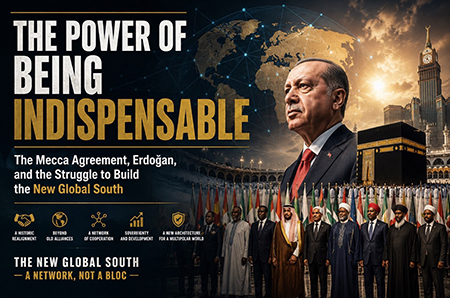
Not the power to command everyone – the power to become indispensable to everyone
The most important question raised by the Mecca Defense Agreement of August 7, 2026, signed by Türkiye, Saudi Arabia, and Pakistan, may not be whom the new agreement is directed against.
The truly decisive question may be another: who will succeed in becoming indispensable precisely because of it?
The agreement has already been described as the possible birth of an “Islamic NATO”.
The comparison is evocative, but it risks missing the deeper transformation taking place. What is emerging may be something far more fluid – and potentially far more consequential: a security network connecting regional powers that do not intend to abandon their relationships with Washington, Beijing, or Moscow, but increasingly refuse to depend exclusively on any one of them.
At the center of this emerging architecture stands Türkiye.
Ankara is not leaving NATO. It is not becoming a Russian ally, a Chinese satellite, or the formal leader of the Muslim world.
Its strategy appears to be considerably more sophisticated: remain connected to every major power center while simultaneously building relationships that increase the cost of losing Türkiye as a partner.
That is a different conception of power.
Traditional power is often measured through military strength, economic weight, population, or territorial control. But in an increasingly multipolar system, another form of power is becoming decisive: the power of the indispensable node.
Türkiye possesses something few other countries can replicate. It can speak to Washington while engaging Moscow and Beijing; connect NATO to the Muslim world; project military and industrial capabilities into the Middle East; maintain relationships across Central Asia and Africa; and, through its geography, diplomacy, defense industry, and historical influence, occupy multiple strategic spaces simultaneously.
Saudi Arabia brings another form of power: financial resources, energy, Arab influence, and the unparalleled religious legitimacy derived from Mecca and Medina.
Pakistan brings military depth, nuclear deterrence, strategic experience, a privileged relationship with China, and direct access to South Asia.
Their convergence therefore should not be understood simply as a response to Iran, nor automatically as an anti-Western or anti-Indian project. Its deeper significance lies in the architecture it makes possible.
And this is where the Global South enters the picture.
The Global South is not a bloc. It is an arena of competing networks. India and Pakistan are rivals. Saudi Arabia and Iran are strategic competitors. China and India are increasingly strategic competitors.
Turkey, the Gulf states, Russia, China, and the countries of South Asia pursue overlapping – but rarely identical – interests.
The emerging struggle is therefore not necessarily about choosing sides.
It is about building networks.
The country that succeeds in connecting the greatest number of otherwise separate strategic systems may acquire influence disproportionate to its material power. And the country that becomes the node through which multiple networks intersect may become more difficult to contain than a traditional regional leader.
This is precisely why the Mecca agreement deserves close attention.
Its significance may ultimately have less to do with the clause stating that an attack against one signatory will be considered an attack against all than with what that clause could become: the institutional seed of a broader security and political network.
If that network expands – to Bangladesh or other Muslim-majority states, for example – the strategic equation could change dramatically. India would have to take it seriously.
Iran would have to account for what it leaves outside the emerging architecture. China and Russia would have to manage their relationships with it. Washington would have to confront the possibility that regional partners increasingly possess alternatives to exclusive dependence on American security guarantees.
And Türkiye would sit at the intersection of all these relationships.
This does not mean that Erdoğan is destined to become the leader of the Muslim world.
Perhaps he does not need to.
Leadership requires followers.
Indispensability requires only that everyone has something to lose if you leave.
That may be the real logic behind Ankara’s strategy – and perhaps the most important geopolitical lesson contained in the Mecca agreement.
The First Test: From Declaration to Architecture
The reactions to the Mecca Agreement have already revealed how differently the emerging architecture is being perceived.
In Western capitals and strategic circles, the initial debate has largely focused on whether the pact represents a challenge to the United States, a response to Iran, a new security arrangement in the Gulf, or the beginning of an “Islamic NATO”.
China has tended to view it more pragmatically, as part of a broader movement toward greater strategic autonomy among regional powers.
Russia, meanwhile, has every reason to watch the development closely, particularly because any new security architecture linking the Gulf, Türkiye, and South Asia inevitably affects Moscow’s relationship with the wider Muslim world and the changing balance of influence across Eurasia.
But the most significant development may not be found in any of these interpretations.
It happened on August 31st, in Istanbul.
Just twenty-four days after the agreement was signed in Mecca, Türkiye, Saudi Arabia, and Pakistan are holding the inaugural meeting of the Strategic Political and Defence Committee created by the pact.
Foreign ministers, defence ministers, and military chiefs are participating in the meeting, which marks the first formal step in translating the political declaration of August 7 into an operational mechanism.
The timing is important.
Twenty-four days is an extraordinarily short interval for an agreement of this strategic magnitude to move from signature to its first high-level institutional meeting. This is not, by itself, proof of a predetermined timetable or of a hidden strategic plan.
But it is significant evidence that the three governments do not intend to leave the Mecca Agreement as a symbolic declaration. The process is already moving toward implementation.
That distinction matters.
The agreement announced on August 7 created a political commitment. The Istanbul meeting begins to create a mechanism.
And mechanisms are what turn geopolitical ideas into durable structures.
The three countries are expected to address precisely those areas that could determine whether the pact remains a limited deterrence arrangement or develops into something much larger: political-military coordination, interoperability, joint exercises, defence capabilities, and cooperation in defence technology and production.
Türkiye has already indicated that the framework could potentially be expanded to other countries.
This is why the international reaction should not be assessed only through the question of whether the agreement is directed against Iran, India, Israel, the United States, or anyone else.
The more consequential question is whether the mechanism created in Mecca can begin to generate its own momentum.
If it does, the strategic significance of the agreement will no longer depend exclusively on the intentions declared by its founders. It will depend increasingly on the relationships, capabilities, institutions, and dependencies that emerge around it.
And this brings us back to the central argument of this paper.
A bloc is defined by whom it excludes.
A network is defined by whom it connects.
The speed with which the Mecca Agreement is moving from declaration to implementation therefore deserves particular attention. Today’s meeting in Istanbul may ultimately prove to be more important than the language of the original announcement itself – not because it immediately transforms the three countries into a new geopolitical bloc, but because it provides the first opportunity to determine whether the agreement can become the institutional seed of a wider network.
If that process begins, the question will no longer be simply what the Mecca Agreement is.
The question will be what it becomes.
The full analysis goes considerably further, examining the origins of the pact, the Turkish-Saudi rivalry and convergence, Pakistan’s strategic role, India’s position, Iran’s exclusion, the potential evolution of the network, the religious dimension, the competition for influence within the Sunni world, and the broader struggle to shape the emerging Global South.
The complete paper is available for download in the attachments.
I strongly encourage readers to download it and read it carefully in full.
The purpose is not to predict what the Mecca agreement will inevitably become, but to identify the strategic possibilities that its emergence has opened – and to ask the question that may ultimately matter most:
“In the new multipolar order, who will have the power not to command everyone else, but to become indispensable to everyone?”