

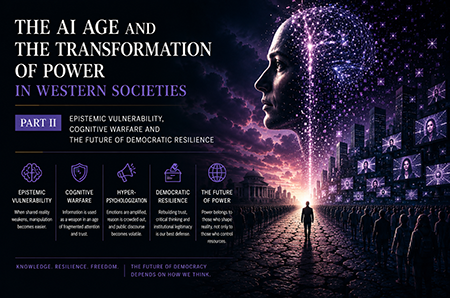
Epistemic Vulnerability, Cognitive Fragmentation and the Resilience of Democracies
The emergence of a cognitive divide does not merely transform labor markets or educational outcomes. It raises a more fundamental question: what happens to democratic societies when cognitive autonomy ceases to be a majority condition.
1. Political Consequences in Western Democracies
The increase in technological complexity poses a particular challenge to democratic systems based on universal suffrage.
There is no evidence that automatically links a higher level of education to better political decisions. However, a growing gap between the complexity of problems and the average person’s ability to understand them can have significant effects.
Among these:
- greater reliance on cognitive intermediaries;
- increased polarization;
- a crisis in traditional representation;
- an increase in the influence of technocracies and specialized bodies.
Such dynamics should not be interpreted as inevitable outcomes, but rather as probabilistic trends whose intensity depends on the quality of institutions, the level of social trust, and the ability of educational systems to adapt to the new cognitive complexity.
The average citizen may increasingly find themselves in a situation where they must make choices without possessing the necessary tools to independently evaluate complex problems.
In this context, political consensus risks depending less on the quality of decisions and more on the ability to construct simple, coherent, and emotionally persuasive narratives.
2. The Geopolitical Framework
Outside the West, the scenario takes on different characteristics.
China may prove relatively less vulnerable, since its political legitimacy does not depend primarily on competitive electoral consensus but on its ability to guarantee stability, growth, and administrative performance.
India presents an ambiguous case: it simultaneously boasts some of the world’s most highly skilled technical and scientific elites and faces significant educational inequalities.
Japan, South Korea, and Singapore, on the other hand, appear particularly well-positioned thanks to their high average levels of skills, technical expertise, and institutional efficiency.
Looking ahead to the period 2025–2045, the emergence of three major hubs appears plausible:
- an American hub based on innovation, capital, and universities;
- a Chinese hub based on scale and coordination;
- an Indo-Asian hub based on demographics and the talent pool.
The common challenge for all will be to prevent the gap between a highly skilled minority and the rest of the population from becoming a permanent source of instability.
3. From hyper-psychologization to cognitive vulnerability: a matter of transnational security
The analysis of cognitive competencies, of the transformation induced by artificial intelligence, and of the redefinition of power in the twenty-first century risks remaining incomplete if one does not consider a deeper cultural transformation that has been crossing Western societies for decades: the process of hyper-psychologization of public life.
With this expression is meant the progressive extension of interpretative categories proper to individual psychology to domains of reality that were traditionally analyzed through political, economic, historical, legal or geopolitical tools.
Structural phenomena such as social conflicts, economic inequalities, institutional crises or international tensions are increasingly frequently read through concepts such as trauma, subjective well-being, perception, identity, emotional resilience or relational dynamics.
This shift is not in itself pathological. On the contrary, it has produced relevant benefits: greater attention to mental health, greater sensitivity toward the subjective dimensions of experience, and a broader understanding of interpersonal dynamics.
However, when such paradigm tends to become dominant, it produces systemic effects that go beyond the clinical field and affect the collective capacity to interpret and govern complexity.
From the centrality of facts to the centrality of perceptions
For much of Western modernity public debate has been based on a tension between facts, interests and interpretations. The fundamental questions were: is it true? does it work? what are the consequences?
In hyper-psychologized societies this architecture tends to progressively shift toward a different question: how is it perceived? what emotional impact does it produce?
When this shift becomes structural, the validation criterion of public decisions no longer depends mainly on their effectiveness or empirical coherence, but on their capacity to generate reassurance, identification or positive emotional response.
The consequence is not a simply “less rational” society, but a society in which political competition progressively shifts from the level of verification to the level of perception.
Polarization and transformation of political conflict
This change can contribute to the dynamics of polarization in contemporary democracies, interacting with technological, economic, media and institutional factors.
When political categories are integrated into personal identity, disagreement is no longer perceived as a divergence of opinions, but as a threat to one’s identity. The confrontation thus tends to transform into symbolic and moral conflict, rather than dispute over interests or interpretations of reality.
In these conditions the willingness to compromise decreases and the space of intermediate reasoning is reduced, which instead constitutes an essential element of the functioning of liberal democracies.
Polarization is therefore not only a distance between political positions, but a progressive fragmentation of shared reality.
Cognitive warfare and systemic vulnerability
This transformation takes on an even greater relevance in the context of so-called cognitive warfare.
Unlike traditional forms of propaganda, cognitive warfare does not simply aim to influence opinions, but to intervene in the processes through which individuals and collectives construct what they consider real.
The objective is not necessarily to obtain consensus, but to reduce the ability to distinguish in a shared way between information and disinformation, between analysis and narrative, between knowledge and persuasion.
In this framework, the vulnerability of a society does not depend only on economic or military factors, but on the quality of its collective cognitive processes: institutional trust, critical capacity, informational literacy and epistemic cohesion.
Societies characterized by strong polarization, low trust and growing prevalence of emotional criteria are structurally more exposed to such dynamics. The strategic effect is not the conversion of opinions, but the production of fragmentation, distrust and inability to coordinate.
Artificial intelligence as a multiplier
Artificial intelligence introduces a further level of complexity into this scenario.
Contemporary algorithmic systems are able to personalize content, adapt languages and optimize messages on the basis of extremely granular cognitive and emotional profiles. For the first time it is possible to produce at scale communications designed not only to inform or persuade, but to maximize engagement, emotional adherence and attention retention.
In a context already marked by hyper-psychologization and polarization, artificial intelligence acts as a systemic multiplier. It does not necessarily introduce new dynamics, but amplifies existing ones, accelerating the divergence between objective reality and perceived reality.
A matter of transnational security
In this perspective, hyper-psychologization cannot be considered an exclusively cultural or sociological phenomenon. It progressively assumes a strategic dimension, becoming a component of transnational security.
If the ability of a society to distinguish between true and false, between information and persuasion, or between analysis and narrative is weakened, its vulnerability increases regardless of the level of wealth, technological development or military power.
The critical point does not concern only the quality of public debate, but the stability of cognitive processes that make collective deliberation possible.
In this sense, cognitive resilience becomes a primary strategic resource of the twenty-first century, alongside economic, energy or military security.
Geopolitical competition thus tends to progressively shift from the control of territories to the control of the processes through which societies construct their representation of reality.
4. The redefinition of the concept of power
If artificial intelligence represents a transformation comparable to the industrial revolution, even the concept of power itself may need to be rethought.
Historically power has been associated with:
- military force;
- population;
- territory;
- natural resources;
- industrial capacity;
- financial capital.
In the AI Age a new dimension emerges:
the capacity to generate, validate, control and apply reliable knowledge at high speed.
The historical sequence could be schematized as follows:
- agrarian era: land;
- industrial era: energy and manufacturing;
- advanced twentieth century: capital and technology;
- digital era: data and networks;
- AI Age: organized cognitive capacity.
Competitive advantage no longer consists primarily in access to information, but in the ability to rapidly distinguish what is true, relevant and useful from what is not.
The truly scarce resource could become competent human attention.
In this perspective, competitive advantage does not derive exclusively from data availability or computational power, but from the capacity to transform abundant information into reliable knowledge and coordinated action.
5. The great decoupling and the transformation of mechanisms of social cohesion
A possible interpretative key of the ongoing transformation is represented by what can be defined as a great decoupling.
For much of the twentieth century, in fact, the complexity of Western societies grew in a relatively synchronized way with respect to the increase in the average level of education, functional literacy, and the widespread ability to interpret economic, political and technological phenomena. In other words, the growth of complexity was accompanied by a parallel strengthening of the cognitive tools necessary to manage it.
In the AI-Age this relationship instead tends to weaken. The complexity of technological, informational and geopolitical systems grows at a higher rate than the average evolution of the competences necessary to understand and govern them.
This misalignment produces a series of structural effects.
Historically, societies have reacted to situations of this kind through four main compensatory mechanisms:
- increasing delegation to experts and technical elites;
- ideological simplification of complex phenomena;
- tribalization of political and identity-based confrontation;
- psychologization of social dynamics.
In the current historical phase, the fourth mechanism – psychologization – takes on a particularly relevant and systemic role.
The increasing difficulty of understanding complexity tends in fact to shift the center of gravity of public communication from causal explanation to subjective narration. As a consequence, social demand progressively moves away from the criterion of verification (“Is it true?”) and toward experiential and emotional criteria (“How does it make me feel?”, “What identity does it confirm?”).
This shift does not necessarily imply a loss of individual rationality, but a transformation of the way collective rationality is organized and selected.
In this context, information systems and digital platforms – increasingly mediated by personalization algorithms – tend to reinforce cognitive segmentation, reducing the sharing of common interpretative frameworks.
The overall result is a progressive weakening of the cognitive coordination capacity of societies, that is, their ability to construct shared interpretations of reality sufficiently stable to support complex collective decisions.
6. The decisive question of the twenty-first century: from epistemological crisis to competition between realities
The fundamental challenge of the twenty-first century may not be primarily technological, economic or military, but epistemological.
A modern democracy is in fact based on the existence of shared criteria – explicit or implicit – to distinguish between true and false, between information and propaganda, between interpretation and manipulation, between knowledge and persuasion.
When such criteria weaken or fragment, public debate tends to transform progressively. The confrontation between different interpretations of reality gives way to a competition between alternative perceptual realities, each internally coherent but increasingly less verifiable according to common standards.
In this scenario, the central problem is not the presence of political conflict in itself – a physiological element of democracies — but the growing difficulty in maintaining a shared ground of factual verification.
The consequences of this dynamic are multiple:
- reduction of trust in institutions and informational intermediaries;
- increase in dependence on personalized cognitive sources;
- growth of polarization and identity closure;
- increasing difficulty in distinguishing between information, opinion and propaganda;
- weakening of traditional deliberative mechanisms.
In systemic terms, this may result in a loss of collective decision-making capacity, even in the presence of high economic and technological resources.
In this framework, the strategic advantage in the twenty-first century may not belong exclusively to systems that possess the most advanced artificial intelligence technologies, but to those able to preserve and strengthen:
- institutional trust;
- widespread critical literacy;
- the capacity for information verification;
- minimal social cohesion;
- continuity of shared reality criteria.
The central node therefore does not concern only the production of knowledge, but the stability of the processes through which a society determines what it considers valid knowledge.
Ultimately, contemporary geopolitical competition may increasingly concern not the direct control of territories or resources, but rather the capacity to influence — or preserve — the cognitive conditions through which societies construct their relationship with reality.
7. Conclusions
The arguments developed in this contribution converge toward a general hypothesis: in the AI-Age power tends to depend less and less on the simple possession of information and more and more on the capacity to organize, validate and coordinate reliable collective cognitive processes.
The first thesis proposed concerns the emergence of a progressive decoupling between the growing complexity of technological, economic and geopolitical systems and the average capacity of populations to understand and govern them.
In this context, artificial intelligence does not eliminate the need for advanced cognitive competences, but rather tends to increase their strategic value, raising the thresholds of functional literacy required to effectively participate in economic, social and political life.
The second thesis concerns the transformation of democratic dynamics. When complexity exceeds widespread capacity for critical elaboration, the recourse to cognitive intermediaries, simplified narratives and forms of epistemic delegation increases.
The risk does not consist simply in the spread of incorrect information, but in the progressive fragmentation of the criteria through which a society distinguishes between knowledge, opinion and persuasion.
In such conditions, political competition tends to shift from confrontation between interpretations of reality to competition between competing perceptual realities.
The third thesis identifies psychologization of public life as a possible amplifying factor of these dynamics. This work does not argue that psychologization is the sole or necessary cause of contemporary polarization.
Rather, it proposes the hypothesis that, in combination with technological, economic and media transformations, it may contribute to reinforcing processes of cognitive fragmentation and the growing centrality of perceptions over shared verification criteria.
From this perspective, cognitive resilience emerges as a fundamental strategic resource of the twenty-first century. The ability to verify information, distinguish between facts and narratives, integrate different sources and maintain shared criteria of knowledge validation may become as important as historically attributed to economic, energy or military resources.
The implications of this transformation do not concern exclusively Western democracies. All major powers will be called to confront the problem of managing cognitive complexity in increasingly interconnected societies mediated by intelligent systems.
However, political systems based on public deliberation and democratic consensus may be particularly sensitive to the erosion of the epistemic conditions that make a shared reality possible.
The proposed interpretative model inevitably presents theoretical and empirical limits. The described dynamics do not manifest with the same intensity in all national contexts and do not allow deterministic predictions about the evolution of Western societies. They instead identify certain structural trends that may gain increasing relevance in the coming decades.
If this interpretation were at least partially correct, the decisive question of the twenty-first century may not concern only who will possess the most advanced technologies, the largest volumes of data, or the highest computational power.
It may concern, more deeply, which societies will be able to preserve the collective capacity to distinguish what is true from what only appears to be so, what is relevant from what merely captures attention, and what deserves trust from what merely succeeds in persuading.
In this sense, power in the AI-Age may be defined less and less by control of territory and more and more by the quality of the cognitive processes through which a society constructs its relationship with reality.
Essential bibliography
Cognitive skills and PIAAC
- Organisation for Economic Co-operation and Development (OECD)
- (2024). Do Adults Have the Skills They Need to Thrive in a Changing World? Survey of Adult Skills 2023. Paris: OECD Publishing.
- (2019). Skills Matter: Additional Results from the Survey of Adult Skills. Paris: OECD Publishing.
- (2016). The Survey of Adult Skills: Reader’s Companion (Second Edition). Paris: OECD Publishing.
Complexity, knowledge and cognitive limits
- Simon, H. A. (1971). Designing Organizations for an Information-Rich World. In M. Greenberger (Ed.), Computers, Communication and the Public Interest.
- Simon, H. A. (1996). The Sciences of the Artificial (3rd ed.). MIT Press.
- Polanyi, M. (1966). The Tacit Dimension. University of Chicago Press.
Rationality, bias and decision
- Kahneman, D. (2011). Thinking, Fast and Slow. Farrar, Straus and Giroux.
- Tetlock, P. E., & Gardner, D. (2015). Superforecasting: The Art and Science of Prediction. Crown Publishing.
Democracy, public sphere and validation of knowledge
- Habermas, J. (1984). The Theory of Communicative Action. 1. Beacon Press.
- Habermas, J. (1987). The Theory of Communicative Action. 2. Beacon Press.
- Sunstein, C. R. (2017). #Republic: Divided Democracy in the Age of Social Media. Princeton University Press.
Polarization, identity and cognitive fragmentation
- Haidt, J. (2012). The Righteous Mind: Why Good People Are Divided by Politics and Religion.
- Haidt, J. (2024). The Anxious Generation. Penguin Press.
- Mason, L. (2018). Uncivil Agreement: How Politics Became Our Identity. University of Chicago Press.
Technology, algorithms and society
- Zuboff, S. (2019). The Age of Surveillance Capitalism.
- Postman, N. (1985). Amusing Ourselves to Death. Penguin Books.
- Postman, N. (1992). Technopoly: The Surrender of Culture to Technology.
Cognitive warfare and informational competition
- NATO Innovation Hub. (2021). Cognitive Warfare.
- Paul, C., & Matthews, M. (2016). The Russian “Firehose of Falsehood” Propaganda Model. RAND Corporation.
Artificial intelligence and cognitive transformation
- Brynjolfsson, E., & McAfee, A. (2014). The Second Machine Age. W.W. Norton.
- Bengio, Y., Hinton, G., & LeCun, Y. (2021–2025). Articles and public interventions on cognitive transformation induced by AI systems.