

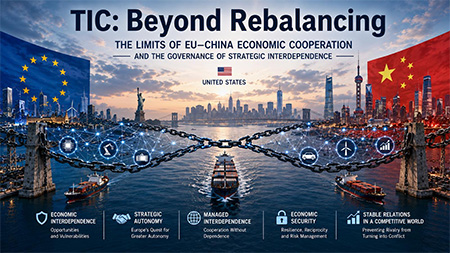
The Limits of EU – China Economic Cooperation and the Governance of Strategic Interdependence
The negotiation between the European Union and China cannot be understood as a conventional trade negotiation.
Behind the discussion of market access, trade imbalances, industrial subsidies, investment conditions, export controls, and regulatory barriers lies a broader question concerning the governance of economic interdependence between two major economic powers whose development strategies increasingly intersect with national security considerations.
The Trade and Investment Cooperation (TIC) therefore emerges within a context in which economic relations can no longer be separated entirely from questions of economic security, technological autonomy, industrial policy, and strategic dependence.
For the European Union, the persistence of a substantial trade imbalance with China is not merely a question of aggregate trade flows.
It is increasingly connected to concerns regarding structural asymmetries, Chinese industrial overcapacity, state support, unequal market access, technological dependence, and the vulnerability of European supply chains.
For China, by contrast, the relationship with Europe remains important precisely because the European Union represents a major market, investment partner, and economic actor whose relationship with Beijing cannot be reduced entirely to the framework of strategic competition between China and the United States.
The central question of this analysis is therefore not simply whether the European Union and China can reach an agreement, but how deep such an agreement can realistically be.
More specifically, the analysis asks whether Beijing can accept a meaningful rebalancing of the economic relationship without modifying the fundamental instruments through which it pursues industrial development, technological self-reliance, economic security, and national strategic autonomy.
The argument developed in this work is that the two sides attach potentially different meanings to the concept of rebalancing.
The European Union increasingly tends to understand rebalancing in structural terms: reducing the conditions that generate persistent asymmetries, improving reciprocity, addressing industrial overcapacity, and creating more symmetrical conditions of competition.
China, on the other hand, may be more willing to pursue a form of managed rebalancing based on increased imports, selective market opening, regulatory predictability, and the management of trade flows, while preserving the fundamental architecture of its industrial and economic-security policies.
This difference does not necessarily make an agreement impossible.
Rather, it defines its likely limits. The analysis therefore develops the concept of a “zone of compatibility”: an area in which Beijing can make commercially and procedurally meaningful concessions without relinquishing the strategic instruments considered essential to its development model, while Brussels can accept greater predictability and openness without abandoning its increasingly developed economic-security framework.
Within this zone, the objective of the TIC would not be to eliminate structural interdependence, but to make it more predictable, reciprocal, and less vulnerable to coercive use.
The analysis consequently distinguishes between different levels of Chinese concessions and identifies a possible hierarchy of negotiating limits.
Commercial, regulatory, and procedural concessions may remain compatible with China’s strategic priorities, whereas demands directly affecting industrial policy, technological self-reliance, strategic productive capacity, supply-chain security, or the availability of economic-security instruments are likely to encounter substantially stronger resistance.
These limits are not presented systematically as formally declared Chinese “red lines”. Rather, some are analytically reconstructed from Chinese legislation, policy documents, industrial strategies, and recent state practice.
A further dimension concerns the role of the United States. The credibility and strategic value of any European commitment toward China depend partly on whether Beijing considers European economic choices sufficiently autonomous and durable within the broader China – US strategic confrontation.
European strategic autonomy therefore becomes not an external issue, but an internal variable of the TIC itself. The stronger Europe’s capacity to act as an autonomous economic and technological pole, the greater its potential negotiating relevance; at the same time, the more its economic-security policies are perceived as inseparable from Washington’s strategy toward China, the narrower the space for genuinely autonomous European commitments may become.
The historical dimension developed in the final part of the work serves a specific analytical purpose. It does not establish a direct analogy between contemporary Europe and the European powers of the nineteenth century, nor does it suggest a deterministic repetition of historical patterns.
Rather, it examines the recurring strategic problem created when an established international system encounters the emergence or re-emergence of a significant economic and political centre of power.
From this perspective, the development of European strategic autonomy can be understood as a process whose consequences extend beyond EU – China relations and affect the broader configuration of relations among Europe, China, the United States, and Russia.
The central thesis of this work is therefore that the TIC can be effective without being transformative. Its most realistic outcome may not be the elimination of the structural imbalance between Europe and China, but its institutionalisation within mutually acceptable limits.
The decisive question is consequently not whether the two sides can compromise, but whether they can develop a framework capable of managing strategic interdependence without systematically converting it into economic coercion.
In this sense, the TIC represents more than a negotiation over trade and investment.
It constitutes a test of the respective conceptions of economic security, strategic autonomy, and national development pursued by the European Union and China – and, ultimately, a test of whether interdependence between them can be governed without requiring either side to abandon the strategic instruments it considers fundamental.