
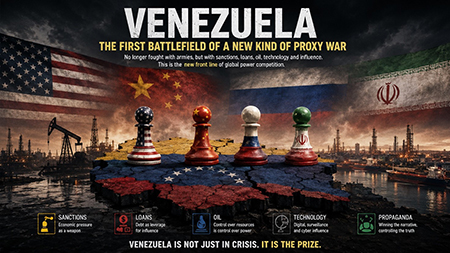
No longer fought with armies, but with sanctions, loans, oil, technology and influence. This is the new front line of global power competition
For more than two decades, the international debate over Venezuela has revolved around a deceptively simple question: Who destroyed the country?
The conventional answer points to Hugo Chávez and, later, Nicolás Maduro. Their governments undoubtedly accelerated Venezuela’s economic collapse, institutional deterioration, and political polarization. Yet this explanation mistakes the moment of collapse for the origins of the crisis itself.
Venezuela’s tragedy did not begin with Chávez. It began nearly a century earlier, when oil became the foundation upon which the Venezuelan state was built.
Throughout the twentieth century, Venezuela evolved into one of the world’s archetypal rentier states. Rather than generating prosperity through a diversified productive economy, successive governments relied on oil exports to finance public spending, maintain political stability, and sustain social consensus.
The relationship between citizens and the state became increasingly mediated by the distribution of oil rents rather than by taxation, productivity, or institutional accountability.
For decades, the model appeared remarkably successful. Oil wealth financed highways, modern cities, public services, and rising living standards. Venezuela became one of Latin America’s wealthiest countries.
But beneath this apparent prosperity lay a profound structural weakness.
The economy remained overwhelmingly dependent on hydrocarbons. Domestic manufacturing never became internationally competitive. Agriculture steadily declined. State institutions increasingly specialized in managing oil revenues instead of creating the conditions for long-term economic diversification.
As long as oil prices remained high, these contradictions were largely invisible.
When prices fell, the foundations of the entire political and economic system began to crack.
The democratic order established after the 1958 Puntofijo Pact reinforced this model rather than replacing it. Political competition revolved around managing and redistributing oil wealth, not transforming the country’s productive structure.
By the 1970s, soaring oil prices and the nationalization of the petroleum industry seemed to confirm that Venezuela had discovered a permanent path to prosperity.
Instead, the state became even more dependent on a single source of wealth.
The crises of the 1980s and 1990s—including the Caracazo riots and the collapse of the traditional party system—were not isolated accidents. They revealed the exhaustion of a political economy that had been accumulating structural vulnerabilities for decades.
It was in this context that Hugo Chávez emerged.
His rise should therefore be understood less as the origin of Venezuela’s crisis than as the political consequence of a rentier state that had reached its historical limits. Chávez did not create the underlying structural weaknesses; he inherited them.
His government undoubtedly deepened many of those vulnerabilities, but it did so within an institutional and economic framework that had been developing for almost a century.
Yet focusing exclusively on Venezuela’s domestic failures obscures an equally important transformation.
Over the past two decades, Venezuela has ceased to be merely a country suffering from economic collapse. It has become one of the principal arenas in which twenty-first-century geopolitical competition is unfolding.
This is where the Venezuelan story acquires global significance.
The United States has sought to constrain the Maduro government through progressively tighter financial sanctions, restrictions on access to international capital markets, and measures targeting the country’s oil exports. China has become one of Venezuela’s largest creditors, providing billions of dollars in loans backed largely by future oil production.
Russia has expanded military cooperation, supplied advanced weaponry, and used Venezuela as a strategic platform from which to project influence into the Western Hemisphere. Iran has strengthened cooperation in refining, energy logistics, and technological assistance, helping Caracas mitigate the effects of international isolation.
Each of these actors pursues different objectives.
Yet together they have transformed Venezuela into something far more significant than a collapsing petrostate.
The country has become a strategic arena where the world’s major powers compete without engaging in direct military confrontation.
Unlike the proxy wars of the Cold War, this competition is not primarily fought through opposing armies or insurgent groups. There is no conventional battlefield in the traditional sense.
Instead, influence is exercised through financial sanctions, sovereign lending, oil infrastructure, military cooperation, diplomatic recognition, strategic investments, technology transfers, information campaigns, and competing monetary and energy architectures.
The battlefield is no longer defined solely by territory.
It is defined by financial systems, energy supply chains, international credit, logistics, and geopolitical influence.
In this sense, Venezuela may represent one of the first fully developed examples of what could be described as a systemic proxy conflict.
The conflict is not being fought in Venezuela alone.
It is increasingly being fought through Venezuela.
This distinction matters because it reflects a broader transformation of the international order itself.
The return of great-power competition has fundamentally altered the nature of geopolitical rivalry. In an increasingly fragmented multipolar system, strategic competition no longer depends exclusively on military confrontation. Economic coercion, sanctions, financial dependence, resource governance, technological influence, and control over critical infrastructure have become central instruments of statecraft.
Countries characterized by structural economic fragility and exceptional strategic resources are particularly vulnerable to this new form of competition.
Venezuela illustrates this transformation more clearly than almost any other case.
Its enormous oil reserves, its geographic proximity to the United States, and its long-standing institutional weaknesses have combined to make it one of the principal laboratories of twenty-first-century geopolitical rivalry.
Seen from this perspective, Venezuela’s crisis is not simply a story of authoritarianism, corruption, or economic mismanagement.
Nor is it solely the story of a failed rentier state.
It is the story of how a structurally vulnerable resource-dependent country became embedded within an emerging global competition among major powers.
That does not absolve Venezuela’s political leadership of responsibility for the country’s suffering.
But it does require us to abandon simplistic explanations that reduce one of the world’s most complex crises to the actions of a single political movement or a single leader.
The real lesson of Venezuela extends far beyond Latin America.
It demonstrates how resource-dependent states can evolve from fragile rentier economies into strategic platforms where geopolitical influence is projected through finance, energy, technology, sanctions, and diplomacy rather than conventional warfare.
The twenty-first century’s most consequential conflicts may not resemble the proxy wars of the Cold War.
They may instead resemble Venezuela: a country where the principal actors of the emerging multipolar order compete across multiple domains simultaneously, turning structural economic vulnerability into a theater of global strategic rivalry.
If that is the future of international politics, then Venezuela is no longer merely a country in crisis.
It is one of the first battlefields of a new geopolitical age.