
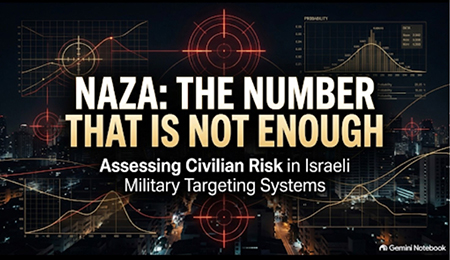
What We Really Know About the Israeli System for Estimating Civilian Casualties
Abstract
This investigation examines the claims made in the documentary Naza concerning the Israeli military system for estimating civilian casualties before an attack.
Its central question is not whether the acronym Naza exists, but what the numbers associated with it actually mean.
The available evidence confirms that the Israeli military uses the term Nezek Agavi (“collateral damage”) and incorporates estimates of expected civilian harm into the targeting and authorization process.
It also confirms the existence of numerical thresholds that can affect the level of authorization required for certain attacks. What remains unproven, however, is the documentary’s strongest implication: that these figures constitute predetermined quotas of civilians whom commanders are authorized to kill.
The investigation therefore distinguishes between three fundamentally different concepts: a prediction of expected civilian casualties, a procedural threshold determining who may authorize an attack, and an actual authorization to accept a specified number of civilian deaths.
Testimonies from Israeli military personnel and journalistic investigations provide evidence for the first two, while the available public evidence does not yet establish the third.
In particular, the documentary’s most striking figure, “500″, cannot currently be connected through publicly available documentation to a specific target, operation, authorization, and final civilian-harm estimate.
The investigation then moves beyond the numerical question and examines the broader problem of asymmetric urban warfare. Independent evidence confirms at least some cases in which Hamas used civilian facilities for military purposes, while independent investigations have also raised serious concerns regarding Israeli attacks and civilian-protection measures.
These findings demonstrate that civilian presence cannot be treated simply as a statistical variable: its origin, the conduct of the adversary, the available alternatives, the military advantage sought, and the risks transferred to one’s own forces all form part of the decision-making environment.
The central conclusion is therefore deliberately narrower than either the documentary’s accusation or the IDF’s defense. Naza appears to be a real mechanism for estimating and managing civilian harm, but its existence does not by itself establish that civilian casualties are treated as a predetermined quota.
Conversely, the existence of a formal mitigation procedure does not prove that every individual attack is proportionate or lawful.
The decisive evidentiary chain remains: prediction → authorization → attack → result. Until that chain can be reconstructed for specific operations, the number alone is not enough.
There is a number that runs through the documentary Naza like a sentence: 20, 100, 200, until reaching the most striking one, 500.
The narrative mechanism is powerful and, at first sight, almost irresistible: an army that, before striking a target, calculates how many civilians might die and, on the basis of that number, decides whether or not to proceed.
The question the film leaves the viewer with is therefore apparently simple: how can an army establish how many civilians it is willing to kill?
But this is precisely where the problem of proof begins.
Because between “we predict that 20 civilians will die”, “an attack with a risk of 20 casualties requires authorization from a higher level”, and “the commander is authorized to kill 20 civilians”, there is an enormous distance.
The first proposition describes a prediction; the second a procedural rule; the third a genuine quota of accepted casualties. Confusing them means transforming a risk-assessment procedure into a policy for authorizing killing. And it is precisely this passage that a serious verification must put to the test.
The first surprise, for anyone approaching the issue without preconceptions, is that Naza does not begin with an invention. The term really exists.
It is the Hebrew acronym for Nezek Agavi, “collateral damage”, and is used by the IDF to indicate the assessment of expected incidental harm to civilians and civilian property during an attack against a military target1.
The IDF itself maintains that this assessment is carried out so that commanders can determine whether an attack is lawful, adopt additional precautions, modify the plan, or cancel it.
Not only that: in its official response to the documentary, published in September-October 2026, the military explicitly acknowledges that numerical thresholds for civilian harm exist and can affect the level of authorization required2.
Thus, the first element of the film’s narrative is real: there is a procedure in which the possible presence and possible number of civilian casualties are quantified and brought into the decision-making process. The question, however, is no longer whether the number exists. It is understanding what that number means.
And this is where we need to introduce a distinction that is continually erased in the public debate. A procedural threshold is not necessarily a casualty quota.
If a rule establishes that an attack with a certain level of expected civilian harm must be submitted to a higher-ranking commander, that rule does not yet say that such harm is automatically acceptable.
It only says that the decision cannot be made at the lower level. The IDF itself now maintains that no numerical threshold constitutes automatic authorization to strike a target while knowing that a certain number of civilians will die: every attack should be subjected to an individual assessment of proportionality and precautions2.
The decisive formula, therefore, would not be “expected number → attack”, but rather “expected number → authorization level → assessment of military advantage → assessment of alternatives → decision”.
This is anything but a semantic difference. It is the difference between a risk-management procedure and a table of human lives that may be sacrificed.
This does not mean, however, that the numbers recounted in the film are necessarily invented.
On the contrary, several journalistic investigations have collected testimony from Israeli military personnel and officials according to which, at least during certain phases of the war and for certain categories of targets, civilian-harm thresholds existed and were associated with different levels of authorization.
A 2024 investigation by +972 Magazine and Local Call reported, on the basis of testimony from officers involved in targeting processes, figures in the range of 15–20 civilians for lower-level targets and numbers above 100 for higher-ranking figures3.
The New York Times had also documented, on the basis of interviews with more than one hundred soldiers and officials, the existence of authorization rules that, under certain circumstances, allowed mid-level officers to approve attacks carrying significant civilian risk4.
The existence of these testimonies therefore makes the caricature that everything was simply invented by the documentary untenable. But testimony describing a threshold still does not demonstrate what the legal and operational function of that threshold was.
To reach the more serious conclusion, it must be demonstrated that the number actually represented a quantity of civilians the system considered expendable.
The most spectacular number is, naturally, 500. It is also the one on which the documentary exposes itself most strongly. The IDF denies ever having planned, approved, or carried out an attack in which 500 civilians, or a number close to that figure, were expected to die, and disputes that the film provided sufficient elements to identify the attack to which the testimony refers2.
This point cannot be dismissed as merely an institutional denial, but neither can it be ignored. If the claim is that “500” was an authorized casualty quota, the evidence should make it possible to connect that number to a concrete operation: a target, a date, a unit, an estimate, an authorization level, and, above all, a decision in which someone actually said that number was acceptable.
In the absence of this documentary chain, 500 remains testimony, not a demonstrated fact. It may be true testimony; it may be a preliminary estimate; it may be an incomplete recollection; it may be a number referring to a different stage of the process. But we cannot turn it into a document we do not have.
And this is precisely where the IDF’s response introduces a technically interesting objection. According to the military, the people interviewed in the documentary often describe only an initial stage of the process, while the civilian-harm estimate can change during planning: the point of impact, type of munition, timing, information concerning evacuation, the actual presence of civilians, and other elements of the operation may change2 .
This objection is important because it shifts our attention from the initial number to the final number. An analyst may have seen “500” at a preliminary stage; but the decisive question is: what was the estimate when the attack order was actually authorized?
If, in the meantime, the number had fallen to 50 because a different weapon had been selected, the point of impact modified, or the departure of civilians awaited, then the picture presented by the film would be incomplete.
If, on the other hand, the number remained 500 and the attack was nevertheless authorized precisely because 500 were considered acceptable, then we would finally have proof of the stronger thesis.
The problem is that, without the document or operational reconstruction of the specific attack, we cannot know which of the two things happened.
There is another element that makes it even more difficult to sustain the representation of Naza as a simple table of expendable lives: the IDF has documented cases in which the presence of civilians actually caused the action to change.
In one case, an ambulance identified after the attack order led to the munition being diverted; in another, the attack was canceled after civilians were unexpectedly identified; in a third, after children were detected in the area, the attack was postponed until they had left5.
These are examples produced by the IDF and therefore cannot, by themselves, be considered independent verification of the effectiveness of the entire system.
But they demonstrate at least that, within the procedure described, there is a concrete possibility of interrupting or modifying the action precisely on the basis of civilian presence.
If Naza were simply a table of the kind “up to X, the target may be struck”, it would be difficult to explain why a last-minute change in the presence of civilians should result in the cancellation of the attack.
If, instead, Naza is a dynamic estimate inserted into a broader process, those cases become perfectly consistent with the declared functioning of the system.
There is, however, one reconstruction that allows us to observe the process before the attack with unusual precision. On July 8, 2014, in Abasan al-Kabir, the IDF planned an attack against a weapons depot located in the home of a Palestinian Islamic Jihad commander.
The target card subsequently published by the Israeli government explicitly listed among the people present “the military commander, his family, and Palestinian Islamic Jihad operatives”.
The legal review was conditional upon the provision of effective advance warning; the planning called for real-time visual surveillance, a nighttime attack, and a single bomb. The stated logic was explicit: the target was the structure and the weapons inside it, not the people present9.
This case is important because it allows us to separate what we know from what we still do not know. We know that the presence of civilians was known. We know that this presence changed the conditions under which the attack could be carried out. We know that the legal authorization was conditioned upon a concrete precaution.
What we do not know, however, is the numerical value assigned to those civilians in the Naza assessment. And this distinction is precisely the point. The documentation demonstrates the existence of a process for assessing and mitigating civilian risk; it does not demonstrate a numerical quota of accepted casualties.
The following day, in another attack in Khan Younis against a Hamas weapons depot, the situation was almost the mirror image. During planning, the IDF assessed that no civilians would be harmed. Only afterward did it emerge that a café was also operating inside the building, information that was not available to the operators before the attack.
The attack had nevertheless been planned at night, with a munition considered suitable for limiting damage and with real-time visual surveillance. Several civilians were subsequently injured10.
Here we encounter the distinction that the documentary tends to compress: the prediction is not the result. A system can estimate zero and be wrong; it can estimate fifty and then reduce the estimate to ten; it can know that a family is present and impose an advance warning; it can cancel an attack when a civilian appears.
To determine whether Naza represents a prediction, a threshold, or a casualty quota, we therefore need to find not merely the number, but its position within the decision-making sequence.
Prediction → authorization → attack → result.
That is the evidentiary chain that matters. And this case gives us something that testimony alone cannot: a documented record showing that civilian presence could become a concrete condition of the attack itself. What it still does not give us is the missing number.
And that absence is not a weakness of the investigation. It is precisely the reason why we must resist turning a documented civilian-harm assessment into a claim about an authorized number of deaths.
At this point, however, the most interesting question of the entire investigation emerges: why are those civilians there? A number, taken by itself, is a snapshot; it is not a causal explanation.
Saying “there are 50 civilians in the area” is necessary to assess the risk, but it does not tell us whether those 50 are residents, displaced people, people unable to leave, people who gathered spontaneously, or civilians who are next to a military target because an armed organization deliberately chose to operate among the population.
This distinction does not change the value of those people’s lives and does not erase the attacker’s obligations; it does, however, change our understanding of the phenomenon the system is attempting to manage.
A model that perfectly counts civilians but does not adequately consider the cause of their presence may measure the harm without fully explaining the structure that produces it.
Here lies, probably, the true conceptual limitation of a purely quantitative reading of Naza.
In a conventional war, the military objective and the civilian population may be relatively separable; in an urban war against an organization operating within the population, that separation can become extremely difficult.
If an armed group places fighters, weapons depots, command centers, launch positions, or military infrastructure inside civilian buildings or densely populated areas, the presence of civilians enters directly into the calculation of the attack.
The party seeking to reduce harm must then invest more intelligence, choose less destructive weapons, wait, issue warnings, modify its tactics, or give up the objective.
In this sense, there is a genuine asymmetry: the obligation to protect civilians can become a variable in the fighting. But this observation does not authorize the opposite leap, namely that once Hamas’s use of civilians has been demonstrated, every attack against the area automatically becomes lawful. It does not work that way.
The proof of what we are saying must be sought in concrete cases. And here we have at least one example in which the military use of a civilian facility by Hamas has been independently verified.
The United Nations Independent International Commission of Inquiry documented the case of the Anas Bin-Malik boys’ school in the Tal al-Hawa neighborhood of Gaza City.
The Commission examined a video published by Hamas in which its militants placed at least two explosive devices inside the school, stating that they were preparing an ambush against Israeli forces, and subsequently detonated the devices against approaching forces6.
This is important evidence precisely because it does not depend solely on an Israeli statement. But the same Commission introduces an equally important caution: it was unable to independently verify many of the other Israeli allegations concerning the military use of schools.
The correct conclusion, therefore, is not “Hamas uses schools as a general rule”, but “there is at least one specific, verified case in which a school was used for a military activity”. It is this distinction that prevents our counter-investigation from becoming propaganda of the opposite kind.
The point becomes even more interesting when we observe that the same Commission also documented the use of educational facilities by Israeli forces as bases or deployment areas6.
This does not make the two forms of conduct equivalent, nor does it automatically alter the legal assessment of each individual case; it does, however, demonstrate that the overlap between civilian space and military space is precisely the problem that must be analyzed without applying a double standard.
If our question really is “how does urban warfare work?”, we must be willing to investigate the same phenomenon regardless of which actor produces it.
It is therefore time to subject the theory to a concrete case. On May 26, 2024, two Israeli bombs struck the Kuwaiti Peace Camp, an improvised displacement camp in Tal al-Sultan, in the western part of Rafah.
Amnesty International reconstructed at least 36 deaths, including six children, and more than one hundred injured; at least four of those killed were fighters.
The organization verified that the attack targeted Hamas commanders present among the displaced population and identified the weapons used as two U.S.-made GBU-39 bombs7.
Here, therefore, we have a case in which the existence of a military objective is not simply an Israeli assertion left unverified: Amnesty identified several Hamas members among the dead. But precisely for this reason, the case becomes more, not less, interesting.
If the target was real, the question is no longer “Did Israel have a military objective?” but “How did it assess the civilian risk associated with that objective, and what alternatives did it actually have available?”
According to Amnesty, the GBU-39s used contained approximately 17 kilograms of explosive each and were capable of projecting fragments hundreds of meters; the organization also argued that the IDF had precision munitions with smaller area effects available and that the presence of a large number of displaced people in the camp was known7.
The IDF, for its part, maintained that it had used the smallest munitions that could be launched from its aircraft under those circumstances and stated that the attack was directed against two Hamas commanders7.
The dispute therefore fits our question perfectly: we no longer need to discuss whether “Naza” is good or bad in the abstract, but reconstruct the decision.
How many civilians were expected? What was the anticipated military advantage? What weapons were available? What alternatives had been considered?
How long could they wait? What level of authorization was required? And, above all, what was the final NAZA figure before someone decided to press the button?
This is where our investigation encounters its limit and, at the same time, reaches its most important conclusion.
We have found the procedure; we have found the thresholds; we have found the testimony; we have found cases of attacks canceled or modified because of the presence of civilians; we have found independently verified cases of Hamas military activity inside civilian facilities; we have found Israeli attacks in which independent organizations raised serious doubts about proportionality and precautions5, 6, 7.
What we have not yet found, however, is the document that incontrovertibly connects a NAZA number to a concrete attack and allows that number to be followed from prediction to authorization. And it is precisely that document that would be needed to prove the documentary’s stronger thesis.
This does not mean that the film is “disproved.” It means something more precise and, precisely for that reason, more important: the available evidence does not yet authorize all the conclusions the film draws from its testimony. A former analyst may have seen an estimate of 500 civilians.
Another may have worked with thresholds of 20 or 100. Another may have seen targets generated or classified through intelligence tools. All of this may be true simultaneously.
But none of these elements, taken alone, demonstrates that the military had a policy of the kind “this target may kill 20 civilians, so strike it”. To reach that conclusion, the transition from information to decision must be demonstrated.
And there is another distinction that public debate tends to lose: even demonstrating that Naza is a real procedure and that it is used correctly would not demonstrate that every attack is proportionate or lawful.
A system can exist and be applied badly. It can contain formally lawful thresholds but be used in an excessively permissive manner. It can inaccurately estimate the number of civilians.
It can underestimate the alternatives. It can assign excessive value to the military advantage. It may fail to update information correctly.
For this reason, the true test of a system of this kind is not merely its existence, but the possibility of reconstructing, case by case, the sequence prediction → decision → result.
And this is where the issue of soldiers also enters our analysis, but it must be formulated correctly. Israeli military personnel are not “collateral victims” in the technical sense in which civilians incidentally struck are.
They are instead the human risk that can be transferred from one tactical choice to another. An airstrike may reduce the risk to soldiers but increase it for civilians; a ground operation may reduce civilian risk but increase it for military personnel.
There is therefore not always a choice between “civilian deaths” and “no deaths”. There is often a choice between different configurations of risk.
This does not mean that the lives of soldiers can simply be placed against those of civilians as if they had the same legal status; it means that a real military assessment must also consider the human and operational cost of the available alternatives.
At this point we can return to the initial question and even reformulate it. The problem with Naza is not necessarily that it “counts civilians”. On the contrary: in urban warfare, counting civilians is indispensable. The problem would be if the number were treated as sufficient. Seventy civilians are not merely seventy statistical units.
They are seventy people who may be there for different reasons, in a situation determined by a combination of the adversary’s behavior, forced displacement, inability to evacuate, intelligence failures, and military decisions.
A system that truly sought to measure risk should therefore not only ask “how many are there?” but also “why are they there?”, “can they be moved?”, “can the target be struck in another way?”, “can I wait?”, “can I use a different weapon?”, “what concrete military advantage do I gain?” and “what risk do I transfer to my soldiers by choosing the alternative?”
It is in this sense that our initial thesis can be maintained, but made much more rigorous. Naza can be mathematically correct and conceptually incomplete. It can accurately estimate civilian harm without, by itself, being able to describe the causal structure that produces that harm.
In an asymmetric war, in which an armed organization can operate within the civilian population, the presence of civilians can simultaneously become a humanitarian reality, an operational variable, and a strategic element.
This does not automatically transfer responsibility for the casualties to the adversary and does not absolve the attacker of its own obligations; it does, however, prevent us from automatically attributing the entire causality of the risk to the attacker simply because it is the attacker who dropped the bomb.
This is where the historical comparison with Via Rasella can be useful, provided it is used cautiously. On March 23, 1944, the GAP attacked a column of the Polizeiregiment Bozen on Via Rasella; the German reprisal the following day led to the killing of 335 people at the Fosse Ardeatine8.
The story has often been transformed into the claim that the partisans deliberately provoked the massacre, but this conclusion is not demonstrated in those terms, and there was no German ultimatum to the partisans that would have allowed the reprisal to be avoided through a simple surrender8.
The value of the case, therefore, does not lie in demonstrating criminal intent on the part of the partisans, but in illustrating a more general strategic problem: in asymmetric warfare, the adversary’s reaction can become part of the environment in which military action is conceived. It is a lesson about strategy, not proof of the guilt of one side.
And so, we arrive at the point that, after all this research, seems more interesting to me than the documentary itself. The question is not “Is Naza true or false?”
The question is: what do we really know about the passage through which a number becomes a decision? We know that the number exists. We know that it is estimated. We know that it can affect authorization.
We know that the presence of civilians can cause an attack to be modified, postponed, or canceled. We know that thresholds exist and that Israeli military personnel have said they encountered them.
We also know that there are verified cases in which Hamas used civilian facilities for military activities and cases in which Israeli attacks caused a high number of civilian casualties, prompting disputes over proportionality2, 5, 6 e 7.
But we still do not have sufficient public evidence to transform all of this into the much stronger proposition that the IDF established a number of civilians it was simply “allowed to kill”.
This distinction is not a technicality. It is the heart of the entire issue. A prediction of harm is not a decision to cause it. A hierarchical threshold is not a license. Testimony is not an operational order.
An operational order does not by itself demonstrate that it was applied correctly. And an actual death toll following an attack does not automatically tell us what the prediction was before the attack. Every step must be proven.
For this reason, paradoxically, the definitive answer to NAZA cannot be an ideological one. If the documentary is right, it should be possible to find the document that proves it.
If the IDF is right when it maintains that thresholds serve to determine the level of authorization and not the number of civilians “permitted”, this too should be demonstrable through operational documentation. In both cases, the criterion is the same: we must not decide in advance whom to believe. We must follow the number.
From prediction to authorization. From authorization to attack. From attack to result.
Only then will we truly know what Naza is.
And perhaps this is precisely the most uncomfortable conclusion for everyone: the number, by itself, is not enough.
Because if Naza really is a tool for limiting harm, we must verify how effectively it does so. If, instead, it is a tool for making a certain level of casualties administratively acceptable, we must prove it.
And between these two possibilities there is not a narrative difference: there is the difference between a harm-mitigation procedure and a policy of accepting casualties.
The point, in the end, is not to know how many civilians Naza “allows” to be killed. It is to know whether that number describes a prediction, a threshold, or a decision.
Between these three things lies the difference between a military procedure that attempts to manage risk and a system in which human lives are transformed into an operational variable.
And that is precisely why the number is not enough.
Essential Bibliography
[1] Israel Defense Forces, The IDF Spokesperson’s Response Following the Publication of the Movie “Naza”, September 2026: definition of NAZA/Nezek Agavi and general description of the civilian-harm assessment. https://www.idf.il/en/mini-sites/israel-hamas-war-gaza/articles-israel-hamas-war-gaza/distributions-swords-of-iron-war-gaza/the-idf-spokesperson-s-response-following-the-publication-of-the-movie-naza/
[2] Israel Defense Forces, IDF Response to the Film “Naza”, October 1th 2026: detailed response to the documentary’s main allegations, including cases involving numerical thresholds, the alleged “Naza 500”, Lavender, and the relationship between harm assessment and authorization. https://www.idf.il/en/mini-sites/idf-press-releases-israel-at-war/october-26-pr/idf-response-to-the-film-naza/
[3] +972 Magazine / Local Call, investigations into the Israeli targeting system and civilian-harm thresholds during the Gaza war. The source is journalistic and based largely on testimony from military personnel and officials, and should therefore be used as a testimonial source, not as definitive documentary proof. https://www.972mag.com/lavender-ai-israeli-army-gaza/
[4] The New York Times, investigation into Israeli targeting methods and levels of civilian-harm authorization during the Gaza war. The source is used here as journalistic corroboration of the existence of thresholds and authorization procedures, not as proof that those thresholds automatically constituted a casualty quota. https://www.nytimes.com/2024/03/26/world/middleeast/israel-gaza-ai.html
[5] Israel Defense Forces, Examples of the IDF’s Aborted and Diverted Strikes During the War Against Hamas, February 22, 2024: three official examples of attacks diverted, canceled, or postponed after civilians were identified. https://www.idf.il/en/mini-sites/israel-at-war/all-articles/examples-of-the-idf-s-aborted-and-diverted-strikes-during-the-war-against-hamas/
[6] United Nations Independent International Commission of Inquiry, Report on attacks on educational facilities and religious and cultural sites, A/HRC/59/26, 2025: independent verification of Hamas’s military use of the Anas Bin-Malik school and simultaneous documentation of the use of educational facilities by Israeli forces. https://www.un.org/unispal/document/report-of-the-independent-international-commission-of-inquiry-on-the-occupied-palestinian-territory-including-east-jerusalem-and-israel-a-hrc-59-26/
[7] Amnesty International, Israel/OPT: Israeli attacks targeting Hamas and other armed group fighters that killed scores of displaced civilians in Rafah should be investigated as war crimes, August 2024: reconstruction of the May 26, 2024 attack on the Kuwaiti Peace Camp, identification of the GBU-39s, civilian and fighter casualties, and assessment of precautions and proportionality. https://www.amnesty.org/en/latest/news/2024/08/israel-opt-israeli-attacks-targeting-hamas-and-other-armed-group-fighters-that-killed-scores-of-displaced-civilians-in-rafah-should-be-investigated-as-war-crimes/
[8] Historical studies on the Fosse Ardeatine massacre and the Via Rasella attack, used for reconstruction of the context and not as evidence of a prior intention to provoke the reprisal.
https://www.britannica.com/event/Fosse-Ardeatine-massacre
https://encyclopedia.ushmm.org/content/en/article/the-fosse-ardeatine-massacre
[9] State of Israel, The 2014 Gaza Conflict: Factual and Legal Aspects, May 2015, Chapter VI, IDF Conduct During the 2014 Gaza Conflict. The report includes the target card for the July 8, 2014 strike in Abasan al-Kabir, documenting the presence of the military commander, his family, and Palestinian Islamic Jihad operatives, and recording an “effective advance warning” as a condition of the legal review. The report was published by the Israeli Ministry of Foreign Affairs on June 14, 2015. The original MFA archive link is no longer reliably accessible; the Israeli government’s publication page remains available here:
https://www.gov.il/en/pages/briefing-on-publciation-of-israeli-report-2014-gaza-conflict-14-jun-2015
[10] IDF Military Advocate General, decisions concerning exceptional incidents during Operation Protective Edge, July 9, 2014 Khan Younis weapons-depot strike. https://www.idf.il/en/mini-sites/military-advocate-generals-corps/operation-protective-edge/