

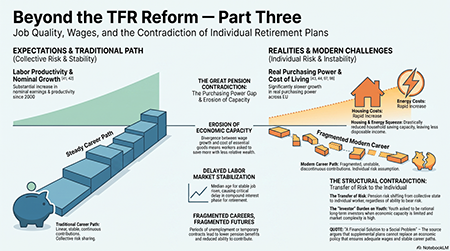
Job Quality, Wages, and the Contradiction of Individual Retirement Plans
The transformation of Europe’s economic structure has not only altered the relative weight of the various economic sectors. It has also altered the nature of the jobs created by the new development model.
This aspect represents one of the most significant – yet least discussed – elements when analyzing the future of supplemental pension plans.
Public debate often tends to focus on the need to increase individual retirement savings, as if the ability to accumulate capital were a condition automatically available to all workers.
But the ability to save does not stem from the availability of a financial instrument. It stems first and foremost from the economic structure that determines incomes, job stability, and career prospects.
A system based on individual capitalization, in fact, presupposes a fundamental condition: the worker must have a real opportunity to set aside a portion of their income for the future. This principle seems obvious, but it is often underestimated in the pension debate.
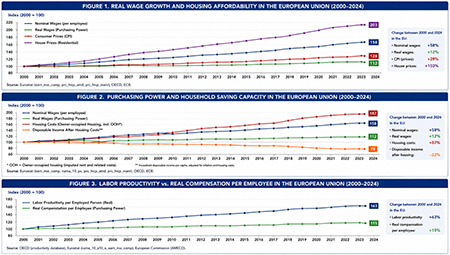
Supplementary pension plans can function effectively when the workforce is characterized by sufficiently stable incomes, relatively continuous careers, and a widespread capacity for saving across the population.
When these conditions are no longer met, the issue is no longer merely a matter of which financial instrument to choose, but rather the very ability of millions of people to participate fully in the system.
In recent decades, particularly for younger generations, the European labor market has become increasingly fragmented.
Increased flexibility has allowed businesses to adapt more easily and has fostered new forms of employment, but it has also led to a wider prevalence of temporary contracts, discontinuous career paths, and difficulties in achieving economic stability comparable to that of previous generations.
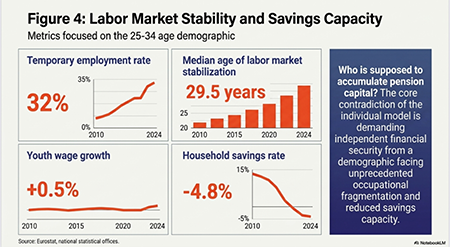
The problem is not just precariousness in the sense of a lack of work. It is also the economic quality of the available work.
A young person may enter the labor market, have a job, and yet lack the necessary conditions to build long-term economic security. Lower starting incomes, slower wage growth, greater difficulty in buying a home, and careers marked by periods of discontinuity directly affect the ability to accumulate savings.
This creates a potential structural contradiction.
It is precisely the generations that are being asked to take on greater individual responsibility for building their own retirement security who are often required to make financial decisions at a stage of life when their economic capacity is most limited.
The problem, therefore, is not merely educating young people to invest. It is understanding whether they actually have the resources to invest.
The evolution of the Italian debate offers a significant example of this distinction. Discussions that emerged as early as the first few years of the 2010s often tended to portray the pension crisis as the risk of the disappearance of the public pension system.
Subsequent developments revealed a different and, in many respects, more complex scenario: the central issue was not the absence of a pension, but the gradual erosion of its ability to guarantee income levels comparable to those enjoyed by previous generations.
It is precisely this shift in perspective that makes it essential today to analyze not only social security instruments but also the economic and employment model on which their sustainability depends
As early as the beginning of the 2010s, this issue had begun to surface in the Italian public debate, although it was often framed in highly alarmist terms.
A statement attributed to the then-President of INPS, Antonio Mastrapasqua, drew particular attention; he claimed that the widespread use of pension simulations for certain categories of quasi-subordinate workers could provoke “social unrest.”
The issue did not concern the non-existence of the public pension system -as was sometimes claimed in the debate of those years – but rather the risk that discontinuous careers, low incomes, and fragmented contributions would result in pension benefits significantly lower than those of previous generations.
More than fifteen years later, that episode can be reevaluated with greater objectivity: the most radical claims have not been borne out, but the fundamental issue – the future adequacy of social security benefits for a growing segment of the workforce – is now at the center of the European debate.
Financial education is certainly an important tool. A better understanding of economic and financial mechanisms can help citizens make more informed choices. However, financial education cannot serve as a substitute for the economic conditions that determine the very possibility of saving.
A better understanding of financial markets does not automatically enable a worker with insufficient income to accumulate significant capital.
The issue of social security, therefore, cannot be separated from the issue of wages.
A system that incentivizes individual capitalization should consider not only how to better invest available savings, but also how to create the conditions that allow those savings to exist in the first place.
The Transformation of Work and the New Vulnerability of Social Security
The historical period in which many European social security systems were established was characterized by a relatively linear career path: entry into the labor market, career advancement, continuous contribution, and retirement after a long career.
This model is no longer the norm.
Contemporary careers are more fragmented. Technological changes, global competition, and the transformation of business models have increased professional mobility and reduced the predictability of career paths.
This transformation has positive aspects: greater opportunities to change sectors, the emergence of new professions, and greater organizational flexibility. But it also presents vulnerabilities, especially when viewed from a social security perspective.
A public, contribution-based system, in fact, requires employment continuity and a sufficiently broad income base. An individual, funded pension system, on the other hand, requires something more: the ability to accumulate financial resources over very long periods.
Both models are therefore linked to the quality of the labor market.
The difference is that in the individual model, a greater share of the consequences of any employment instability falls directly on the worker.
A career characterized by long periods of reduced or intermittent income not only creates a contribution problem for the public pension system. It also reduces the ability to contribute to a private pension fund.
From this perspective, a key point emerges: supplemental pension plans cannot be evaluated independently of the society in which they are introduced.
It is not enough to tell citizens to invest for the future.
We must analyze what kind of economic future is being offered to them.
The risk of a financial solution to a social problem
This line of thought leads to a broader issue.
The growing importance attached to supplemental pension plans stems from a real problem: many European public pension systems will likely be unable to maintain the same levels of coverage guaranteed to previous generations in the future without profound changes.
But the response cannot be evaluated solely from a financial perspective.
If the cause of the pressure on social security is also linked to structural changes in the economy, the labor market, and income distribution, then a purely financial solution risks addressing only part of the problem.
Creating instruments through which to invest savings is necessary.
But first, we must ask ourselves about society’s ability to generate those savings.
Otherwise, there is a risk of creating a system in which those with higher incomes, greater job stability, and greater financial literacy will benefit most from the new pension framework, while those in more precarious economic circumstances risk remaining more vulnerable.
The issue therefore also becomes one of equity.
A pension system should primarily protect those with fewer economic resources, not amplify the disparities already present in the labor market.
Supplementary pension plans can be a positive component of the future model, but they cannot replace an economic policy capable of creating skilled jobs, adequate wages, and sustainable career paths.
Otherwise, the risk is that workers will be asked to become investors at precisely the moment in history when the economic system makes it more difficult to accumulate capital.
And this is where we connect to the third major transformative factor set to shape the future of European social security: the artificial intelligence revolution.
For while globalization has altered the structure of production and the new labor market has affected the ability of younger generations to save, artificial intelligence could directly alter the quantity and quality of career opportunities available in the coming decades.
The question therefore becomes even more fundamental:
What employment base will underpin European social security when work itself is profoundly transformed by technology?
Individual accountability also requires cultural tools
The assertion that increasing individual empowerment presupposes that citizens have the economic, cultural, and financial tools necessary to exercise it warrants further examination.
While economic conditions represent the material prerequisite for the ability to save, the cultural dimension constitutes the cognitive prerequisite without which that very freedom of choice risks remaining merely formal.
The most immediate historical reference is the United States, where the establishment of social security through individual capitalization schemes has for decades been one of the structural elements of the pension system.
The U.S. experience is frequently cited in the European debate as an example of the possibility of supplementing or replacing, at least in part, public systems with forms of social security based on financial investment.
However, the context in which this model developed differs profoundly from the European one.
In fact, large U.S. pension funds operate in a financial market historically characterized by great depth, ample liquidity, and significant capitalization.
The ability to invest substantially in the stock markets has allowed these funds to participate directly in the growth of the real economy, benefiting in the long term from increased productivity, technological innovation, and business development.
The size of many U.S. pension funds also allows for extremely efficient portfolio management, with high diversification, relatively low costs, and the ability to quickly reallocate investments without significantly affecting market prices.
The path taken in Europe, however, has been different.
For historical, regulatory, and prudential reasons, European supplemental pension plans were initially structured to prioritize capital preservation over the pursuit of returns.
Pension fund regulations have therefore long favored a high exposure to fixed-income instruments and government bonds, limiting the equity component and maintaining a strongly asset-preservation-oriented approach.
This choice responded to understandable needs to protect retirement savings, but inevitably resulted in a different balance between risk and return.
While bond investments are generally more stable in the short term, they primarily finance public and private debt, whereas participation in the growth of the real economy stems mainly from investments in corporate equity.
Consequently, an overly conservative strategy can limit, over the long term, the ability to accumulate pension assets.
The difference between the historical returns achieved by many European pension funds and those recorded by major U.S. institutional investors can also be explained by this different management approach, as well as by the differing characteristics of their respective capital markets.
Furthermore, the economic landscape has changed profoundly in recent decades.
Globalization has progressively altered the geography of industrial production. A significant portion of manufacturing activity has shifted to other parts of the world, while European economies have become increasingly service-oriented.
At the same time, the growing integration of financial markets has vastly expanded the variety of available instruments, making the investment landscape far more complex than in the past.
Alongside traditional stocks and bonds, a universe of sophisticated financial instruments has emerged – structured funds, derivatives, synthetic products, securitizations, and other financial engineering instruments – often characterized by levels of complexity that make them difficult to understand not only for the average investor but also for many professional market participants.
The financial crises of recent decades have shown how instruments that are formally diversified can in reality incorporate risks that are difficult to identify, and how financial complexity can reduce – rather than increase – the transparency of the system.
It is precisely in this context that the reference to cultural tools takes on its deepest meaning.
Indeed, increasing individual responsibility presupposes that workers are able not only to save, but also to understand the nature of the instruments in which those savings are invested, to assess their risks, and to correctly interpret their return prospects.
However, this prerequisite appears increasingly difficult to meet.
If even professional investors are encountering growing difficulties in analyzing increasingly complex financial instruments, it is legitimate to question to what extent it is realistic to place such a broad responsibility on individual workers without ensuring a corresponding level of transparency, simplicity, and comprehensibility in the markets.
The issue, therefore, is not limited to financial education.
It concerns the very relationship between the complexity of economic systems and citizens’ ability to make truly informed choices.
A social security system increasingly based on individual responsibility can function only if the complexity of the markets remains compatible with the saver’s actual ability to understand how they work.
Otherwise, there is a risk that individual responsibility will end up becoming an unwitting delegation of authority, in which citizens bear the full economic consequences of decisions that, in essence, they were never truly in a position to understand.
This line of thought can be further explored in light of some now-classic contributions from the fields of information economics and cognitive science.
George Akerlof, with his theory of information asymmetry, had already shown that markets cannot be considered fully efficient when one party possesses significantly more information than the other.
In the pension sector, this asymmetry takes on particular significance: savers are called upon to make decisions that will have effects thirty or forty years down the line, based on information that is inevitably incomplete and with an often limited understanding of the actual structure of financial products.
Added to this difficulty are the cognitive limitations highlighted by Herbert Simon through the concept of bounded rationality. In fact, individuals do not operate under conditions of perfect rationality but make decisions using necessarily partial information and limited cognitive abilities.
Daniel Kahneman subsequently demonstrated how these limitations are further amplified by the presence of numerous cognitive biases that affect the perception of risk, probabilities, and future returns.
The idea that an individual worker can become a fully rational investor therefore appears to be more of a theoretical construct than a realistic description of human behavior.
Added to this is a further factor, highlighted by Nassim Nicholas Taleb, according to whom the growing complexity of economic systems makes it increasingly likely that high-impact and difficult-to-predict events (Black Swan events) will occur, capable of radically altering scenarios that until recently appeared stable.
From this perspective, pension risk depends not only on market trends but also on the growing difficulty of predicting the economic and technological context in which these markets will operate.
This consideration inevitably leads to what is likely the most significant transformation today: the advent of the so-called Artificial Intelligence Age.
Previous technological revolutions have certainly replaced entire occupational categories, but they have generally created, in the medium term, new productive activities capable of absorbing a substantial portion of the workforce displaced from traditional sectors.
The current artificial intelligence revolution, however, has characteristics that are at least partly different. For the first time, automation affects not only repetitive manual tasks but also a growing number of cognitive, administrative, professional, and decision-making functions that, until just a few years ago, seemed reserved for human labor.
It is still a matter of debate whether this process will lead, in the long term, to a net reduction in employment or to a profound restructuring of the labor market.
However, numerous studies agree that the transition could be accompanied by significant polarization of the labor market, with a growing concentration of labor demand in highly skilled professions and a gradual reduction in opportunities in the intermediate skill levels.
Should this scenario materialize, the issue of social security would take on an even more complex dimension.
A system based on individual capitalization, in fact, presupposes the presence of a large pool of workers capable of generating sufficiently high and steady incomes to allow for regular pension savings.
If, on the other hand, a growing share of the population were to experience discontinuous careers, low wages, or prolonged periods of exclusion from the labor market, one of the fundamental economic premises of supplemental pension plans would be undermined.
But the consequences could also extend to the social and political spheres.
In industrial societies, work has not only been a source of income but also the main factor in social integration and one of the tools through which citizens have historically exercised their political influence.
For over a century, labor disputes, collective bargaining, and even strikes have been the means through which organized labor has influenced economic and institutional balances.
A society in which a growing proportion of individuals were structurally marginalized from productive processes could profoundly alter this balance as well.
Those who do not participate significantly in production inevitably have less ability to influence the economic mechanisms that regulate the distribution of wealth and, as a result, risk seeing their political bargaining power diminish as well.
This is not about hypothesizing deterministic scenarios or arguing that artificial intelligence will inevitably lead to such an outcome. Rather, it is a matter of recognizing that the sustainability of social security systems will depend not only on the evolution of financial markets or demographics, but also on the ability of institutions to manage a technological transformation that could redefine the very relationship between work, citizenship, income distribution, and social protection.
Selected Bibliography and Data Sources
Labour Markets, Wages and Inequality
Organisation for Economic Co-operation and Development (OECD), Employment Outlook, various editions.
Eurostat, Labour Market Statistics, Earnings Statistics and Demographic Indicators.
Autor, D. H., Dorn, D., “The Growth of Low-Skill Service Jobs and the Polarization of the US Labor Market”, American Economic Review, 2013.
Acemoglu, D., Restrepo, P., “Artificial Intelligence, Automation and Work”, in economic literature on technological change.
Piketty, T., Capital in the Twenty-First Century, Harvard University Press, 2014.