
Where does the most dangerous threat to freedom lie?
The election results in Saxony reflect an increasingly polarized Germany.
But the real question isn’t just why the AfD is growing – it’s why part of the West seems unable to recognize threats to democracy when they come from within its own ranks.
The results of the September 2024 regional elections in Saxony deserve close attention, not least because they reveal something that extends far beyond the borders of that state.
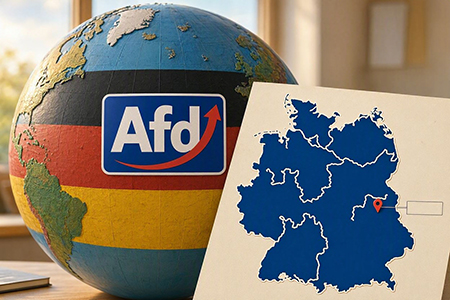
The AfD did not come in first: the CDU won 31.9% of the vote, compared to the AfD’s 30.6%. But the politically significant fact is that the AfD has become the second-largest political force in the state, trailing the Christian Democratic party by a very narrow margin, thereby consolidating a rise that can no longer be dismissed as a marginal or fleeting phenomenon. (Bundeswahlleiterin – https://www.bundeswahlleiterin.de/europawahlen/2024/ergebnisse/bund-99/land-14.html?utm_source=chatgpt.com)
After all, just a few months earlier, in the June 2024 European elections, the AfD had actually emerged as the leading party in Saxony with 31.8%, ahead of the CDU, which remained at 21.8%. (Bundeswahlleiterin – https://bundeswahlleiterin.de/en/europawahlen/2024/ergebnisse/bund-99/land-14.html?utm_source=chatgpt.com)
It is therefore difficult to continue describing what is happening simply as an extremist interlude destined to fade away. The phenomenon exists, it has substantial electoral support, and, above all, it taps into a significant portion of the discontent present in German society.
And this is precisely the point we need to examine.
Because a mature democracy should ask itself not only who votes for a particular party, but also why millions of citizens choose to do so.
Demonizing voters – automatically attributing their political choices to ignorance, extremism, or nostalgia for the past – may be politically reassuring, but it risks preventing us from understanding the deeper reasons behind the phenomenon.
It is in this context that the broader issue of the polarization of Western societies and the growing difficulty of distinguishing between legitimate political debate and the radicalization of conflict takes on significance.
For years I have been writing about these issues and trying, in some way, to warn those in a position to act against threats that no one seems willing to take seriously.
Yet it is precisely these threats that risk bringing about the West’s downfall – not through a direct attack, but through implosion.
An implosion driven by a series of factors that seem aimed at polarizing our societies and radicalizing debate on every issue, even the most trivial ones.
An increasingly divided society, in which every issue is transformed into a clash between opposing factions and in which it becomes progressively more difficult to distinguish legitimate dissent from radicalization.
Added to this is the growing, excessive emphasis placed on the psychological dimension of the individual, which – due to an excess of self-referentiality – has made most people extremely vulnerable and susceptible to any narrative proposed to them by those with an interest in striking at us and influencing us from within, even steering domestic policy – even before foreign policy – in a direction contrary to our own.
And it is precisely here that one of the most evident contradictions of our time emerges: the differing perception of threats depending on who expresses them and the political context in which they arise.
The proof?
The AfD achieved an election result that puts it just one step behind the CDU in Saxony.
One need only read its platform and observe its leadership to understand that the party’s political reality is more complex than the caricature often portrayed.
Yet the streets are in an uproar, and representatives of the European left immediately denounce the danger posed by this party, which, they claim, seeks to return sinister, nostalgic Nazi-Fascists to power in Germany, thereby promoting a widespread erosion of civil liberties throughout Europe.
nks of these outraged libertarians are also people who, without any shame, go so far as to call for the reopening of concentration camps and crematoria for Jews, raise swastikas, and praise Adolf Hitler.
And all of this takes place while marching alongside those who openly support Hamas and Hezbollah – Islamist terrorist organizations that, if they could, would not hesitate to direct the same violence seen on October 7 against those very same libertarians, inclusive and democratic individuals who support them today.
This is precisely the contradiction that should give us pause for thought.
How is it possible to consider a political party an intolerable threat because of its positions – whether real or perceived – while at the same time tolerating, downplaying, or trivializing demonstrations that feature anti-Semitism, Nazi symbols, and support for terrorist organizations?
The problem, therefore, is not merely a matter of determining who is right in a given political dispute. The problem is understanding whether we are still capable of recognizing a threat to freedom and democracy regardless of who expresses it and which political side it comes from.
Because if some signs are immediately identified, amplified, and denounced as dangerous, while others – far more disturbing – are systematically ignored or justified, then the risk is not merely that of failing to see the enemy.
It is the far more serious risk of not wanting to see him.
And so one naturally wonders: who is really the enemy at work?
Where, in reality, does the most dangerous threat to freedom lie?
And above all: are we still able to recognize it when it appears before us with the reassuring face of someone who proclaims themselves to be democratic, inclusive, and libertarian?