

From Italy’s Severance Pay Reform to the European Issue of Social Security Risk
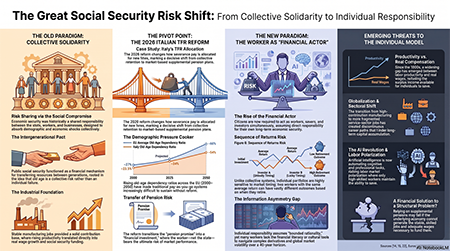
The 2026 Italian reform of severance pay (TFR) is a concrete example through which to observe a transformation that extends far beyond national borders.
The change in how severance pay is allocated for new hires in the private sector is not merely a technical decision regarding the management of retirement savings; rather, it is part of a broader process affecting numerous European systems: the gradual shift from a model based primarily on collective solidarity toward one in which individual responsibility plays an increasingly important role in building future economic security.
The details of the reform have been analyzed in depth in a previous article by the author, to which readers are referred for technical and regulatory aspects. In this paper, however, it is used as a case study to examine a Europe-wide transformation: the gradual transfer of pension risk from the collective system to the individual.
Entrusting an increasing share of social security to the financial markets effectively introduces a new element into the relationship between the worker and their economic future.
The worker is no longer merely the recipient of a social security promise built through a collective system, but is gradually becoming a financial actor called upon to participate directly in the management of their own risk.
This transformation is often described in positive terms: greater autonomy, greater awareness, individual accountability, and financial literacy. All of these elements can have tangible value.
However, any process of empowering individuals should be accompanied by an equally rigorous assessment of the conditions that make it possible to truly exercise that responsibility.
An individual can be considered fully responsible for a choice only when they have the necessary tools to understand its implications, evaluate the alternatives, and consciously assume the risk associated with the decision.
And it is precisely on this point that one of the most significant issues of the new pension model emerges.
A young worker entering the labor market today faces a choice that spans an extremely long time horizon.
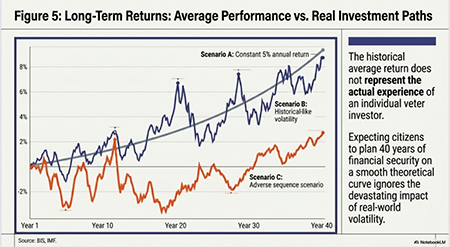
They are asked to help build their own future security through financial instruments that depend on complex variables: global economic growth, inflation, productivity, trends in the stock and bond markets, monetary policies, and international financial stability.
No individual, no matter how knowledgeable, can predict the economic environment in which those savings will be invested over the course of thirty or forty years.
This does not mean that supplemental retirement planning is irrational or that financial markets are incapable of generating value over the long term.
Economic history shows that diversified investing has been a fundamental component of the growth of private and institutional wealth.
The point is another: a positive historical return does not constitute an automatic guarantee of future conditions.
The history of financial markets has unfolded within a specific economic context, characterized by factors that have contributed to global growth: population growth, an expanding labor force, rising productivity, market globalization, technological development, and the progressive expansion of financial capitalization.
The generation entering the workforce today, however, may face a profoundly different environment.
The coming decades could be marked by more modest economic growth, greater geopolitical fragmentation, complex energy transitions, high levels of public and private debt, and technological transformations capable of profoundly altering the structure of employment.
For this reason, the debate on supplemental retirement plans cannot be limited to the question: How much have financial markets yielded in the past?
The most important question is: What economic conditions will allow the markets to produce similar results in the future?
The Problem of Risk Distribution
Every pension system stems from a fundamental choice: how to distribute risk among individuals, institutions, and generations.
The traditional European public model has historically sought to distribute this risk through a collective mechanism.
Economic difficulties, employment crises, and demographic imbalances were addressed through policy decisions and redistributive tools.
A model based more on individual capitalization follows a different logic. Workers accumulate resources throughout their working lives with the aim of using them later.
The final outcome therefore depends not only on the amount of savings accumulated, but also on market performance during the period in which that capital is invested.
This introduces a key variable: financial risk.
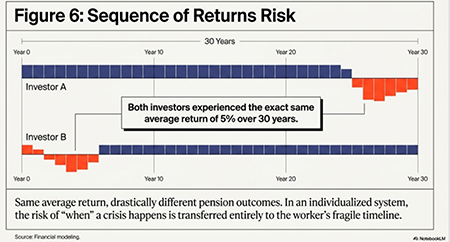
The question, however, is who is responsible for absorbing the cost when the expected scenarios do not materialize.
If a public system faces financial difficulties, the problem is addressed through collective decisions: changes to the rules, spending cuts, revenue increases, and legislative measures.
If, on the other hand, the risk is transferred primarily to individual financial instruments, a greater share of the uncertainty falls directly on the worker.
From this perspective, the real question is not whether supplemental pension plans are a valid tool.
The real question is whether European society has fully assessed the consequences of a gradual shift in the principle upon which social security is based.
From the Pension Issue to the Economic Issue
Precisely for this reason, analyzing the future of pensions necessarily means broadening our perspective beyond social security itself.
A system based on individual capitalization, in fact, requires a prerequisite: a society capable of generating sufficiently stable and widespread incomes.
Supplementary pension plans cannot be separated from the economic context in which they operate.
It requires workers with adequate incomes, sufficiently continuous careers, the ability to save, and prospects for economic growth.
If these conditions are no longer met, the problem is no longer merely a matter of choosing the best financial instrument.
It concerns the very ability of the economic system to generate the necessary resources.
And it is precisely this dimension that is often least explored in public debate.
The European pension crisis does not arise solely because the population is aging.
It also stems from the fact that the economic, productive, and employment model that had underpinned European welfare in the post-World War II era is undergoing a radical transformation.
The issue of social security thus becomes a broader question: “Which European economy will be able to finance the welfare of future generations?”
The sustainability of Europe’s social security systems will not depend solely on the ability of pension systems to raise financial resources, but on the ability of European economies to generate skilled jobs, adequate incomes, and sufficient productivity to support future social welfare.
To answer this, we must analyze three major transformations that have profoundly altered the context in which pension systems must operate today: globalization and the transformation of the productive base; the evolution of the labor market and the savings capacity of younger generations; and, finally, the artificial intelligence revolution.
Selected Bibliography and Data Sources
Pension Systems, Demographic Change and European Welfare
Organisation for Economic Co-operation and Development (OECD), Pensions at a Glance, OECD Publishing, various editions.
European Commission, The 2024 Ageing Report: Economic and Budgetary Projections for the EU Member States (2022–2070), Brussels, 2024.
European Commission, Pension Adequacy Report, Brussels, various editions.
International Monetary Fund (IMF), Global Financial Stability Report, various editions.
Barr, N., The Welfare State as Piggy Bank: Information, Risk, Uncertainty, and the Role of the State, Oxford University Press, 2001.
Barr, N., Diamond, P., Reforming Pensions: Principles and Policy Choices, Oxford University Press, 2008.