
What the August 31 Communiqué Confirms About Our Analysis
Update – August 31, 2026
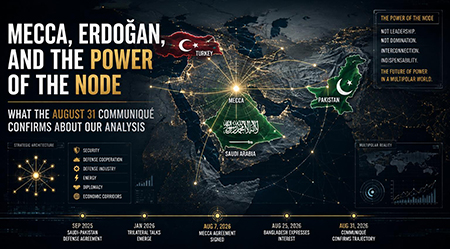
The August 31 communiqué establishes the first permanent institutional structure within the Mecca Agreement: a Secretariat based in Saudi Arabia, to be headed for the first three years by a Pakistani Secretary-General, under the coordination of the Strategic Political and Defense Committee, composed of the foreign and defense ministers and the military leaders of the three countries.
This is a significant step: the agreement is no longer merely an accord but is beginning to establish its own institutional infrastructure.
There comes a point in geopolitical analysis when events cease to be merely facts to be commented on and begin to serve as elements through which to test a hypothesis.
This is exactly what is happening with the mutual defense agreement signed in Mecca on August 7, 2026, by Turkey, Saudi Arabia, and Pakistan, and with the new statement released today, August 31.
Read together, today’s statement, the previous article published on August 27 in Il Nuovo Giornale Nazionale, The So-Called “Islamic NATO” and Erdoğan’s Game, and my essay on the new security architecture do more than simply chronicle the evolution of a military agreement.
Above all, they allow us to verify whether the interpretive framework proposed in recent weeks – that of building a strategic network rather than simply the emergence of an “Islamic NATO” – is confirmed by the facts.
And this, in my view, is precisely the first conclusion that emerges. If one views the matter through the traditional lens of alliances, the August 31 press release may appear to be another step in the construction of a security mechanism among three countries united by shared interests.
If, on the other hand, we view it through the lens of the transformation of the international order, the picture changes.
The issue is no longer merely establishing who will defend whom in the event of an attack, but understanding what geopolitical space is gradually taking shape and, above all, which actor might succeed in positioning itself at the point in the network from which it becomes indispensable to the others.
This was precisely the question we posed in the essay: not “Has an Islamic NATO been born?”, but “What new power architecture might emerge if some of the major Muslim powers decide to build their own security network without breaking ties with the West and without subordinating themselves to China and Russia?”.
The difference between the two questions is not merely semantic. It is the difference between continuing to interpret the world through the logic of blocs and instead trying to understand it through the logic of networks.
The August 31 statement therefore takes on particular importance because it allows us to verify whether the trajectory set on August 7 is indeed heading in the direction we had hypothesized.
And the answer – at least based on the information currently available – is that the interpretation of Mecca as a potential network infrastructure appears more convincing than the one that reduces it to a mere contingent reaction to a regional crisis.
The Timeline: What We Wrote Before It Happened
At this point, however, we need to take it a step further. For if this analysis is to be more than just a new interpretation of the Mecca Agreement, we must determine how much of the interpretation we are proposing had already been identified before recent developments made some of these elements evident.
This is not a matter of claiming to possess prophetic abilities, nor of asserting that every single development had been foreseen in detail. That would be intellectually dishonest.
It is, quite simply, a matter of comparing chronologically what we had written with what subsequently happened and verifying whether the trajectory identified at that time is borne out by the facts today.
And it is precisely this comparison that proves interesting.
The first insight concerned the very nature of the agreement. Even before the debate focused on the term “Islamic NATO”, we had argued that this definition risked being misleading and that the truly important question was whether a new security network was forming through which certain regional powers could increase their autonomy while simultaneously maintaining relations with Washington, Beijing, and Moscow.
Following the signing on August 7, public debate has indeed centered on the nature of the agreement and its comparability to NATO’s Article 5, while Ankara has continued to emphasize its complementary nature with respect to the Atlantic Alliance.
The prediction, therefore, did not simply concern the existence of a military pact, but the need to interpret it as something other than a new, traditional-style alliance.
The second prediction concerned Turkey’s central role. In the essay, we had argued that Erdoğan did not necessarily seem interested in securing formal leadership of the Muslim world, but rather in transforming Turkey’s position into a form of systemic power, while simultaneously maintaining open relations with NATO, the United States, Russia, China, and Muslim powers.
The Mecca Agreement has placed Ankara precisely at the center of a structure in which these various dimensions overlap. Turkey is simultaneously a member of NATO and a key player in a new military partnership with Saudi Arabia and Pakistan.
It did not have to choose. And it is precisely this lack of choice – already identified as a central element of Erdoğan’s strategy – that today constitutes one of the most interesting aspects of the entire affair.
The third prediction concerned Pakistan. We had written that its presence could not be explained simply in terms of Middle Eastern security and that Islamabad necessarily introduced into the agreement’s dynamics its rivalry with India, its relationship with China, its own military experience, and above all, its nuclear deterrent.
In other words, Pakistan did not merely add a third signatory: it added a new region, another strategic competition, and another major center of power – Beijing – to the emerging structure.
After the signing, it was precisely the Asian dimension of the agreement that became one of the key factors through which to assess its potential consequences.
The fourth preview concerned the possible expansion of the network. When we wrote that the potential involvement of other Muslim countries would transform the issue from a trilateral agreement into a full-fledged network infrastructure, we specifically identified Bangladesh as a country to watch.
A few days later, on August 25, it became publicly known that Dhaka might be considering joining the Mecca mechanism. Again, it would be incorrect to claim that we “predicted” a decision that has not yet been made.
But it is accurate to note that Bangladesh had been identified in advance as one of the countries whose potential participation would profoundly alter the dynamics of the agreement, especially given its implications for South Asia and relations with India.
The fifth prediction concerned New Delhi itself. We had argued that the pact did not necessarily have to be anti-Indian to have a strategic impact on India.
It was sufficient that the strengthening of Pakistan, the possible involvement of Bangladesh, and the growing Turkish-Saudi projection toward South Asia would alter the strategic environment in which New Delhi is forced to operate.
This is an important distinction: we had not argued that India was the agreement’s declared enemy; we had argued that the architecture could produce consequences that would contain India even without having been explicitly designed to do so.
This is precisely the kind of systemic effect that a network-based analysis allows us to identify, whereas an analysis based exclusively on official statements risks overlooking it.
The sixth preview concerned the religious dimension. Here, too, our position had been deliberately cautious. We had not argued that the pact was a religious institution or that it had been conceived as a tool against a specific religious denomination.
We had argued something different: that a shared Islamic identity could constitute a powerful source of legitimacy and, under certain circumstances, a potential lever for political mobilization.
We had also emphasized that the absence, in the public document, of a general obligation of military solidarity toward other Muslim countries did not equate to the absence of the religious dimension as a potential political tool. This distinction remains fundamental even in light of subsequent developments.
The seventh prediction concerned the very timing of the agreement’s genesis. We had insisted that August 7 should not necessarily be considered the moment when it all began.
The available timeline, in fact, showed a previous Saudi-Pakistani agreement from September 2025, trilateral discussions that had already emerged in January 2026, and, above all, Hakan Fidan’s statement that the process would have lasted about two years and eight months.
This led to a clear conclusion: the regional escalation of 2026 may have accelerated and made a pre-existing project politically expedient, rather than having created it out of thin air.
This element, too, is essential for understanding why the agreement should not be interpreted merely as a contingent response to a crisis.
But there is one prediction even more important than the others, because it concerns not a single event but the interpretive framework as a whole.
We had written that the true significance of the new architecture might lie not in the clause stating that an attack against one would be considered an attack against all, but in what that clause made possible: a potentially expandable network.
We had written that Pakistan would bring India and China into the network; that Turkey would bring with it NATO, Europe, the Mediterranean, and its own position as a bridge between different strategic systems; that Saudi Arabia would bring the Arab world, energy, and the holy sites; and that the eventual entry of other countries would gradually transform the triangle into something other than a mere military alliance.
And this is precisely where the comparison between our previous article, the essay, and subsequent developments becomes most significant.
We hadn’t simply predicted an agreement.
We had identified a possible logic.
The logic that, in the new international system, power does not necessarily belong to the state with the greatest material strength, but may belong to the state that occupies a central position within a network of relationships.
And we had identified Turkey as the natural candidate to fulfill this role precisely because of its ability to connect different worlds without fully belonging to any of them.
Today, this hypothesis can be tested against the facts.
Naturally, not everything we had envisioned has come to pass. Some scenarios remain just that. Bangladesh is not yet necessarily part of the structure; we do not know whether the agreement will become a true political platform; we do not know whether the religious dimension will remain merely a tool of legitimization; we do not know whether Ankara and Riyadh will succeed in transforming their tactical convergence into lasting strategic cooperation.
But precisely for this reason, the assessment is more rigorous.
What is already apparent is that the main elements of the identified trajectory were present before subsequent developments made them evident: the agreement’s nature, which is not exclusively anti-Iranian; Turkey’s continued membership in NATO; Ankara’s centrality; Pakistan’s strategic role; the resulting Indian and Chinese dimensions; the possible opening to other Muslim countries; Bangladesh’s role; the tension between realpolitik and religious identity; and, above all, the possibility that the true product of this cooperation is not a new bloc, but a network.
That is why it is unnecessary today to say that we had “foreseen everything”.
Something more substantial suffices: verifying that we had identified, before events fully unfolded, the direction in which the situation was likely to evolve.
And when a geopolitical forecast does not consist of guessing a date or a newspaper headline, but of correctly identifying the logic through which subsequent events tend to unfold, it is precisely this verification that matters.
The timeline, therefore, does not demonstrate prophetic ability. It demonstrates something more important: that an interpretive model formulated before the events can be tested against the facts without needing to turn every coincidence into a “prediction”.
The first point to keep in mind is that the agreement was not signed on August 7. The signing in Mecca is the most visible formal milestone in a process that, according to statements made by the key players themselves, had begun much earlier.
The Saudi-Pakistani bilateral agreement of September 2025 had already established an initial framework for strategic cooperation. In the months that followed, Ankara gradually became part of the arrangement.
In January 2026, Pakistani Minister of Defense Production Raza Hayat Harraj had already spoken of discussions regarding a trilateral agreement and of a draft submitted to the three governments, while Hakan Fidan later indicated that the process leading to the agreement took approximately two years and eight months.
If we take this timeline seriously, it becomes very difficult to argue that the Mecca framework is simply the result of the crisis that emerged in the summer of 2026.
From this perspective, Iran may have served primarily as the catalyst for a pre-existing process. The crisis may have provided the political motivation, the immediate necessity, and the diplomatic window of opportunity to make public what had been gradually built – perhaps to make it more acceptable to the West, as well as to other international and/or regional competitors. But it was not necessarily the root cause.
This is a decisive shift, because it also changes the way we must interpret the mutual defense clause. The reference to NATO’s Article 5 is certainly significant. An attack against one of the member states is considered an attack against all.
But to stop at the formal similarity is to miss the most interesting part of the story. We are not dealing with a miniature NATO. As has already been stated and reiterated, it lacks the institutional structure, integrated command, organizational depth, and operational experience of the Atlantic Alliance.
And Ankara itself continues to present the agreement as complementary to – not an alternative to – its NATO membership.
This apparent contradiction is, in fact, one of the most interesting aspects of the entire project. Turkey can simultaneously be a member of NATO and a promoter of a new security architecture with Saudi Arabia and Pakistan.
Saudi Arabia can continue to be a strategic partner of the United States and, at the same time, build instruments of autonomy with Ankara and Islamabad.
Pakistan can maintain its privileged relationship with Beijing, strengthen its ties with Riyadh, and deepen its partnership with Turkey. No one, at least formally, has to choose a side.
And this is precisely the point we identified in the essay: the new international system does not seem to be moving necessarily toward the replacement of one bloc with another, but toward the multiplication of relationships through which states seek to increase their autonomy.
Power, in other words, is changing in nature. Military strength is not disappearing, deterrence is not disappearing, and economic clout is not disappearing. But the ability to automatically transform material superiority into political control has diminished.
States may be militarily inferior and yet possess sufficient tools to prevent their adversary’s superiority from translating into a definitive political outcome.
Missiles, asymmetric capabilities, networks of influence, informational and cognitive tools, strategic depth, and the ability to shape perceptions of events have altered the relationship between material power and political power.
It is precisely in this new environment that Turkish strategy takes on particular significance.
Erdoğan does not seem to want to leave NATO. Nor does he seem to want to turn Turkey into a Russian or Chinese ally. On the contrary, his strategy appears to be built on the possibility of being many things at once: a member of the Atlantic Alliance, a dialogue partner with Moscow, an economic partner of Beijing, a regional power in the Muslim world, a key player in Central Asia, a dialogue partner in Africa, and a leading figure in the Middle East.
It is not a policy of allegiance. It is a policy of mediation.
And this is where the August 31 statement becomes interesting in light of what we had written. Because if the new agreement continues to be developed without formally taking on the nature of a bloc opposed to another, this actually reinforces the hypothesis that its strategic function may be to create a platform through which its key players increase their room for maneuver vis-à-vis all other centers of power.
Turkey, in this framework, holds a particular advantage. It brings NATO with it – but not just NATO. It brings a significant military apparatus, a growing defense industry, a unique geographical position, a diplomatic network spanning the Middle East, Central Asia, and Africa, a complex relationship with Russia, economic ties with China, and the ability to engage with actors who are often difficult for Washington to reach.
It is precisely this overlap of partial affiliations that transforms Ankara into a potential hub.
And this is the central concept that the new development seems to make even more evident: the power of the indispensable hub.
Traditional leadership assumes that someone commands and someone else follows. Indispensability works differently. It does not require others to recognize your superiority. It requires that they have a stake in not losing you.
Erdoğan does not necessarily need Mohammed bin Salman to recognize him as the leader of the Muslim world. It is enough for him that Riyadh considers Turkish technology and the defense industry to be useful.
He does not need Islamabad to recognize Ankara as a political leader. It is enough for him that Pakistan considers cooperation with Turkey strategically advantageous. He does not need Washington to view Turkey as an obedient ally.
It is enough for him that the United States cannot afford to lose its relationship with a power capable of speaking simultaneously to a growing portion of the Muslim world.
And it doesn’t need Beijing to view Ankara as an ally. It is enough that China has an interest in maintaining a relationship with Turkey that is stable enough to prevent Ankara from becoming an obstacle to its own interests.
This is a form of power far more sophisticated than traditional leadership.
And it is also a form of power perfectly compatible with the multipolar world that is emerging.
For this reason, Pakistan’s presence cannot be considered a mere detail. Islamabad brings much more to the new architecture than just its formal participation.
It brings its nuclear deterrent, its military might, its relationship with China, its strategic experience, and above all, its rivalry with India.
This does not mean that the agreement was conceived against New Delhi. The public text does not support such a conclusion. But it does mean that Pakistan’s entry inevitably has consequences for the balance of power in South Asia. It is a perfect example of the difference between stated intent and systemic effect.
In geopolitics, in fact, an architecture can produce consequences that go beyond the stated objectives of its promoters.
If Bangladesh were to join this framework tomorrow, the problem would become even more evident. Not because Dhaka must necessarily be considered part of an anti-Indian front, but because a network capable of linking Turkey, Saudi Arabia, Pakistan, and Bangladesh would span the Middle East and South Asia, creating a strategic geometry that New Delhi could no longer regard as peripheral.
And this brings us to the real arena of competition: the Global South.
The Global South is not a bloc. It is an arena. India and Pakistan are part of it, but they are rivals. Saudi Arabia and Iran are part of it, but they are competitors.
China and India both belong to the emerging world, but they are engaged in a growing strategic competition. Turkey and Arab countries share important elements of identity, but not necessarily the same conception of the political order.
The Global South is therefore less and less a geographical category and increasingly a space in which nations compete to build networks.
It is here that the previous article from August 27 takes on, in hindsight, a particular significance. We had argued that the term “Islamic NATO” risked being misleading precisely because it led one to immediately seek out an enemy – Iran, Israel, the United States – rather than asking what new power architecture was taking shape.
The August 31 statement, when viewed in the context of its evolution from the previous trajectory, does not seem to contradict this approach. On the contrary, it seems to confirm that the most important issue is not identifying a formal adversary, but observing how the network organizes itself, what capabilities it brings together, and what further relationships it makes possible.
The religious dimension must also be interpreted in the same way.
Islam constitutes a powerful framework for identity and politics, but it is not necessarily the organizing principle of the agreement.
The substance of the agreement concerns security, deterrence, military cooperation, political coordination, technology, and defense. There is no indication, at least in publicly available material, of a general obligation of military solidarity toward any Muslim state simply by virtue of its status as such.
This does not render the religious dimension irrelevant. If anything, it makes it a potential lever.
A shared identity can help legitimize the agreement, facilitate political mobilization, and serve as a tool to influence public opinion. But precisely for this reason, it must be closely monitored.
It is one thing to use religious identity as a political language. It is quite another to transform a geopolitical dispute into a conflict perceived as religious. The shift from realpolitik to sectarian mobilization is not automatic, but neither is it impossible.
It is one of the points on which the essayist had deliberately chosen a cautious stance: not to argue that the agreement is sectarian, but neither to ignore the fact that a network of Muslim states could, if it were gradually expanded and hit by a serious crisis, acquire its own political identity.
And it is precisely here that the convergence between Ankara and Riyadh presents both its strength and its vulnerability.
For years, Turkey and Saudi Arabia have represented two competing models of the Sunni order. Ankara has supported political Islam and, in particular, forces aligned with the Muslim Brotherhood; Riyadh has traditionally viewed the Brotherhood as a threat to the political stability of the Gulf monarchies. The Arab Spring brought this contrast into sharp relief.
Today, that rift has not necessarily disappeared. It has been put on hold by realpolitik.
Mohammed bin Salman needs security, technology, investment, and strategic diversification. Erdoğan needs Saudi capital, Riyadh’s influence in the Arab world, and the opportunity to build a network capable of expanding Turkey’s reach.
It is perfectly possible, therefore, that two powers that do not share the same conception of the political order have discovered that they need one another.
But being partners does not mean being subordinate.
And this is where, in the medium term, the real competition within the new architecture could emerge. Riyadh can accept a strong Turkey without wanting to see it become dominant.
Ankara may accept an indispensable Saudi Arabia without wishing to recognize absolute Saudi leadership. Islamabad can benefit from cooperation with both without wanting to enter into a hierarchy.
The system can therefore be both stable and unstable at the same time: stable because no one has an interest in destroying it; unstable because each party may have an interest in using it to increase its own influence relative to the others.
And it is precisely this ambivalence that makes the new architecture interesting.
Syria, Iran, and the shifting balance of Sunni power must be viewed within this same framework. Syria is no longer merely the arena in which the United States, Russia, Turkey, Iran, and Israel clash.
It can also be viewed as one of the arenas in which the balance of power within the Sunni world is being redefined. The gradual shift in the West’s attitude toward the new Syrian leadership demonstrates just how quickly the categories through which an actor is perceived can change.
But here, too, we must resist the temptation to offer all-encompassing explanations. We do not have sufficient evidence to argue that the West has “created” a specific Syrian leadership to build a new Sunni order.
We can, however, observe that the Syrian transformation directly affects the competition for influence in the Muslim world and that the Turkish-Saudi convergence makes it more difficult to use the divisions between Ankara and Riyadh as a tool for external influence.
This is an important distinction.
For decades, the fragmentation of the Islamic world has allowed external powers to exert influence through internal rivalries. Today, that same fragmentation could, paradoxically, become the basis for pragmatic cooperation.
Not because the Muslim world is becoming unified, but because some of its key players may have realized that they do not need to agree on everything to reduce their dependence on a single center of power.
And this brings us back to the United States.
The problem is not that Washington has become irrelevant. It is not at all. The problem is that its centrality may no longer be sufficient to guarantee automatic control of the balance of power.
In fact, it is precisely the United States’ continued status as an indispensable hub of the system that allows regional actors to use their relationship with Washington as leverage to increase their own autonomy.
Turkey can tell the United States: I’m still in NATO, but precisely for that reason, I can also be useful as an interlocutor for the Muslim world.
Saudi Arabia can say: “I’m still an American partner, but I now have strategic alternatives”.
Pakistan can say: “My relationship with Beijing is fundamental, but it is not the only pillar of my foreign policy”.
This proliferation of relationships raises the cost of making a choice.
And when the cost of making a choice rises, so does the power of those who can postpone it.
This is the heart of Erdoğan’s strategy.
Refusing to make a definitive choice can be a form of power when everyone else has an interest in keeping the relationship with you open.
This is the same logic we have observed in numerous issues related to Turkish foreign policy: Russia, China, the United States, Europe, the Middle East, Africa, and the Mediterranean.
Ankara has often turned its own contradictions into negotiating tools. Its geographical position, rather than being merely a structural condition, has become a political asset. The ability to engage in dialogue with diverse counterparts has become a form of strategic capital.
In this sense, the true outcome of the Mecca agreement may not be the creation of a new military alliance, but the transformation of a geographic and diplomatic position into systemic power.
And here, the August 31 statement becomes, in my view, particularly important because every further step toward consolidating cooperation makes a purely contingent interpretation of the agreement less plausible and a view of it as a platform intended to serve as the infrastructure for relations more plausible.
We do not yet know whether it will become a true regional network. We do not know which countries may eventually join. We do not know what the actual level of military integration will be.
We do not know whether the differences between Ankara and Riyadh can be kept under control in the long term. Nor do we know whether the religious issue will remain a framework for identity or whether it will, in the future, become a tool for political mobilization.
But precisely because we do not know, we must look at the structure.
A structure in which Pakistan brings India and China with it; Turkey brings NATO, Europe, the Mediterranean, and the Caucasus with it; Saudi Arabia brings the Gulf, the Arab world, energy, and the holy sites with it; Syria brings the competition for the new Sunni order with it; Iran represents what this geometry leaves out; China and Russia represent two major external centers with which the network will necessarily have to interact; the United States represents the old guarantor that might, finally, gradually discover that it is no longer the only possible guarantor.
And this is where the analysis of August 31 leads to perhaps its most important conclusion.
The real contest is not necessarily between the new architecture and the West.
It could be the competition to occupy the center of the network.
As already mentioned – but it is worth emphasizing strongly here – Riyadh possesses a form of legitimacy that Ankara cannot replicate: Mecca and Medina, its religious, financial, and energy clout, and its centrality in the Arab world.
Ankara, however, possesses another form of legitimacy and, above all, another form of power: military capability, the defense industry, technology, geographic position, population, diplomacy, and NATO membership.
Islamabad, in turn, possesses what the other two lack: nuclear deterrence, military strength, and strategic depth in South Asia.
We are therefore not dealing with three equivalent powers. We are dealing with three complementary powers.
And it is precisely this complementarity that makes the network possible.
The question, therefore, is not necessarily who will be the leader.
It might be more useful to ask whether it will be possible to build a system in which no one is formally the leader, but in which everyone is mutually indispensable.
If this were the path forward, Erdoğan would have found a solution particularly suited to the new multipolar world. He would not need to secure formal leadership of the Muslim world – a goal that would inevitably meet resistance from Saudi Arabia and other actors.
It would suffice for him to make Turkey the hub through which relations flow – relations that none of the other key players can easily replace -because this is the power of the indispensable hub: power that does not require loyalty, but mutual dependence; that does not require subordination, but interdependence; and, specifically, that does not require others to recognize Turkey as superior, but rather that everyone has something to lose should Ankara decide to definitively side with the other side.
It is a form of power that is difficult to counter precisely because it does not present itself as a project of hegemony, which is why the term “Islamic NATO” is not only reductive but – as mentioned – deeply misleading.
A NATO has an “inside” and an “outside”. A network can have only nodes and connections.
NATO needs an adversary. A network can grow even without one.
NATO organizes security around a system of membership. A network can organize security around interdependence.
The August 31 statement, read in conjunction with what was foreshadowed in the essay and the previous article, does not yet allow us to say that this transformation is complete. But it makes it harder to ignore the possibility that this is precisely the direction in which events are heading.
And so the significance of Mecca changes radically.
August 7 may not have been the day an “Islamic NATO” was born, but it may have been one of the moments when a new center of gravity began to take shape – one that could expand, attract new countries, multiply connections, and transform simple military cooperation into a broader political, economic, and strategic platform.
And if that were to happen, the decisive question would no longer be who will defend whom.
It would be who manages to become indispensable to the others.
Because this is where Erdoğan’s game really gets interesting.
If Turkey’s strategy succeeds, Ankara will not need to make a definitive choice between Washington, Moscow, Beijing, Riyadh, and Islamabad.
It will be able to continue being useful to everyone precisely because it does not fully belong to anyone, embodying the form of power most consistent with the 21st century: not the power to command others, but the power to make its own absence too costly for everyone else.
The real stakes in Mecca, in this sense, seem not at all to be the birth of a new military alliance, but rather the beginning of the construction of a network that has no equal in the world – and within which the real question will never necessarily be who will lead the new Muslim world, but a simpler one: “Who will manage to ensure that others cannot afford to do without him?”