

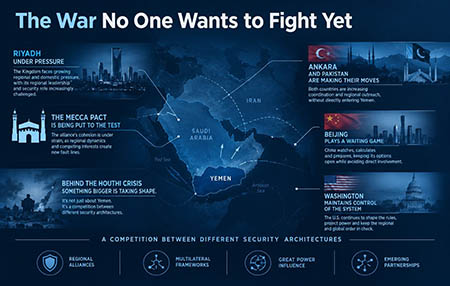
Riyadh is under pressure, the Mecca Pact is being put to the test, and Ankara and Islamabad are beginning to make their moves. But without directly entering Yemen
Behind the Houthi crisis, something bigger is taking shape: a competition between different security architectures, while Beijing plays a waiting game and Washington maintains control of the system.
Abstract
The escalation of Houthi attacks against Saudi Arabia is putting the newly established Makkah Joint Defence Agreement between Saudi Arabia, Türkiye, and Pakistan to its first major test. Yet the central question is not whether Ankara and Islamabad will immediately deploy forces to Yemen.
It is whether the agreement can evolve from a political commitment into an autonomous regional security architecture capable of providing Riyadh with intelligence, military planning, technology, interoperability, and deterrence beyond its longstanding reliance on the United States.
The current crisis reveals a more complex strategic landscape. Türkiye and Pakistan are signaling readiness to support Saudi Arabia while preserving room for maneuver, allowing the United States and CENTCOM to remain the primary operational hub.
At the same time, Saudi Arabia is reportedly making use of functional intelligence channels involving Israel, demonstrating how regional security cooperation increasingly cuts across traditional political alignments without necessarily translating into diplomatic normalization.
China occupies a different position. Beijing does not command the Houthis, nor is there evidence of a Sino-Iranian chain of command. Instead, China operates through a network of economic, diplomatic, technological, and strategic relationships, maintaining ties with Riyadh and Tehran while engaging the Houthis and protecting its own interests around the Red Sea. Its recent pressure on Iran to restrain Houthi attacks, following a Saudi request, illustrates this flexible approach.
This article advances a deliberately cautious hypothesis: China may have little interest either in a Houthi victory or in a complete stabilization of Saudi Arabia under a predominantly U.S. – led security framework.
A prolonged but contained crisis could preserve Chinese strategic leverage, impose costs on Washington, increase European dependence on U.S. security capabilities, and complicate the emergence of an autonomous regional security system. This is an analytical hypothesis rather than a documented Chinese strategy.
The broader argument is that the Middle East is moving from a system of relatively rigid alliances toward overlapping strategic networks. The decisive question is therefore not simply who defeats the Houthis, but which security architecture becomes indispensable when the next missile strikes.
——————————
There is a war that is changing shape, yet – at least for now – no one seems truly willing to fight it to the end. The Houthis have intensified their attacks on Saudi Arabia, striking cities, energy infrastructure, and trade routes, while their pressure along the Red Sea and toward Bab el-Mandeb has opened a second front within a regional crisis that is already deeply internationalized.
In recent hours, Riyadh has had to contend with new attacks on the city and other areas of the Kingdom. The issue is no longer merely the security of a border or a few oil facilities: it is the vulnerability of one of the world’s leading energy economies and one of the planet’s most important trade routes.
And it is precisely here that the Mecca Pact, signed on August 7 by Saudi Arabia, Pakistan, and Türkiye, faces its first real test. The agreement stipulates that an armed attack against any one of the three countries is to be considered an attack against all of them.
But the interesting question isn’t just why Pakistan and Türkiye haven’t yet directly entered the war in Yemen. The question is far more important: what are they building while they choose not to do so?
The difference is not merely semantic. It is strategic.
In recent hours, Ankara has openly declared that it is ready to meet any Saudi military needs, especially on the technical front.
Islamabad, on the other hand, continues to say that no immediate military response under the Pact has been discussed, while reiterating that it will act when the time comes. In other words, both are keeping the military option open without automatically turning it into an operational decision.
At first glance, this might seem like hesitation. But there is another interpretation, perhaps a more interesting one.
Ankara and Islamabad may have a shared incentive to buy time. Not because they want to shirk their commitment to Riyadh, but because directly entering the Yemeni conflict would change the nature of the crisis.
As long as the confrontation remains between Saudi Arabia and the Houthis, with Iranian support in the background, we are still dealing with a regional war – albeit an increasingly dangerous one.
If, on the other hand, Türkiye and Pakistan were to begin deploying forces directly against the Houthis, the conflict would take on a very different dimension: it would become a multinational confrontation involving Saudi Arabia, Türkiye, Pakistan, and the United States – as well as Israel, in terms of intelligence and operational cooperation – on one side, and Iran and the Houthis on the other.
This is precisely the kind of shift that all the actors involved have an interest in carefully considering before taking action.
For this reason, at this stage, taking time is not necessarily a sign of weakness. It is a strategic asset. Waiting allows Ankara and Islamabad to assess how much Riyadh can still achieve through the tools already at its disposal, what level of U.S. commitment there will be, and, above all, whether the Mecca Pact is destined to become a genuine security framework or merely another layer on top of a regional system still dominated by the United States.
Because this is where the true test of the Pact lies.
Not in the almost journalistic question of whether Pakistani or Turkish soldiers will arrive in Yemen tomorrow. But in the agreement’s ability to generate autonomous capabilities: intelligence, planning, interoperability, technology, military production, air defense, drones, surveillance, information sharing, and, above all, a decision-making chain that allows the three countries to respond without necessarily having to go through Washington.
The first meeting of the Pact’s Strategic, Political, and Defense Committee, held in Istanbul on August 31, had already pointed in this direction, discussing industrial cooperation, shared technologies, joint production, and interoperability. What is happening today is thus transforming a diplomatic framework into a very concrete testing ground.
And this is where Washington enters the picture.
While forging a new agreement with Pakistan and Türkiye, Saudi Arabia continues to make full use of its U.S.-backed security framework. Mohammed bin Salman met with CENTCOM Commander Brad Cooper in Jeddah, while the U.S. administration – though it has not authorized direct action against the Houthis- has offered Riyadh intelligence sharing and assistance with targeting. CENTCOM has also activated a task force to strengthen intelligence and planning efforts with Saudi forces.
This is perhaps the most intriguing contradiction in the entire situation. Riyadh is forging a new defense pact with Pakistan and Türkiye even as it continues to rely on the U.S. military ecosystem for some of its most sophisticated capabilities.
But perhaps it is not a contradiction.
It’s the new model.
Saudi Arabia no longer seems interested in choosing a single architecture. It is seeking to build several and have them interact. CENTCOM for U.S. intelligence, surveillance, and operational capabilities.
Pakistan and Türkiye to create a more autonomous regional hub. China for investment, energy, technology, and relations with Iran. And even Israel, in a much more limited and functional capacity than the old Middle Eastern geopolitics would have made conceivable.
The Saudi-Israeli contacts mediated by CENTCOM on the Houthi issue do not amount to political normalization and do not overturn the Saudi position on the Palestinian question.
But they reveal something important: when the threat becomes real, security cooperation can transcend political lines that remain formally intact. It is a logic of networks, not of blocs.
And it is precisely this logic that helps us understand China.
Beijing does not control the Houthis. There is no Sino-Iranian chain of command that turns the Yemeni movement into a Chinese military tool. Reducing the situation to this framework would be too simplistic. The Houthis have their own agenda, their own autonomy, and their own interests.
But that doesn’t mean Beijing lacks leverage.
On the contrary.
China is playing a power game through its networks. It has deep economic and technological ties with Iran. It is in dialogue with the Houthis to protect its trade routes in the Red Sea.
And when the crisis began to directly threaten Chinese energy and commercial interests, Riyadh asked Beijing for help, and Beijing put pressure on Tehran to help curb the attacks on Saudi infrastructure. Reuters reported in recent days that Chinese officials have privately asked Iran to help rein in the Houthis.
This behavior is far more intriguing than the notion of China simply being a “friend” of Iran.
Beijing can simultaneously be a dialogue partner with Riyadh, an economic partner of Tehran, and an indirect dialogue partner with the Houthis. It does not have to choose a side in order to exert influence over the others.
This is the typical logic of a power that prefers to keep its options open rather than turn a relationship into a rigid alliance. And this offers a concrete glimpse into Chinese strategy and logic, which is rooted in something that deserves to be fully understood – and quickly – by a West that is all too reactive.
The logic and philosophy of those who know how to operate not by maximizing their own expressible power, but by seeking to turn their adversary’s power to their own advantage.
And in this sense, there is one detail that makes this operational choice by Beijing even more evident and interesting.
China has a military presence right at the entrance to the strategic theater in question: not in Aden, as is sometimes mistakenly reported, but in Djibouti, where it maintains its only officially recognized military base abroad.
The base is located near Bab el-Mandeb and, according to a recent CSIS analysis based on satellite imagery, has been further upgraded with new communications infrastructure, SATCOM, and capabilities potentially useful for SIGINT collection and command and control.
The question, then, becomes almost inevitable: if Beijing possesses increasingly sophisticated military and intelligence capabilities at this strategically crucial point in the Red Sea, why choose diplomacy over intervention?
The answer may be that this is precisely the strategic choice.
Direct Chinese military intervention would immediately transform Beijing from a power with interests in the region into a guarantor of regional security.
It would mean shouldering the cost of directly protecting Saudi Arabia, maritime traffic, and energy infrastructure, potentially bringing it into conflict with the United States, Israel, and Iran all at once.
Diplomacy costs far less.
And it allows China to achieve part of the desired outcome without paying the price of intervention.
Beijing can exert pressure on Tehran when the Houthis threaten Chinese interests.
It can maintain channels of communication with the Houthis to ensure the security of its own shipping lanes.
It can maintain privileged relations with Riyadh.
It can continue to trade with Iran. It can monitor developments through its own intelligence capabilities. And it can let others bear the military cost of the crisis.
This is why the “China versus the United States” framework risks being just as misleading as the old bloc division.
Beijing may not need to win the game.
It may have an interest in preventing someone else from winning the game outright.
Here comes the boldest hypothesis.
It’s possible that China has no interest in either a Houthi victory or their complete defeat. It may have an interest in a crisis that is contained enough not to disrupt its trade, but persistent enough to keep Saudi Arabia under pressure, force the United States to commit resources to the Middle East, and prevent the rapid emergence of a new regional security architecture that is completely independent of the American system.
This is not a proven fact and should not be presented as a stated Chinese strategy.
It is a hypothesis regarding strategic behavior that becomes particularly interesting when observing the sequence of events: when a crisis threatens concrete Chinese interests, Beijing intervenes diplomatically; when the crisis remains manageable, however, it shows no obvious interest in taking on a military role to resolve it.
A sort of selective stability.
Not enough chaos to harm China. Not enough stability to allow another actor to consolidate its security architecture unchallenged.
Even in the energy sector, China’s position is less vulnerable than it might appear when looking solely at maritime routes. China still imports most of its oil by sea – about 92% in 2024 – but it also has important land-based connections, especially with Russia and Kazakhstan, as well as Myanmar, while Iranian oil continues to play a significant role in its supply.
Furthermore, in 2026, the EIA noted that pipeline imports remained largely stable, while the main reductions were concentrated in maritime flows.
This does not mean that China is immune to the crisis. It is not. But it does mean that the impact may be asymmetric.
For Europe, a prolonged crisis in energy and maritime routes may increase the need for U.S. naval protection, U.S. intelligence, and access to energy sources that depend on Western infrastructure and security guarantees.
For China, the same shock can be partially absorbed through a combination of stockpiles, Russian supplies, land routes, and diversification capabilities.
The result is not necessarily an automatic weakening of NATO. But it may signify something more subtle: greater European dependence on U.S. strategic capabilities and, consequently, a narrowing of the space for full European strategic autonomy.
And this, for Beijing, can be a relative advantage even without China doing anything to bring it about.
This is the key difference between the geopolitics of blocs and the geopolitics of networks.
In the first, you have to choose which side to take. In the second, you try to make yourself indispensable to multiple parties at the same time.
That is exactly what Riyadh is doing. And that is exactly what Beijing seems to be doing, albeit on a much more sophisticated level.
For this reason, the caution shown by Türkiye and Pakistan must be interpreted carefully. Not necessarily as a shirking of the responsibilities outlined in the Mecca Pact, but as a form of strategic flexibility.
If CENTCOM manages to contain the crisis, Ankara and Islamabad will avoid paying the price of a direct war. If, on the other hand, U.S. protection proves insufficient and the attacks continue to threaten Saudi security, the value of the Pact automatically increases.
In this sense, waiting yields information.
And it preserves options.
The paradox is that the Mecca Pact could therefore be more important precisely because it has not yet fully entered the war.
Its function, at least for now, is not to replace CENTCOM. It is to create a potential alternative. A second framework that could become more autonomous if the first proves insufficient.
And this is where its effectiveness is truly measured.
If, when Riyadh is attacked, the final say continues to rest with Washington, the Pact remains an important political and military agreement but within a system still centered on the United States.
If, on the other hand, Pakistan and Türkiye gradually succeed in providing intelligence, technology, planning, defense, and industrial capabilities that Riyadh does not necessarily have to obtain through Washington, then the Pact will have begun to become something different: the core of a true regional architecture.
The current crisis, therefore, does not prove that the Mecca Pact has failed.
It demonstrates that it is still incomplete.
And perhaps that is precisely the most interesting part.
Because while the Houthis are trying to turn Saudi Arabia’s vulnerability into strategic leverage, Riyadh is trying to turn its own vulnerability into diversification. Washington is trying to maintain control of the system without necessarily bearing the cost of a new war.
Ankara and Islamabad are keeping the option of intervening open without immediately plunging into the conflict. Israel steps in, when necessary, through functional intelligence channels coordinated by the United States.
And Beijing plays a waiting game, intervening diplomatically when the crisis crosses the threshold of its own interests but avoiding becoming the region’s military guarantor.
We are therefore not facing a simple war between Saudi Arabia and the Houthis.
We are facing a competition between security architectures.
And this is likely the true new development in the Middle East that is emerging from the crisis.
Alliances are no longer necessarily closed blocs. They are overlapping networks, in which the same country can cooperate with Washington, forge a military pact with Ankara and Islamabad, maintain strategic relations with Beijing, and even, when necessary, utilize security channels with Israel – without turning any of these relationships into a definitive choice.
The game, therefore, is not just about who will stop the Houthis.
The real question is who will become indispensable when the next missile strikes.
Because in geopolitics, alliances are not measured solely by what they promise when they are signed. They are measured by who is called upon when the promise is put to the test.
Methodological Note
The argument regarding China’s possible interest in maintaining a controlled persistence of the crisis is presented in this article as a hypothesis for strategic analysis, not as an established fact or as an expression of a strategy officially declared by Beijing.
It is an inference drawn from China’s observable behavior in the region and the combination of its various instruments of influence.
The available evidence, however, supports the factual points regarding Türkiye’s and Pakistan’s willingness to support Saudi Arabia, CENTCOM’s role in security cooperation with Riyadh, the diplomatic pressure exerted by Beijing on Tehran to curb Houthi attacks against Saudi infrastructure, and the gradual strengthening of China’s intelligence and surveillance capabilities at the Djibouti base.
The distinction between documented facts, interpretations attributed to sources, and strategic hypotheses is intentional. In particular, the Chinese hypothesis represents an attempt to interpret events not only through what the actors state, but also through the incentives that may arise from the overall configuration of the crisis.
Bibliography
Kingdom of Saudi Arabia, National Platform / Saudi Press Agency. “Saudi Arabia, Türkiye, and Pakistan Issue Joint Statement of the Makkah Al-Mukarramah Summit for Joint Defence”. August 9, 2026. http://my.gov.sa/en/news/2835346
- Ministry of Foreign Affairs of Pakistan. “Makkah Al-Mukarramah Summit for Joint Defence”. August 7, 2026. http://mofa.gov.pk/news/makkah-al-mukarramah-summit-for-joint-defence
- Republic of Türkiye, Ministry of Foreign Affairs. “Regarding the First Meeting of the Strategic Political and Defence Committee Established Under the Makkah Joint Defence Agreement”. August 2026. http://www.mfa.gov.tr/no_-168_-mekke-ortak-savunma-anlasmasi-kapsaminda-tesis-edilen-stratejik-siyasi-ve-savunma-komitesi-nin-ilk-toplantisi-hk.en.mfa
- Republic of Türkiye, Ministry of Foreign Affairs. “Strategic Political and Defence Committee of the Makkah Agreement for Joint Defence – Joint Statement”. August 31, 2026.
http://www.mfa.gov.tr/strategic-political-and-defence-committee-of-the-makkah-agreement-for-joint-defence%E2%80%93joint-statement%E2%80%9331-august-2026.tr.mfa
- “Turkey Says It Could Help Meet Saudi Military Needs Under Defence Pact”. September 19, 2026. http://www.reuters.com/business/aerospace-defense/turkey-says-it-could-help-meet-saudi-military-needs-under-defence-pact-2026-09-19/
- “Pakistan Says No Military Response Discussed Under Mecca Pact Over Houthi Attacks on Saudi Arabia”. September 10, 2026. http://www.reuters.com/world/middle-east/pakistan-says-no-military-response-discussed-under-mecca-pact-over-houthi-2026-09-10/
- “Saudi Crown Prince, U.S. CENTCOM Chief Discuss Developments After Houthi Escalation”. September 14, 2026. http://www.reuters.com/world/middle-east/saudi-crown-prince-us-centcom-chief-discuss-developments-after-houthi-escalation-2026-09-14/
- “China Presses Iran to Help Rein in Houthis After Saudi Appeal, Sources Say”. September 17, 2026. http://www.reuters.com/world/china/china-presses-iran-help-rein-houthis-after-saudi-appeal-sources-say-2026-09-17/
- “Oil Slides After China Asks Iran to Limit Houthi Attacks on Saudi Oil Facilities”. September 18, 2026. http://www.reuters.com/business/energy/oil-prices-fall-1-hopes-limited-supply-disruptions-2026-09-18/
- “Pakistan Warns Iran to Rein in Houthis as Riyadh Strikes Back”. September 9, 2026.
http://www.reuters.com/world/asia-pacific/pakistan-warns-iran-rein-houthis-riyadh-strikes-back-2026-09-09/
- “Houthi Blitz Leaves Saudi Arabia Exposed, Iran Emboldened”. September 16, 2026.
http://www.reuters.com/world/middle-east/houthi-blitz-leaves-saudi-arabia-exposed-iran-emboldened-2026-09-16/
- Center for Strategic and International Studies (CSIS). Funaiole, Matthew P., Brian Hart, Aidan Powers-Riggs, and Douglas Comstock. “Extended Range: China Upgrades Its Military Base in Djibouti”. September 17, 2026.
http://features.csis.org/hiddenreach/china-djibouti-base-upgrade/
- Council on Foreign Relations. “Conflict in Yemen and the Red Sea”. 2026. http://www.cfr.org/global-conflict-tracker/conflict/war-yemen
- Institute for the Study of War. “Iran Update”. September 18, 2026. http://understandingwar.org/research/middle-east/iran-update-september-18-2026/
- Al Jazeera. “Turkish FM Says Ready to Meet Saudi Defence Needs – What Does That Mean?” September 20, 2026. http://www.aljazeera.com/news/2026/9/20/turkish-fm-says-ready-to-meet-saudi-defence-needs-what-does-that-mean
- Al Jazeera. “Pakistan Pledges Full Commitment to Defence of Saudi Arabia”. September 18, 2026. http://www.aljazeera.com/amp/news/2026/9/18/pakistan-pledges-full-committment-to-defence-of-saudi-arabia
- “U.S., Israeli and Arab Military Chiefs Hold Secret Meeting on Iran”. September 15, 2026.
http://www.axios.com/2026/09/15/military-commanders-us-israel-arab-countries-iran-meeting-germany.html
- The Times of Israel. “Saudi Arabia Seeks Regional and Western Help as Houthi Attacks Escalate”. September 17, 2026. http://www.timesofisrael.com/
- S. Energy Information Administration (EIA). “China – Country Analysis Brief”. 2026.
http://www.eia.gov/international/analysis/country/CHN
- “China in Touch With Yemen’s Houthis to Allow Ships to Sail Through Red Sea, Sources Say”. July 29, 2026. http://www.reuters.com/world/china/china-in-touch-with-yemens-houthis-allow-ships-sail-through-red-sea-sources-say-2026-07-29/