
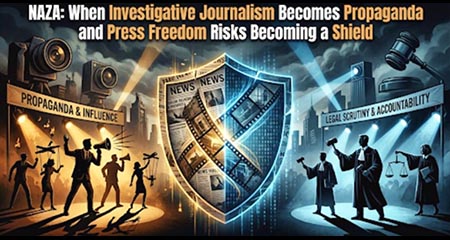
When Investigative Journalism Becomes Propaganda and Press Freedom Risks Becoming a Shield
A documentary is not a court ruling, a testimony is not definitive proof, and freedom of information cannot turn into preemptive immunity.
If confidential information has been disclosed, any resulting liability must be established. Without prejudice, but without no-go zones
The most effective propaganda does not necessarily invent things. It selects.
A documentary can contain authentic testimonies, real images, and statements that were actually made, and yet construct a profoundly one-sided representation of reality.
There is no need to falsify every element: it may be enough to select certain voices, give prominence to some facts, omit others, and organize the narrative in such a way as to steer viewers toward a predetermined conclusion.
This is precisely where we need to examine Naza.
The question is not whether a documentary may criticize Israel: of course it may. Nor is it a matter of arguing that every testimony originating from military or intelligence circles must be considered unreliable. That would be a mirror-image error of the very kind one seeks to denounce.
The question is different: what picture of reality is being constructed, through which testimonies, with what omissions, and with what political outcome?
If the final product ends up fueling a narrative that serves the propaganda of Hamas and its supporters, that effect deserves to be discussed openly. Not because every criticism of Israel is propaganda, but because political criticism, to be credible, must confront the facts in their entirety, not merely those that support the desired conclusion.
It is not enough for testimonies to be compelling. They must be verified, placed in context, and compared with independent evidence. Showing one part of reality is not enough to claim to have told the whole story.
Propaganda is recognized not only by the falsehoods it spreads, but also by the partial truths it turns into a misleading overall picture.
Propaganda, moreover, does not always need to invent a lie: it may be enough to repeat an accusation, circulate it through multiple channels, and allow its continued dissemination to give it the appearance of truth in the eyes of the public.
A statement commonly attributed to Goebbels summarizes this mechanism, although its exact historical wording has not been established with certainty: a lie repeated many times can eventually come to be believed as true.
This is precisely where an essential distinction must be made: the dissemination of an accusation is not the same as its verification, just as the repetition of the same testimony by multiple parties does not necessarily constitute multiple independent corroborations.
If a documentary makes serious allegations, the question is not merely how many people will repeat them, but what evidence supports them, what independent verification has been carried out, and what information the public can actually examine.
Otherwise, the risk is that the power of the narrative will take the place of the strength of the evidence.
It is on this basis that Naza must be judged: not according to the intentions attributed to its authors, which would have to be demonstrated, but according to the content, narrative choices, omissions, and conclusions the documentary invites the public to draw, without having considered the possibility that someone may have requested to see the objective evidence supporting the thesis being conveyed.
Testimonies Are Not a Verdict
The documentary collects anonymous testimonies from military personnel and people connected to Israeli intelligence about operations in Gaza.
These are statements that deserve to be examined, but their significance does not eliminate the need to verify their content, context, and scope.
Anonymity may be justified by the need to protect sources, but it makes it all the more important to be able to verify the interviewees’ roles, their direct knowledge of the events, and the reliability of the information they provide.
A distinction must be made between those who directly participated in an operational decision, those who worked in a preliminary intelligence-gathering or analysis phase, and those reporting information they learned from others. These are not equivalent positions, and they do not automatically support the same conclusions.
The same applies to the most serious allegations. A testimony can raise serious questions and justify further investigation, but on its own it is not enough to prove every conclusion the documentary suggests to viewers.
The Israeli military has publicly challenged the film, arguing that the testimonies are partial, that some interviewees may not have knowledge of the entire process for authorizing strikes, and that the editing omits essential elements.
These objections must be examined, just as the documentary’s testimonies must be examined. The IDF’s response does not automatically prove that the film is false, but neither can it be dismissed out of hand.
The standard must be the same for everyone: verify the facts, compare accounts, and distinguish what is documented from what is merely alleged.
If Naza constructs a misleading representation of Israeli operations, this must be demonstrated through specific examples: uncorroborated testimonies, passages taken out of context, significant omissions, or conclusions that the available material does not support.
A concrete example concerns the claim that a strike was authorized with approximately 500 civilian casualties anticipated. As The Times of Israel has noted, the documentary reportedly does not provide sufficient evidence to independently verify this specific claim, which rests on the testimony of one interviewee.
The IDF has rejected the account, stating that it has never planned, authorized, or carried out a strike in which a number of civilian casualties equal to or close to 500 was anticipated.
The military’s denial does not settle the matter, but neither can the testimony be treated as conclusive proof. The incident would need to be identified, the relevant documentation verified, and the decision-making process reconstructed.
Above all, it is necessary to distinguish between the statement of a single source, proof that a particular decision was actually made, and proof that such a decision represented a systematic practice.
It is precisely at this point that an investigation risks turning an unverified claim into a general conclusion. If the available material does not establish all these steps, the problem is not necessarily that the testimony is false, but that there is a disproportion between what it demonstrates and what the narrative claims to conclude.
If, on the other hand, some testimonies document unlawful conduct, those facts must not be ignored because they are inconvenient for Israel.
The credibility of an investigation does not depend on the severity of the accusations it makes, but on the quality of the evidence supporting them.
Military Personnel and Intelligence Services: Confidentiality Is Not a Minor Matter
There is also a separate issue that cannot be dismissed with a generic appeal to press freedom.
If, as reported, the documentary uses information provided by Israeli military personnel or intelligence service members, it is legitimate to ask whether information subject to confidentiality obligations was disclosed, whether any authorizations were required, and whether those obligations were respected.
Based solely on participation in a documentary, we do not know whether any violations were committed. It would be wrong to reach a conclusion without knowing the nature of the information, the applicable obligations, and the circumstances of its disclosure.
But that is precisely why the issue deserves serious examination.
What information was disclosed? Was it already public? Was it classified or otherwise protected? Was the person who disclosed it authorized to do so? Which laws applied? And what concrete evidence makes it possible to establish whether a violation occurred?
These are precise questions, not insinuations. They do not become illegitimate simply because they concern a journalistic work.
Press freedom is a fundamental guarantee. It protects the right to seek information, criticize those in power, and make matters of public interest known. But it does not, in itself, constitute an unrestricted authorization to disclose any information under any circumstances.
The position of journalists must be distinguished from that of their sources, the specific protections that apply must be assessed, and any individual liability must be examined. This requires expertise and evidence, not slogans.
Freedom of information deserves to be defended precisely because it is a freedom protected by law, not a privilege exempt from all scrutiny.
What Israeli Law Provides
The issue is not merely political. Israeli law contains provisions that may be relevant when confidential information is disclosed or when conduct is intended to assist an enemy during wartime.
Article 113 of the Israeli Penal Code addresses specific offenses involving secret information and its unauthorized transmission. Whether the provision applies depends on the specific offense, the nature of the information, the manner of disclosure, and the subjective elements required by law.
Article 99, by contrast, concerns assisting the enemy in wartime. It provides for the death penalty or life imprisonment for anyone who, with the intention of assisting the enemy in its war against Israel, commits an act capable of providing such assistance.
The provision includes transmitting information with the intention that it reach the enemy or with the knowledge that it may reach the enemy.
This is a serious provision, but it cannot be interpreted as an automatic formula applicable to anyone who communicates information to a journalist. The elements required by law must be established, and the specific circumstances must be assessed.
The distinction is fundamental: a possible breach of confidentiality obligations is not automatically equivalent to assisting the enemy; an unauthorized disclosure does not, by itself, demonstrate an intention to help an adversary; and publishing an uncomfortable investigation does not, in itself, constitute a crime.
These distinctions do not undermine the legitimacy of inquiries. On the contrary, they indicate exactly what must be verified.
If concrete evidence suggests the unlawful disclosure of classified information, the competent authorities may examine it in accordance with the applicable procedures. If the evidence is insufficient, suspicion cannot lawfully be turned into a conviction.
This is not about confusing a testimony with treason, nor about invoking national security to silence all criticism. It is about recognizing that, in a state governed by the rule of law, even the most sensitive issues must be addressed on the basis of laws and evidence.
This is all the more important in a contemporary conflict, in which cognitive warfare – the competition to influence perceptions, interpretations, and decisions – represents an increasingly significant strategic dimension.
Information does not merely serve to tell the story of a war: it can also help shape public perceptions of it and, through those perceptions, its political consequences.
Neither immunity in the name of journalism nor guilt in the name of national security.
The Boundary Between Criticism, Unlawful Disclosure, and Criminal Liability
There is one point that must be addressed unambiguously: calling for scrutiny does not mean calling for convictions in advance.
The possible disclosure of confidential information may have different consequences depending on the nature of the data, the status of the person involved, the applicable laws, any existing authorizations, and the specific circumstances.
Not every breach of a confidentiality obligation automatically constitutes a serious crime, and not every controversial act can be equated with assisting the enemy.
If particularly serious criminal offenses are being alleged, it is necessary to identify the elements required by law and determine whether concrete facts exist that could satisfy them. The wartime context may be legally relevant, but it does not replace proof.
This does not weaken the criticism. It makes it more serious.
If evidence exists that justifies an investigation, it must be examined by the competent authorities. If no such evidence exists, the evidentiary gap cannot be filled by invoking the gravity of the historical moment or political disapproval of the documentary’s outcome.
But the reverse is also true: the prominence of a work, its claimed journalistic value, or its presentation as an exposé in the public interest cannot, on their own, render any potentially unlawful conduct irrelevant.
The principle must be the same for everyone: press freedom is not absolute immunity, just as national security must not become a justification for suppressing criticism.
If one wishes to argue that Naza raises issues warranting judicial examination, one must identify the facts that justify such scrutiny and allow any liability to be established in accordance with the law.
This is the difference between a reasoned allegation and an accusation made without evidence.
Israel Is a Democracy. And for That Very Reason, It Must Have No No-Go Zones
Israel’s democratic character must not be invoked only when convenient.
Israel is a democracy with institutions, courts, laws, and legal safeguards. This does not mean that every decision it makes is right, that its conduct is immune from criticism, or that all its institutions always act correctly.
Rather, it means that disputes must be addressed through legal and institutional mechanisms, by examining the facts and respecting safeguards.
If a person has broken the law, that person must be held accountable under the applicable rules. If the law has not been broken, that person must not be prosecuted merely because their statements are uncomfortable or politically damaging.
But democracy does not require abandoning all scrutiny when national security, the confidentiality of information, or the responsibilities of people in sensitive positions are at stake.
On the contrary, a democratic state demonstrates its strength when it can reconcile two requirements: protecting fundamental freedoms and establishing, through legitimate procedures, whether the law has been violated.
Press freedom is not a license for impunity. National security is not a license for repression. Both become dangerous when turned into absolute principles exempt from all oversight.
That is why, in the case of Naza, the choice between defending the documentary unconditionally and treating it as guilty in advance is a false one. It is possible to recognize the right to make it while also demanding that any potentially unlawful conduct be examined.
A democracy is not measured by how much criticism it tolerates only when that criticism is harmless, but by its ability to apply the law even when the stakes are politically explosive.
Comparing Israel With Repressive Regimes Is Not an Acquittal of Israel
There is another difference that should not be overlooked: the context in which a person exercises freedom of expression.
In Iran, as in the territories governed by Hamas in Gaza, dissent and freedom of expression can be exposed to severe forms of repression.
Criticizing those in power, denouncing abuses, or disseminating unwelcome information can carry risks that are not comparable to those found in a democracy with judicial institutions and formal legal safeguards.
In authoritarian contexts, certain acts considered politically hostile may be punished with extremely harsh penalties, including capital punishment for specific offenses.
The consequences nevertheless depend on the applicable laws and the circumstances: it would be inappropriate to claim that conduct similar to that alleged in the NAZA case would necessarily carry the death penalty in Iran or Gaza.
This comparison must not become an excuse for Israel. A democracy is not exempt from mistakes, abuses, or violations merely because worse regimes exist.
But the comparison remains useful as a reminder that freedoms are not an ornamental detail: they constitute a substantial difference between political systems.
The point, therefore, is not to argue that Israel is always right. It is to insist that judgments about Israel be based on facts, laws, and individual responsibility, rather than on an ideological representation that flattens every distinction between a democracy and a repressive regime.
If the right to criticize Israel is defended, the right to question the reliability of accusations against Israel must also be defended. Freedom of expression protects both positions. It does not guarantee that either one is right.
Responsibility Is Individual. And Evidence Comes Before Conclusions
A documentary, however persuasive, cannot be used as a shortcut to reach an overall verdict on a state, an army, or a society.
Where responsibility exists, it is individual and must be proven. The conduct of institutions must be examined on the basis of specific facts. Testimonies must be assessed in light of their context, any independent corroboration, and any evidence that might contradict them.
This standard applies to Israel and to those who accuse it. It applies to those who report alleged abuses and to those who argue that such reports are instrumentalized. It applies to investigative journalism and to criticism of investigative journalism.
If Naza presents credible testimonies and documents verifiable facts, those facts deserve to be examined, even when they are inconvenient for Israel.
If, instead, it selects evidence in a way that produces a distorted representation, its methods and political outcome may legitimately be challenged.
And if concrete evidence emerges of possible violations of the law, it is legitimate to ask that the competent authorities assess it.
There is no contradiction between these positions. On the contrary, there is one consistent standard: do not confuse narrative with proof, suspicion with established liability, or political criticism with a judicial ruling.
The Right to Inform Is Not the Right to Be Believed Without Verification
The deeper problem with Naza concerns not only the documentary’s content. It concerns the way the public consumes political narratives today.
An audiovisual work can appear convincing because it arranges images effectively, presents emotionally powerful testimonies, and guides viewers toward a conclusion. But narrative force is not the same as evidentiary strength. Emotion can attract attention; it cannot replace verification.
For this reason, the documentary must be subjected to the same critical examination that would apply to any other source: who is speaking, what facts do they know firsthand, what has been omitted, what independent evidence corroborates the account, and which conclusions are actually justified by the material presented?
If the result helps reinforce a narrative that serves Hamas, this must be stated and argued. Simply applying the label “propaganda” is not enough to shut down the discussion, just as invoking the label “journalism” is not enough to make the discussion impossible.
Journalism does not lose its value because it is criticized. It loses its value when it claims to be beyond criticism. And criticism does not acquire value merely by being aggressive: it must be documented, consistent, and willing to distinguish what it knows from what it suspects.
This is the point on which there should be no retreat.
Conclusion: Freedom Is Not Impunity, and Criticism Is Not a Conviction
Naza can be discussed, challenged, and subjected to rigorous scrutiny without this constituting a denial of press freedom. Its testimonies must be assessed according to what they demonstrate; its representation of reality must be judged by what it includes and what it excludes; and any violations of the law must be established on the basis of facts and applicable legal provisions.
If sufficient evidence does not emerge, suspicion cannot be turned into an accusation. If concrete evidence does emerge, the work’s journalistic value cannot be invoked to prevent all scrutiny.
This is not a position against freedom of information. It is a position in favor of a freedom that does not need privileges in order to be defended.
Israel must be open to criticism. But criticism must be subject to verification, like any other public claim. Those who make allegations must provide evidence supporting their conclusions; those who challenge an allegation must do the same.
And anyone suspected of violating the law must be entitled to the safeguards provided by the legal system.
What is at stake is not choosing between Israel and journalism, or between security and freedom. It is preventing words from taking the place of evidence and political convictions from becoming verdicts handed down in advance.
A democracy does not defend itself by abandoning freedom. But neither does it defend itself by abandoning the law. It defends itself by applying the law, without privileges, without revenge, and without fear of verifying the facts.