

Globalization and the Transformation of Europe’s Productive Base
One of the least explored aspects of the debate on the crisis in European pension systems concerns the transformation of the economic structure upon which those systems were built.
Attention is typically focused on the effects of demographic aging and the gradual increase in the ratio of retirees to active workers.
While this factor is certainly central, it risks overshadowing an equally important transformation: in recent decades, the economic foundation from which income, employment, and the ability to pay contributions derive has changed profoundly.
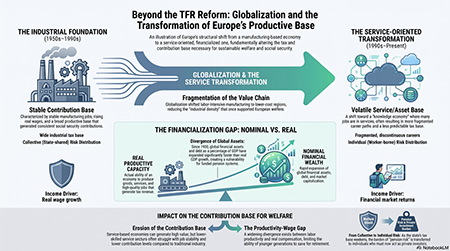
Post-World War II European pension systems emerged in an economic context characterized by strong industrial expansion. The growth of manufacturing, rising productivity, the spread of stable salaried employment, and rising real wages formed, for decades, the economic foundation upon which the European welfare state was built.
The relationship was relatively simple: a broad productive base generated stable employment; employment generated social security contributions; and the public system redistributed these resources across the different stages of life.
Over the past forty years, this balance has been progressively altered by globalization.
The growing integration of global markets has produced significant economic benefits: greater production efficiency, access to new markets, lower costs for many consumer goods, and an acceleration of international trade.
However, this same process has profoundly altered the geographic distribution of production and the relative roles of different economic sectors within advanced economies.
A significant portion of traditional manufacturing activities has been progressively shifted to regions of the world characterized by lower production costs, greater availability of labor, and competitive conditions that differ from those in Europe.
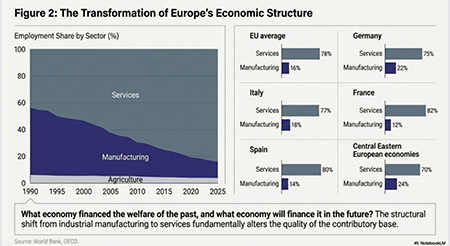
This phenomenon has not merely led to a quantitative reduction in industrial production but has altered the overall structure of the European economy.
Many countries have gradually increased the share of the service sector, transforming from predominantly industrial economies to economies increasingly based on services.
This change is not necessarily a negative development. Advanced economies have always undergone sectoral transformations, and the shift toward activities with a higher content of knowledge, technology, and services can represent a natural evolution of economic development.
The critical issue, however, concerns the quality and revenue-generating capacity of the new model.
A complex social security system depends not only on the amount of wealth produced, but on the economy’s ability to generate stable incomes, skilled employment, and a sufficiently solid tax base.
The shift from an industrial economy to one more service-oriented has therefore raised a fundamental question: Is the new economic model capable of producing a tax base equivalent to the one that supported European welfare in the previous phase?
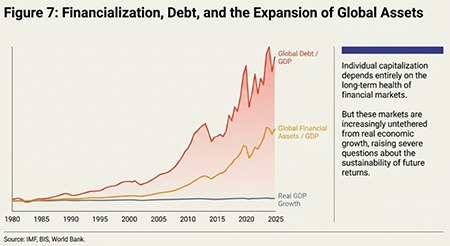
The issue becomes even more significant when we consider the growing gap between the real economy and the financial economy.
In recent decades, the growth of financial markets has taken on an increasingly central role in the global economy. The proliferation of financial instruments, the rise in asset capitalization, and the growing role of finance in resource allocation have created significant opportunities, but they have also introduced new vulnerabilities.
When the growth of financial assets outpaces that of the real economy, a potential imbalance emerges between nominal wealth and actual productive capacity.
A pension system based on individual capitalization is inevitably at the center of this dynamic. Pension funds invest in financial markets and participate in the growth of global assets.
This mechanism can create value over the long term, but it presupposes the existence of a sufficiently stable relationship between financial development and real economic growth.
The question that arises, therefore, is not whether finance is useful. Finance is an essential component of modern economies. The question is whether a growing dependence of workers’ future security on the performance of financial assets can be assessed without considering the transformation of the economic system that underpins those assets.
Economic history shows, in fact, that financial growth is not independent of the productive context. Markets can experience long periods of expansion when supported by economic growth, innovation, rising productivity, and favorable demographic conditions.
But they can also enter phases of high vulnerability when the relationship between financial valuations and the real capacity to generate income becomes unbalanced.
This factor takes on particular importance in the case of retirement savings.
A young worker who joins a pension fund today is not simply investing in an abstract market.
They are entrusting part of their future security to the global economy’s ability to continue generating growth and returns for several decades.
The issue, therefore, is not just about the expected return on investments.
It concerns the context in which those returns will need to be generated.
The decline in the central role of manufacturing and the problem of the contribution base
The transformation of European production has also had an impact on the relationship between work, income, and the financing of the welfare system.
Manufacturing has historically played a role that went beyond the mere production of goods. For decades, large industrial systems have been sources of stable employment, vocational training, wage growth, and social mobility.
The gradual decline in the relative importance of industry does not mean that Europe has completely lost its productive capacity. The continent still has highly competitive sectors and leading companies in numerous industries.
However, the overall structure of the economy has become more dependent on activities in which the relationship between growth, stable employment, and income distribution may differ.
An economy based more heavily on services can certainly generate significant added value, especially in highly skilled sectors. But not all services generate the same level of productivity, job stability, and tax revenue.
In fact, there is a significant difference between advanced, high-value-added services and activities characterized by low productivity, intense cost competition, and greater job insecurity.
This distinction is fundamental because the sustainability of social security does not depend simply on the number of people employed, but on the economic quality of the jobs created.
A system may have a large number of employed workers but still face difficulties if those workers have insufficient incomes, discontinuous careers, or a reduced ability to make contributions.
And this is precisely the direct link between productive transformation and supplemental pensions.
The growing expectation that citizens will independently build part of their own retirement future presupposes, in fact, that there is a widespread capacity to save. But the ability to save stems first and foremost from the economic structure that generates income.
It cannot be created simply through financial instruments.
If economic transformation reduces job stability and curtails wage growth, the pension problem cannot be solved solely through greater participation in financial markets.
Before even asking where to invest pension capital, we must ask what kind of economy will be capable of producing that capital.
The New European Demand
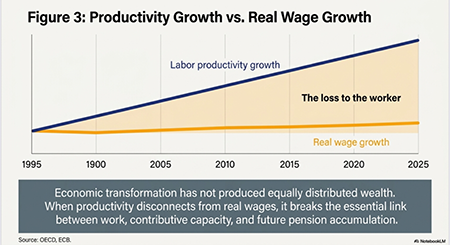
The issue of European social security thus takes on a broader dimension. The problem is not only the aging population, but also the transformation of the economic model that had made it possible to finance the welfare system through decades of industrial growth, increased productivity, and an expanding labor force.
Supplementary pension plans can offer a partial and useful solution, but they cannot replace an economic policy capable of generating stable jobs, adequate wages, and sustainable growth.
Otherwise, there is a risk of addressing a structural problem with a predominantly financial solution, and this is precisely where the connection lies with the second critical element: the quality of the jobs generated by the new economic model.
Because even if financial markets were able to offer adequate returns over the long term, a fundamental question would remain: “How many people will actually have the financial means to accumulate enough savings to benefit from those returns?”
The answer inevitably leads to the next issue:
the transformation of the European labor market, pressure on wages, and the ability of younger generations to build individual retirement security.
Selected Bibliography and Data Sources
Italian Pension Reform and the TFR Debate
Silverio Allocca, “TFR 2026: previdenza del futuro o trasferimento del rischio sui giovani?”, Nuovo Giornale Nazionale, 2026
Istituto Nazionale della Previdenza Sociale (INPS), Rapporti annuali e Relazioni programmatiche, various years.
Commissione di Vigilanza sui Fondi Pensione (COVIP), Relazione annuale sulla previdenza complementare, various editions.
Fornero, E., Economic-ideological foundations of pension reforms, in international pension reform literature, various contributions.
Velo, D., Palladino, G., I fondi pensione verso il 2000: il problema previdenza in otto paesi industrializzati, Il Sole 24 Ore, Milano, 1987.
Articoli stampa sul dibattito previdenziale italiano 2010–2013 (Corriere della Sera, Il Sole 24 Ore, La Repubblica, altri quotidiani economici nazionali).