

The Artificial Intelligence Revolution and the Transformation of Work
The third major transformation set to profoundly impact the future of European social security systems concerns technology – and, in particular, the artificial intelligence revolution.
While globalization has altered the structure of production and the transformation of the labor market has affected the ability of younger generations to accumulate savings, artificial intelligence raises an even more radical question: what will be the employment base upon which the economic and social security systems of the coming decades will be built?
The debate on artificial intelligence often focuses on the most immediate aspects: increased productivity, automation of repetitive tasks, improved business efficiency, and the potential to create new economic sectors.
These factors are real and represent potential opportunities for development.
However, a comprehensive assessment of the consequences of artificial intelligence cannot be limited to the expected positive effects on productivity.
In fact, every major technological transformation also alters income distribution, the structure of employment, and the relationship between capital and labor.
And it is precisely this dimension that takes on particular significance when analyzing the future of social security.
Pension systems – whether public or supplemental – ultimately depend on the economy’s ability to generate income. Behind every pension contribution there is a worker; behind every wage there is productive activity; behind every welfare system there is an economic foundation capable of supporting the transfer of resources across generations.
If the nature of work changes profoundly, the pension model must also be evaluated in light of this transformation.
Previous industrial revolutions followed a relatively recognizable pattern: certain professions were replaced or transformed, but at the same time new sectors emerged capable of absorbing the workforce and creating new employment opportunities.
The mechanization of agriculture, industrialization, and subsequently the digital revolution have transformed the labor market, but these changes were accompanied by the emergence of new economic activities.
The artificial intelligence revolution, however, has potentially different characteristics because it does not concern only manual or operational tasks.
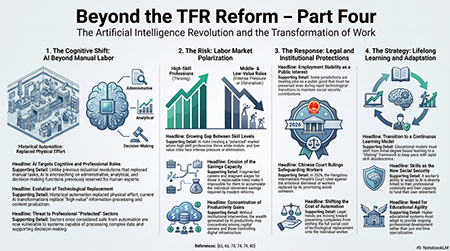
For the first time, a technological transformation is also significantly affecting cognitive, analytical, administrative, and professional functions.
Sectors that for decades have been considered relatively protected from technological replacement could be progressively transformed by the use of systems capable of processing information, producing content, analyzing data, and supporting complex decision-making processes.
The risk is not necessarily that of a simple elimination of human labor.
A more realistic outlook is that of a profound redefinition of the labor market, in which some professions will be enhanced by technology, others will be scaled back, and new jobs will emerge based on the skills required by the new productive environment.
The central issue will therefore be the distribution of the effects of this transformation.
The productivity gains generated by artificial intelligence could represent an enormous economic benefit. But productivity, on its own, does not automatically guarantee a balanced distribution of wealth.
The impact on social security will depend less on the technology itself and more on the economic distribution of its benefits.
Economic history shows, in fact, that productivity gains produce socially positive effects when accompanied by institutions capable of distributing the benefits through wages, employment, and investments in training.
In the absence of these mechanisms, there is a risk that a growing share of the value generated by technology will be concentrated among those who control capital, digital infrastructure, and intellectual property.
This factor is particularly relevant for social security.
A system in which workers are asked to independently build an increasing portion of their own future security through financial instruments requires a broad, stable, and sufficiently well-paid workforce.
But if technological transformation were to lead to greater polarization in the labor market – with the best opportunities concentrated in highly skilled professions and increasing pressure on medium – and low-value-added activities – households’ ability to save could become even more unequal.
The Risk of Economic Polarization
One of the most debated effects of artificial intelligence concerns the potential polarization of the labor market.
On the one hand, highly skilled professions could emerge, characterized by high productivity, the ability to use advanced tools, and strong complementarity with technology.
On the other hand, difficulties could increase for those workers whose skills are more easily replaceable or less valued in the new production context.
This dynamic would have consequences not only for employment but also for social security.
A system based on individual capitalization tends to reward income continuity and the ability to accumulate savings over time. Those with higher wages and more stable career paths have a better chance of building a significant supplemental pension.
Conversely, those who experience periods of unemployment, intermittent work, or insufficient income risk accumulating less capital at the very moment when the system demands greater autonomy from them.
This could therefore create a contradiction: the people most exposed to technological transformation might also be those with the least opportunity to build individual pension protection.
This does not mean that artificial intelligence will necessarily lead to social decline.
Technology is not an inevitable fate. Its impact will depend on the economic, educational, and institutional choices that are made.
Also significant in this regard is the recent trend in Chinese case law regarding labor relations.
In 2026, several Chinese court rulings highlighted a trend aimed at limiting companies’ ability to unilaterally shift the costs of technological replacement onto workers.
In particular, the Hangzhou Intermediate People’s Court upheld the illegality of the dismissal of a worker whose role had been gradually replaced by artificial intelligence.
This approach is part of a broader strategy by Chinese authorities aimed at promoting the adoption of artificial intelligence while safeguarding employment stability and social cohesion.
The difference extends beyond the regulation of artificial intelligence alone; it reflects two distinct conceptions of the relationship between technological innovation and social cohesion.
While the prevailing view in major Western economies is that the labor market must adapt to technological transformation through reskilling, continuing education, and labor mobility, the position taken by Chinese authorities appears instead to place greater emphasis on employment stability as a public interest to be preserved, at least during the transition to an economy increasingly characterized by the use of artificial intelligence.
This difference in approach could also have significant implications for social security, since the way in which major economies manage the employment effects of automation will directly influence the future contribution capacity of pension systems.
The real question, therefore, is not whether artificial intelligence will destroy jobs.
The question is what kind of jobs will emerge, how the benefits of technological productivity will be distributed, and what tools will be created to support this transformation.
Training, Human Capital, and the Future of Social Security
A key factor will be the ability of European education systems to adapt to the new technological era.
Many educational models are still structured according to principles from the previous industrial era: initial acquisition of skills, entry into the labor market, and gradual specialization through experience.
The new context, however, calls for a model based on continuous learning.
The rapid pace of technological change makes the value of skills acquired early in one’s career less stable and increases the need for ongoing professional development.
This aspect is directly linked to the issue of social security.
A worker who manages to adapt to technological transformation can maintain greater professional continuity and earning capacity.
A worker excluded from new production processes, on the other hand, risks greater economic vulnerability, with consequences for their ability to make social security contributions and to accumulate savings.
Pension security for the future, therefore, cannot be separated from labor policy and education policy.
Asking young people to invest in their own future without questioning the quality of the economic opportunities that will be available to them means addressing only part of the problem.
The issue of social security thus becomes inseparable from the question of the future of the world of work.
A New Challenge for the European Model
Globalization, the transformation of work, and artificial intelligence are three distinct yet deeply interconnected processes.
Globalization has reduced the relative importance of traditional industrial production and altered global economic chains.
The transformation of the labor market has made careers more fragmented and made it more difficult for younger generations to save.
Artificial intelligence could further accelerate this transformation, altering the relationship between capital, technology, and human labor.
In this scenario, the issue of social security takes on a much broader significance than simply choosing between a public pension and a supplemental pension plan.
The real question concerns the kind of economy Europe wants to build in the coming decades.
Because a pension system may be financially sophisticated, may use advanced investment tools, and may benefit from global markets, but at its core, it always requires the same fundamental condition:
a society capable of generating income, skilled labor, and the ability to pay contributions.
Supplementary pension plans may represent an important component of the future, but they cannot be considered a standalone solution in the face of the profound transformations that are reshaping the European economic system.
The ultimate question, therefore, is not merely: “How will young people invest for their retirement?”
The most important question is: “What kind of labor market are we building so that these young people can truly accumulate the resources necessary for their future?”
Selected Bibliography and Data Sources
Globalization, Productivity and Financialization
World Bank, World Development Indicators.
Bank for International Settlements (BIS), Annual Economic Reports.
European Central Bank (ECB), Financial Stability Review.
Reinhart, C. M., Rogoff, K. S., This Time Is Different: Eight Centuries of Financial Folly, Princeton University Press, 2009.
Minsky, H. P., Stabilizing an Unstable Economy, Yale University Press, 1986.