

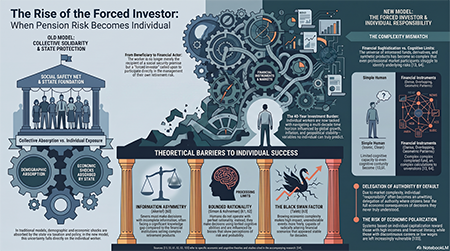
The Shift in Risk: From Intergenerational Solidarity to Individual Responsibility
The central issue that emerges from the preceding analysis does not concern only the functioning of pension funds or the ability of financial markets to generate returns over the long term.
It concerns a more profound shift in the way European societies are addressing the issue of future economic security.
For decades, the European social security model has been built around a fundamental principle: the collective sharing of risk.
Public pensions were not merely an economic transfer between working people and retirees. It was one of the tools through which society redistributed the effects of economic, demographic, and social changes over time.
This model was not without its problems. The pressures of an aging population, declining birth rates, and rising life expectancy have made it clear that major adjustments are needed. No social security system can remain unchanged when the conditions upon which it was built change radically.
However, the response adopted by many advanced economies introduces a fundamental transformation: an increasing share of the risk is transferred from the collective system to the individual.
The Italian reform of severance pay (TFR) represents a particularly significant example of this broader European trend.
The point is not to determine whether this shift is positive or negative in absolute terms. Supplementary pension plans can be a useful tool and, in certain contexts, can improve citizens’ ability to supplement their public pension benefits.
The most important issue, however, concerns the nature of the change.
When an increasing share of future security is entrusted to the individual’s ability to save and invest, the relationship between the citizen and the economic system also changes.
The worker is no longer merely a contributor within a collective mechanism.
They gradually become an investor, called upon to understand complex financial instruments, evaluate long-term scenarios, choose risk levels, and directly bear the consequences of their own decisions.
This transition requires a much broader reflection on the distribution of knowledge and decision-making capacity within society.
Individual Responsibility and Information Asymmetry
One of the guiding principles of the new social security framework is to empower workers.
Empowering citizens is certainly a laudable goal.
A modern society cannot ignore the importance of financial literacy and individual participation in economic decisions.
However, responsibility and risk are not the same thing.
Responsibility presupposes the ability to make a truly informed choice among known alternatives.
Risk, on the other hand, can be transferred even when the individual involved does not fully possess the tools to understand it.
This distinction becomes central in the context of social security.
A young worker entering the labor market today faces decisions that span a forty-year time horizon.
They must evaluate financial instruments, investment strategies, the relationship between risk and return, the effects of inflation, and possible future economic scenarios.
But can they realistically possess all the necessary skills to do so?
The issue goes beyond an individual’s level of financial literacy.
It concerns a clear asymmetry between the complexity of the decisions required and the average level of preparation of those called upon to make them.
A professional with an economics background, market knowledge, and higher earning potential does not face the same choices as a young worker in their first job, with limited income and still-uncertain career prospects.
Yet both are gradually being placed within the same framework: that of individual responsibility for building their own retirement future.
The Risk of Confusing a Tool with a Solution
One of the most important aspects of the debate concerns the difference between a tool and a solution.
Supplemental retirement planning is a tool.
It can be effective, it can yield benefits, and it can be a rational component of a personal financial strategy.
But it cannot automatically be transformed into a structural solution to problems that have much deeper demographic, economic, and social roots.
The evolution of the Italian debate offers a significant example of this distinction.
Discussions that emerged as early as the first few years of the 2010s often tended to portray the pension crisis as the risk of the public pension system disappearing.
Subsequent developments revealed a different and, in many respects, more complex scenario: the central issue was not the absence of a pension, but the gradual erosion of its ability to guarantee income levels comparable to those enjoyed by previous generations.
It is precisely this shift in perspective that makes it essential today to analyze not only social security instruments but also the economic and employment model on which their sustainability depends
If the problem stems from population aging, slowing economic growth, the transformation of the labor market, and pressure on public budgets, the solution cannot be limited to creating a system in which citizens invest a larger share of their resources in financial markets.
Because the financial market, too, ultimately depends on the health of the real economy.
Financial assets generate value because there are businesses, workers, consumers, innovation, and economic growth.
A pension system that shifts an increasing portion of future security to the markets must therefore also consider the economic conditions that will make that growth possible.
The question is not merely: “How much will these investments yield?”
The deeper question is: “What kind of economy will sustain those returns over the next forty years?”
A New Responsibility for Policymakers
If the European pension model is changing, the role of institutions must change as well.
It is not enough to simply encourage participation in pension funds. We need to establish a framework in which citizens are truly informed about the benefits and risks.
A responsible pension policy should present not only favorable scenarios but also adverse ones, and, above all, should explain that compound interest is a powerful mathematical tool, but that markets do not follow linear trajectories.
It should highlight not only the expected average return but also the possibility of prolonged periods of stagnation, high inflation, financial crises, and returns that fall short of expectations.
It should clarify that a pension fund is not equivalent to a public pension guarantee, but rather represents a financial investment with opportunities and risks.
A central element of Europe’s economic transformation concerns wage trends. The increase in nominal wages recorded in recent decades should not be confused with an equivalent increase in real purchasing power.
The key factor for pension sustainability is not merely the growth in the monetary amount received by workers, but the actual capacity of that income to support consumption, savings, and pension accumulation over time.
In many European economies, especially since the 1990s, real wage growth has slowed compared to previous periods, while the cost of certain essential goods – particularly housing, energy, and services – has placed an increasing burden on households’ disposable income.
Consequently, the future social security challenge does not concern solely the nominal level of wages, but rather the portion of income that remains effectively available to build long-term economic security.
This distinction is crucial because the future of social security for the younger generations cannot be built on implicit expectations.
Confidence in the markets is important, but confidence cannot replace analysis.
The final question: what kind of society are we building?
The Italian reform of severance pay thus serves as a vantage point for a broader European transformation.
It is not merely about the allocation of a portion of deferred compensation.
It concerns the gradual shift from a model based primarily on intergenerational solidarity to one in which an increasing portion of future security is entrusted to the individual’s ability to accumulate capital.
The evolution of the European debate shows how an issue initially perceived in Italy as specific to precarious workers has gradually emerged as a common theme across the social security systems of the major European economies.
The issue no longer concerns the financial sustainability of a single social security institution, but rather the ability of European economies to guarantee, in the face of demographic, productive, and technological transformations, adequate pension benefits for future generations.
In this sense, the problem has gradually shifted from the sustainability of pension systems to the broader economic and social sustainability of the European welfare model.
This transformation may be partly inevitable – though “inevitable” does not automatically mean without consequences.
The real question is not whether citizens should have greater financial literacy.
It is certainly necessary.
The real question is whether a society can ask young people to take on greater individual responsibility without simultaneously guaranteeing them sufficiently solid economic conditions to exercise that responsibility.
If work becomes more intermittent, if wages grow more slowly, if technological transformation increases uncertainty, and if the global economy enters a phase different from the past, then the pension issue cannot be addressed solely through financial instruments.
It requires a broader reflection on the European economic model because, ultimately, the fundamental problem is not where pension contributions will be invested, but rather what kind of society, economy, and labor market will be able to generate those contributions.
The real challenge of the coming decades will not be merely to guarantee financial returns.
It will be ensuring that there is still a sufficiently strong economic, social, and productive foundation upon which to build security for future generations.
Because the greatest risk isn’t necessarily relying on the markets. The greatest risk is thinking that a collective problem can be solved simply by breaking it down into a sum of individual responsibilities.
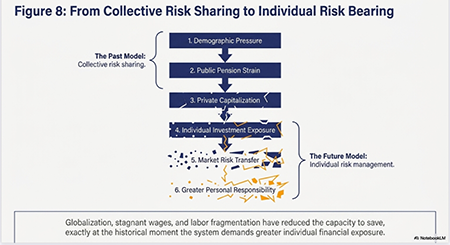
A responsible society does not eliminate risk, but recognizes it, distributes it fairly, and develops appropriate tools to address it.
And this is precisely the question that the European debate should address:
are we creating freer and more informed citizens, or are we simply shifting an increasing share of the uncertainties that the collective system can no longer manage onto them?
Selected Bibliography and Data Sources
Artificial Intelligence, Technology and the Future of Work
Organisation for Economic Co-operation and Development (OECD), OECD “Employment Outlook: Artificial Intelligence and the Labour Market”, recent editions.
International Labour Organization (ILO), reports on generative AI and employment transformation.
Brynjolfsson, E., McAfee, A., “The Second Machine Age”, W. W. Norton, 2014.
Acemoglu, D., Johnson, S., “Power and Progress: Our Thousand-Year Struggle Over Technology and Prosperity”, PublicAffairs, 2023.
Xinhua / China.org.cn, “Chinese court defends labor rights in new AI-replacement case”, 30 April 2026
China Daily, “Chinese courts rule AI-driven layoffs and pay cuts illegal”, 5 May 2026
The Guardian,”Chinese courts awards compensation to sacked worker replaced by AI”, 13 May 2026
Chen, Q., Ge., J., Xie, H., Xu, X., Yang, Y,. “Large Language Models at Work in China’s Labor Market”, 2023