

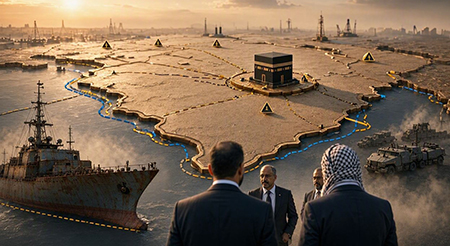
The Houthi Crisis Is Testing More Than a Military Guarantee. It Is Testing Who Will Shape the Middle East’s Next Security Architecture
Abstract
The Mecca Pact between Saudi Arabia, Pakistan, and Turkey, signed on August 7, 2026, has been interpreted primarily in light of the Houthis’ escalating attacks on Saudi territory and infrastructure, to the point of being described as a new security architecture that has already faced its first – and problematic – test.
This article offers an alternative interpretation. The central hypothesis is that the decisive issue is not the possible failure of the agreement, but its ability to evolve into an autonomous and progressively expandable regional security hub.
The sequence of events – from the signing of the agreement to the first meeting of the Strategic Committee in Istanbul, through the intensification of Houthi attacks and the caution shown by Pakistan -suggests that the real test concerns the relationship between the new architecture and existing security systems.
The analysis focuses in particular on the role of the United States, which, through CENTCOM, continues to serve as a key hub for Saudi intelligence and military coordination, and that of Israel, whose potential intelligence cooperation with Riyadh against the Houthi threat creates a significant disconnect between the Saudi position on the Palestinian issue and the concrete demands of its own national security.
At the same time, China’s behavior – characterized as much by its relations with Iran and channels of communication with the Houthis as by the pressure it exerts on Tehran, at Saudi Arabia’s request, to help limit attacks on the Kingdom’s energy infrastructure – appears difficult to attribute to a simple strategy of supporting destabilization.
Hence the broader hypothesis: Beijing may have an interest not in provoking the collapse of the Mecca Pact, but in preventing it from evolving into an autonomous regional architecture capable of bringing in additional states and reducing the Gulf’s dependence on major external powers.
This dynamic is potentially compatible – for different reasons – with the U.S. interest in preserving CENTCOM’s central role. The Middle Eastern conflict would thus emerge not as a simple confrontation between blocs, but as an overlapping competition between different security architectures.
The true indicator of the Mecca Pact’s success would therefore not be merely its survival, but its ability to determine who will be indispensable when the next security crisis strikes Riyadh
There is an interpretation of recent developments in the Middle East that risks being too simplistic to be truly useful.
According to this interpretation, the Mecca Pact has faced its first real test and is emerging from it weakened: Saudi Arabia is under increasing military pressure from the Houthis, Pakistan has not announced any immediate military intervention, Turkey has not translated the agreement into an operational response on the ground, and Riyadh has been forced to once again seek the support of existing security architectures, starting with the United States.
All true. But precisely for this reason, the conclusion might be wrong.
Because the point is not to determine whether the Mecca Pact has already proven to be a success or a failure. It’s too early to tell.
The strategically more interesting question is another: what is this crisis trying to prevent?
And above all: Who would have an interest in preventing the new Saudi-Pakistani-Turkish agreement from evolving, over time, into a genuine regional security hub independent of the major powers?
This is where the story becomes much more interesting than daily news reports suggest.
On August 7, Saudi Arabia, Pakistan, and Turkey signed the Makkah Joint Defense Agreement in Mecca. The wording is not merely symbolic: the agreement stipulates that an armed attack against any one of the three countries must be considered an attack against all three and provides for strengthened cooperation on defense matters.
It is not, therefore, merely a new diplomatic framework. It is an attempt to build a collective deterrent capability. And the choice of these three key players is no accident. Saudi Arabia brings financial resources, a strategic geographic location, energy infrastructure, and enormous political and religious influence in the Muslim world. Pakistan brings a large military structure, operational experience, missile and nuclear capabilities, and a deep strategic relationship with Beijing.
Turkey brings a large defense industry, technological capabilities, and a regional military presence that in recent years has gradually broken free from its traditional dependence on Western arms. Taken individually, the three countries belong to different strategic systems.
Together, they have the potential to build something different. And that is precisely the point: a new security hub does not necessarily have to be fully formed from the outset to be strategically significant. It is enough that it has the potential to become one.
The context in which the agreement is being signed is anything but coincidental. In the days leading up to the signing, Riyadh warned of the possibility of coordinated attacks from the north and south, involving Iraqi militias and the Houthis, posing a threat to energy infrastructure, ports, and airports.
A senior Saudi official reported at the time that the available intelligence also stemmed from cooperation with the United States and other regional countries. The attacks were therefore already part of the scenario when Erdoğan and Shehbaz Sharif arrived in Saudi Arabia. The Mecca Pact was born under pressure.
And in the weeks that followed, the pressure increased. The Houthis intensified their attacks on Saudi territory and energy infrastructure. The crisis then spread to the maritime domain, with the Houthis advancing along Yemen’s Red Sea coast and toward the Bab el-Mandeb area, one of the most critical chokepoints in the global energy and trade system. But there is one chronological detail that deserves attention.
On August 31, less than a month after the signing, the foreign and defense ministers and military leaders of the three countries met in Istanbul for the first meeting of the political-strategic and defense committee established under the new agreement.
And this was not merely a ceremonial meeting: the three governments decided to institutionalize their cooperation, establish a permanent secretariat in Saudi Arabia, strengthen industrial cooperation, develop joint technologies, and enhance the interoperability of their respective armed forces.
This is a crucial step, because it means the Pact has not remained merely a political declaration: it has begun to build a structure. And it was precisely after this institutionalization phase that the Houthi crisis gained new momentum.
However, we must be rigorous here. Based on currently available public information, there is no evidence that the Houthis have stepped up operations to deliberately undermine the Mecca Pact.
That would be a logical leap not supported by the evidence. But there is a timeline that cannot be ignored: August 7, signing of the Pact; August 31, formalization of the Pact in Istanbul; September 7–8, a new and much more serious Houthi escalation against Saudi territory and infrastructure; September 10, Islamabad clarifies that no immediate military response was discussed within the framework of the Pact.
This last point is particularly significant. Pakistan did not denounce the agreement, did not disavow it, and did not say it would not honor its commitments. It said something much more subtle: an immediate military response was not discussed; when the time comes, Islamabad will act in accordance with the agreement.
From a diplomatic standpoint, this is perfectly consistent with the text of the agreement. From the standpoint of deterrence, however, it raises a question: when exactly will that moment arrive?
Because a defense alliance becomes credible not only when it has solemn clauses, but when adversaries are convinced that those clauses automatically produce operational consequences. And it is precisely here that the Mecca Pact is facing its first test.
But it is precisely at this point that the interpretation of the crisis can change completely. The problem is not necessarily the failure of the Pact. It is its dependence. Let’s imagine for a moment that the Pact does not fail.
Let’s imagine that it remains formally intact, that Pakistan and Turkey continue to cooperate, that the p is established, and that joint industrial production and technological development increase.
But let’s also imagine that, every time a serious military crisis arises, Saudi Arabia has to return to Washington to obtain intelligence, targeting, missile defense, or operational coordination. In this scenario, the Pact survives. But it does not become autonomous.
And that is a fundamental difference. The real issue at stake, then, may not be the survival of the Mecca Pact, but rather its autonomy. An agreement can exist while simultaneously being unable to become the centerpiece of a new regional architecture.
It can stabilize without empowering. It can coordinate without replacing. It may even enhance the security of its members without becoming the new framework through which the Middle East organizes its own security.
This distinction also allows us to interpret the behavior of the major powers in a different light. The United States faces a seemingly paradoxical problem. On the one hand, it does not necessarily have an interest in seeing an agreement fail that enhances its partners’ ability to defend themselves.
On the other hand, it has a structural interest in preserving the centrality of the U.S. security architecture in the Gulf and the Middle East. The two are not necessarily incompatible. Washington can therefore accept – and even encourage – greater military capabilities on the part of Saudi Arabia, Pakistan, and Turkey, provided that these capabilities remain interoperable with the U.S. system and do not become an alternative to it.
Recent developments are highly telling. As the Houthi escalation reached a higher level, Riyadh sought U.S. military assistance. Washington offered intelligence and targeting assistance, while Saudi Crown Prince Mohammed bin Salman met with CENTCOM Commander Admiral Brad Cooper in Jeddah.
This is exactly the kind of behavior that allows a parallel architecture to exist without becoming an alternative. The Mecca Pact may grow. But when crisis strikes, CENTCOM remains in the room. And perhaps this is the true balance that Washington has an interest in preserving.
Then something even more interesting happens: Israel enters the picture. According to regional sources cited by the Jerusalem Post, Saudi Arabia and Israel have begun talks mediated by CENTCOM to provide Riyadh with intelligence assistance against the Houthis.
This news should be interpreted with extreme caution. It does not mean Saudi-Israeli normalization. It does not mean that Riyadh has abandoned the Palestinian cause. It does not mean that Saudi Arabia has suddenly turned Israel into a political ally.
It signifies something more limited – and, for that very reason, perhaps more significant: in the face of a concrete threat, Riyadh can utilize Israeli capabilities while maintaining a distinct political stance on the Palestinian issue.
It is a conceptual distinction that the Middle East has often struggled to maintain. And it is potentially disruptive. Because it introduces a rift in the binary narrative according to which any cooperation with Israel necessarily implies abandoning the Palestinian cause, while any opposition to Israel necessarily implies alignment with Iran or Hamas.
The reality is more complex. Saudi Arabia can support the prospect of a Palestinian state. It can challenge Israeli policies. It may not normalize diplomatic relations. And at the same time, it may consider Israeli capabilities useful against a threat from the Houthis. This is not a contradiction. It’s foreign policy.
And this is where the issue takes on an even deeper political dimension. It is incorrect to say that Riyadh has “abandoned Palestine”. That is not what its public positions indicate.
The real news is something else: Riyadh is showing that the Palestinian issue does not automatically dictate every other Saudi national security decision.
This makes it harder to maintain a political narrative in which Israel is portrayed as the absolute enemy, while Iran and Hamas are placed, directly or indirectly, in the same camp of “resistance”.
Saudi Arabia’s request for Israeli assistance against the Houthis does not erase the Israeli-Palestinian conflict. But it demonstrates that an Arab government can distinguish between its position on Palestine and its need to defend itself against a threat backed by Iran.
This conceptual distinction is enormous. And it could become even more important if other Arab states began to act in the same way. Not because they would suddenly become pro-Israeli, but because they would stop viewing their relationship with Israel as a variable that automatically determines all other strategic relationships.
And this is where Beijing comes in.
China is perhaps the most interesting player in this entire affair precisely because it is the one that is most difficult to fit into a binary framework.
Beijing maintains a strategic relationship with Iran, has enormous economic interests in the Gulf, depends on Middle Eastern oil, needs secure maritime routes, maintains channels of communication with the Houthis, and, above all, has no interest in seeing the Middle East plunge into an uncontrollable war that would simultaneously jeopardize the Strait of Hormuz and the Bab el-Mandeb Strait.
This is the point that allows us to move beyond the simplistic explanation that China “supports” the Houthis. The question is not whether Beijing wants a Houthi victory. The question is how much control and influence Beijing can exert over the crisis as a whole.
And this is where the most surprising element comes in. According to Reuters, following an appeal from Riyadh, China privately asked Tehran to help rein in the Houthis and prevent attacks on Saudi oil infrastructure from leading to further escalation.
Sources cited by the agency claim that Beijing is primarily concerned about the conflict spreading to the energy and trade routes on which it depends.
This information is crucial because it shows that Beijing is not simply viewing the crisis from an ideological standpoint. It is trying to manage it.
And this gives rise to a more ambitious hypothesis.
Perhaps Beijing does not want the Mecca Pact to fail. Perhaps it wants something more sophisticated: it may have an interest in preventing the Pact from becoming a fully autonomous regional security hub.
That’s not the same thing.
A collapsing pact would, in fact, also be a problem for Beijing. It would mean more instability, greater Saudi dependence on the United States, greater risk to energy routes, a higher likelihood of an uncontrolled regional conflict, more pressure on Iran, and potentially greater U.S. militarization of the Gulf. That’s not necessarily the ideal scenario for China.
On the contrary, a Pact that survives but remains limited could be much more manageable.
Because an agreement that stabilizes Saudi Arabia is useful.
An agreement that expands, gains independent credibility, integrates new military powers, and gradually becomes self-sufficient is another matter entirely.
It could, in fact, alter the very structure of the regional balance of power.
And this is where the scenario becomes interesting. An agreement can be stabilizing when it is limited; it can become strategically problematic when it begins to draw other states into its orbit.
The difference lies entirely in scale.
Let’s imagine a scenario in which the Mecca Pact works: Pakistan and Turkey develop integrated defense systems with Saudi Arabia; military industries collaborate; drones, anti-aircraft systems, missiles, radar, and joint intelligence capabilities are developed; other Gulf countries begin to consider joining; the model proves replicable.
At that point, we would no longer be dealing simply with Saudi Arabia, Pakistan, and Turkey. We would have the core of a regional Muslim security architecture capable of gradually attracting other actors.
And that is what would change the nature of the agreement.
It would no longer be a partnership.
It would become a hub.
And an autonomous hub would have consequences for everyone: for Washington, because it would reduce the need for American oversight; for Beijing, because it would limit the ability to manage relations with individual states bilaterally; for Tehran, because it would create a regional counterweight; for Israel, because it would alter the regional security landscape; for Russia, because it would further reduce Moscow’s freedom of maneuver in an area where it has sought to exploit the fragmentation of the balance of power.
However, this is a strategic hypothesis, not a proven fact. We have no evidence that Beijing has devised a plan to prevent the Pact’s expansion. But we have enough evidence to rationally consider this possibility. And this is precisely what distinguishes an analysis from mere reporting.
From this perspective, Pakistan represents the most sensitive issue. Islamabad is formally one of the three pillars of the new agreement, but at the same time it is bound to China by a deeply rooted strategic relationship, has enormous economic interests with Beijing, must maintain manageable relations with Iran, and cannot afford to turn Yemeni territory into a theater of direct war against Tehran.
Pakistan’s caution, therefore, should not automatically be interpreted as weakness or as a betrayal of the agreement. It could be a consequence of the very structure of Pakistan’s interests. But it is precisely this caution that creates a problem of perception.
If the other Gulf countries observe the first serious attack against Saudi Arabia and see that the Pact primarily results in consultations, while actual defense continues to depend on the United States and Western capabilities, they might ask themselves: why join a new security architecture if, at the decisive moment, the operational guarantor remains the same as before?
This is perhaps the most dangerous question for the Pact, and this not because it proves the Pact’s failure, but because it may limit its expansion.
And it is precisely expansion – even more so than survival – that determines the geopolitical value of a new alliance.
For this reason, the Istanbul meeting on August 31 deserves to be reexamined in light of what has happened since. The three countries decided to establish a Secretariat, strengthen industrial cooperation, and develop joint technologies.
They explicitly spoke of making collective deterrence more credible and effective. Then came the escalation. And immediately afterward came Pakistan’s clarification that there would be no immediate military response.
One could interpret this sequence in a straightforward way: the Pact was institutionalized and then failed to work.
But it can also be interpreted in a much more interesting way: the institutionalization of the Pact transformed a political declaration into a strategic project; the ensuing crisis then began to reveal just how independent that project truly was from pre-existing security structures.
This second interpretation is, in my view, much more useful, because it allows us to observe what normally escapes the news coverage: not only who attacks whom, but who is forced to turn to whom when things go wrong.
And it is often there that the true hierarchy of power becomes apparent.
At this point, the Middle East appears less as a system dominated by two blocs and more as a space in which at least three architectures overlap. The first is the emerging structure of the Mecca Pact: Saudi Arabia, Pakistan, and Turkey.
The second is that of U.S. security, with CENTCOM as the coordinating body and a network of relationships that includes Arab states, Israel, and Western partners.
The third is the much more fluid structure consisting of relations between China, Iran, and the armed groups linked to Tehran, within a network in which Beijing does not control the actors but possesses economic and diplomatic tools to exert influence.
These three architectural styles are not completely opposed to one another. On the contrary.
The most interesting fact is precisely that they overlap. Saudi Arabia can simultaneously be a member of the Mecca Pact, a privileged partner of Washington, an economic partner of China, and an indirect partner of Israel.
Pakistan can simultaneously be a pillar of the new pact, a strategic partner of China, and an interlocutor with Iran. Turkey can cooperate with the Gulf states while simultaneously pursuing an independent policy.
This is not confusion: it is the new geopolitics.
The contest, therefore, is not necessarily China versus the United States. Nor is it Israel versus Iran. It’s something more subtle: the competition to determine who will be indispensable when a regional crisis becomes a security crisis.
If Riyadh can resolve its own security through the Mecca Pact, then a new architecture emerges. If Riyadh must still turn to Washington, CENTCOM retains its central role.
If Beijing manages simultaneously to maintain influence over Tehran and prevent the crisis from disrupting energy routes, it retains its role as an external power capable of mediating without directly bearing the costs of security.
And if Israel becomes a source of technological and intelligence capabilities that can also be utilized by Arab states that have not normalized relations with it, the very nature of regional security will change.
This does not necessarily lead to an Israeli-Arab alliance.
Something more ambiguous emerges:
a functional cooperation that can exist even in the absence of full political reconciliation.
And here we come to the paradox.
The Houthi crisis could actually weaken the Mecca Pact.
But it could also have the opposite effect.
It could force the three countries to quickly transform a political agreement into a real military structure.
It could accelerate industrial integration. It could push Pakistan and Turkey to define more clearly what the collective defense clause actually means in practice.
It could push Riyadh to further diversify its sources of technology and intelligence. And it could even make the creation of a regional security system less dependent on a single guarantor all the more urgent.
In other words: the first stress test could be exactly what forces the Pact to become what its signatories have stated they want to build.
But there is also the opposite scenario.
If every major crisis brings Riyadh back to Washington, if effective protection continues to depend on CENTCOM, if Pakistan and Turkey remain cautious on the operational front, and if no other state considers it worthwhile to join, then the Pact may survive without becoming a true regional power center.
And that would be something very different from failure.
It would be a structural limitation.
The point, then, is no longer simply to ask whether the Mecca Pact is failing.
The right question is another:
Who has an interest in the Pact surviving without becoming autonomous?
And immediately after that:
who, on the other hand, would have an interest in transforming it into a true regional security system?
We don’t have all the answers yet. And it would be intellectually dishonest to pretend we do. But some clues are already visible. Washington is maintaining its operational centrality through CENTCOM and intelligence cooperation.
Riyadh is building the Mecca Pact but, at the same time, continues to use American and even Israeli channels to address the Houthi threat.
Islamabad formally reaffirms its commitment to the Pact but is avoiding an immediate military response for now. Finally, Beijing does not seem interested in unlimited destabilization: following the Saudi request, it has pressured Tehran to help rein in the Houthis, above all to prevent the crisis from disrupting the energy and trade routes on which China itself depends.
This last point is perhaps the most important of all.
Because it suggests that China does not need to choose between supporting and opposing the Mecca Pact.
It could seek a third path:
managing its scope.
Let it stabilize.
Prevent it from collapsing.
But, if possible, prevent it from becoming the core of a new regional architecture capable of bringing other countries together, reducing dependence on the United States, and limiting China’s ability to exert influence through bilateral relations.
If this hypothesis were correct, then the current crisis would take on a completely different meaning.
The Houthis would not merely be the military problem that is testing Saudi Arabia.
They would be – whether intentionally or not – the yardstick by which the true depth of a new security architecture is measured.
And the true winner of this contest would not necessarily be whoever defeats the Houthis.
It could be whoever manages to decide who will be indispensable the next time Riyadh is attacked.
That is a huge difference.
Because in geopolitics, alliances aren’t measured solely by what they promise when they’re signed.
They are measured by who is called upon when the first missile strikes
Methodological Note
This analysis deliberately distinguishes between documented facts, interpretations attributed to sources, and the author’s strategic hypotheses.
The chronology of events, the content of the Mecca Pact, its subsequent institutionalization, and the official statements of the governments involved are reconstructed based on primary sources and international news agencies.
The hypothesis that China may have an interest in containing the evolution of the Mecca Pact without causing its failure is not presented as an established fact nor as the existence of a coordinated strategy with other actors, but as a possible interpretation of strategic incentives and observable behaviors.
Similarly, Saudi-Israeli cooperation against the Houthi threat is distinguished from diplomatic normalization and is not interpreted as a departure from the Saudi position on the Palestinian issue.
Essential and Annotated Bibliography
Primary Sources
Government of Pakistan, Ministry of Foreign Affairs. Makkah Al-Mukarramah Summit for Joint Defence, August 7, 2026. https://mofa.gov.pk/news/makkah-al-mukarramah-summit-for-joint-defence?mission=ashgabat&utm_source=chatgpt.com
- Republic of Türkiye, Ministry of Foreign Affairs. Strategic Political and Defence Committee of the Makkah Agreement for Joint Defence – Joint Statement, August 31, 2026.
- Government of Pakistan, Ministry of Foreign Affairs. Makkah Al-Mukarramah Summit for Joint Defence, August 7, 2026.
http://pid.gov.pk/site/press_detail/33499
- Republic of Türkiye, Ministry of Foreign Affairs. No. 168, Regarding the First Meeting of the Strategic Political and Defence Committee Established Under the Makkah Joint Defence Agreement, August 30, 2026.
Timeline and Military Developments
- Reuters. Pakistan says no military response discussed under Mecca pact over Houthi attacks on Saudi Arabia, September 10, 2026.
- Reuters. Houthi blitz leaves Saudi Arabia exposed, Iran emboldened, September 16, 2026.
- Reuters. Saudi crown prince, US CENTCOM chief discuss developments after Houthi escalation, September 14, 2026.
- Associated Press. Saudi Arabia issues alerts across the country for aerial threat, September 19, 2026.
http://apnews.com/article/24211a3b34731a669f3e7ab93314afdf
China, Iran, and the Houthis
- Reuters. Oil slides after China asks Iran to limit Houthi attacks on Saudi oil facilities, September 18, 2026.
- Institute for the Study of War / Critical Threats Project. Iran Update, September 18, 2026, September 18, 2026.
https://www.criticalthreats.org/analysis/iran-update-september-18-2026?utm_source=chatgpt.com
Saudi-Israeli Cooperation and the American Role
- The Jerusalem Post. Israel and Saudi Arabia discuss intelligence aid amid growing Houthi attacks, September 15, 2026.
http://www.jpost.com/middle-east/article-908610
- Reuters. Saudi crown prince, US CENTCOM chief discuss developments after Houthi escalation, September 14, 2026.