

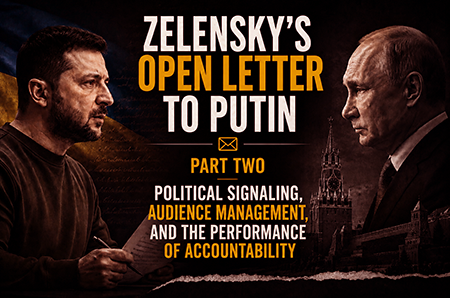
Political Signaling, Audience Management, and the Performance of Accountability
The Call for Dialogue and the Development of Political Accountability
It is, however, in the concluding section of the letter that the text undergoes its most significant transformation.
Up to that point, Zelensky had constructed a lengthy argument based on political, psychological, and symbolic pressure. He has attributed personal responsibility for the conflict to Putin, emphasized the progressive deterioration of the conditions sustaining the war, and placed the entire affair within a broader historical perspective.
At that point, the reader might expect a purely accusatory conclusion, but instead… Instead, it is precisely at that point that the tone shifts: after describing the costs of continuing the conflict, Zelensky introduces a different element – the possibility of a way out.
An invitation to a direct meeting between the two leaders emerges. There is a willingness to agree to a ceasefire during the negotiations. A reference to the possible involvement of international actors capable of offering credible security guarantees appears.
This is an important shift because it alters the document’s overall purpose.
Up to that point, the letter had operated primarily in the realm of interpreting the war. From that point on, it also begins to address the interpretation of peace.
The distinction is less subtle than it might seem.
In the first case, the problem lies in assigning responsibility for what has happened. In the second, it consists of assigning responsibility for what might happen in the future.
And it is precisely here that one of the most interesting aspects of the entire communicative construct emerges.
The proposal for a meeting does not seem to serve merely a diplomatic function. It also has a narrative function.
If Putin were to accept, the letter could be remembered as the starting point of a new attempt at negotiation.
If Putin were to refuse, the same letter could be used to reinforce the argument that the continuation of the war would depend primarily on a decision by the Kremlin.
In both scenarios, the document produces a political outcome by taking the form of a structure reminiscent of what the literature refers to as “audience costs”: a proposal made public generates reputational consequences regardless of whether it is accepted or rejected.
This does not mean that the proposal is necessarily insincere or purely instrumental. Rather, it means that it is structured in such a way as to generate effects even if it is not accepted.
From this perspective, the letter appears designed to operate under conditions of high uncertainty and, as such, does not assume that negotiations will take place, but rather that the Russian response will in any case constitute a political fact to be interpreted. And it is precisely the interpretation of that response that constitutes one of the text’s main objectives.
From this perspective, the letter resembles less a simple diplomatic initiative and more a mechanism for narrative positioning.
To fully understand this passage, it is helpful to focus on a sentence that might seem marginal but which, in reality, reveals a remarkable awareness of the international context.
I am referring to the point where Zelensky observes that the United States appears today to be heavily focused on the Iranian issue and that it would be a mistake to simply wait for the war in Ukraine to return to the center of American attention.
This is a statement that is in some ways unusual, but certainly in line with the current course of events.
For much of the conflict, in fact, the Ukrainian leadership has sought to emphasize the war’s strategic centrality and the need to keep it among the top priorities on the Western agenda.
Here, however, there is an explicit acknowledgment of a reality that has likely been known in Kyiv for some time: the strategic attention of the great powers is not infinite.
Every political system has limited resources. The same applies to diplomatic, media, and strategic attention, so that when new crises emerge in other parts of the world, they inevitably compete with existing ones.
This is a normal dynamic in international relations, but it is rarely acknowledged so directly within a political document of this nature.
This is precisely why the passage deserves attention.
In fact, it suggests that the letter was not conceived solely with regard to relations between Ukraine and Russia. It also appears to reflect a growing awareness of the transformations underway within the Western strategic environment.
In recent years, the conflict in Ukraine has occupied a central position in the political priorities of Washington and much of Europe. However, no war maintains the same level of attention indefinitely.
New crises emerge. New priorities emerge. New domestic political balances influence government decisions.
And the issue does not necessarily concern a sudden weakening of Western support—or at least not merely the growing likelihood of such a scenario—but rather something more subtle.
I am referring to the risk that the war will gradually cease to be perceived as an extraordinary emergency and begin to be regarded as a permanent reality—manageable but not resolvable, whether due to contingent factors or to the strategic considerations of some of its actors.
See, in this regard, the points highlighted in an article published on November 17, 2025, by the Nuovo Giornale Nazionale with the telling title “The War Must Go On: Why Funding the War Is a Life Insurance Policy for European Finances.”
For Kyiv, this would be a problematic scenario, given that a war that becomes part of the geopolitical norm inevitably tends to lose its political centrality; consequently, diplomatic efforts are redirected elsewhere, public opinion grows accustomed to it, and government priorities shift, creating the conditions that give rise to a state of affairs to which this letter also seems to wish to react.
From this perspective, the document can be read as an attempt to reaffirm the centrality of the Ukrainian issue at a time marked by growing fragmentation of the international agenda.
The war is not presented as just one of many ongoing crises in the international system. It is presented as an unresolved issue that requires a political decision.
And it is precisely this political choice that becomes the central theme of the letter’s final section.
The emphasis on direct talks between leaders, on a ceasefire, and on the establishment of security guarantees serves not only to outline a possible path for negotiations, but also – and above all – to establish a criterion for judgment.
If a proposal for dialogue exists and if that proposal is rejected, then the responsibility for the continuation of the conflict can be more clearly attributed to those who chose to reject it.
Of course, the reality of wars is always more complex than any narrative construct. Responsibility can rarely be reduced to a single decision or a single actor.
However, wars are not fought solely on the battlefield. They are also fought on the battlefield of interpretation.
The ability to determine who appears open to dialogue and who appears responsible for its absence is an important component of international political competition, and it is precisely in this regard that the letter seems to have been crafted with particular care.
Rather than seeking an immediate response from Putin, it seems intended to define the framework within which that response will be interpreted by governments, public opinion, and international actors.
It is a subtle but fundamental difference.
The objective does not seem to be simply to open negotiations, but rather a carefully calibrated attempt to establish in advance the political and moral parameters through which the very possibility of negotiating will be interpreted.
Viewed from this perspective, the proposal for a meeting takes on a different meaning, as it would represent not only a diplomatic offer but also a tool through which to influence the distribution of political responsibilities should the war continue.
And it is probably here that one of the most sophisticated aspects of the entire document emerges.
The letter appears to be structured in such a way as to produce significant political effects regardless of the immediate outcome of the proposal it contains.
If dialogue were to begin, the text could be remembered as the starting point of a new phase.
If dialogue does not begin, the text would nonetheless help reinforce a particular interpretation of the reasons that prevented its launch.
In this sense, the proposal for negotiations does not represent the final point of the narrative construction.
It constitutes its completion, and precisely for this reason, after defining the problem, identifying the responsible party, and describing the costs of continuing the war, the letter introduces an alternative possibility by shifting the burden of choice to the interlocutor.
And it is precisely this choice, even more so than the proposal itself, that the document seems to want to bring to the center of international attention.
Who Actually Wrote the Letter? And what does this tell us about Ukraine’s strategy?
One of the most interesting questions that arises from reading the open letter concerns its true authorship—not so much in a formal sense, since the document naturally bears the signature of Volodymyr Zelensky, but rather in a substantive sense: who actually wrote this text?
The question is less trivial than it might seem.
When reading documents of this kind, there is always the temptation to imagine the political leader sitting at his desk, personally writing every sentence. In reality, in contemporary political systems, especially in times of war, the process is almost always much more complex.
Communications intended to have international impact are typically crafted with the input of multiple professionals, including political advisors, diplomats, national security experts, strategic communications specialists, and, in some cases, intelligence agencies.
For this reason, the truly interesting question lies not so much in determining whether Zelensky physically wrote the text word for word, but rather in identifying the underlying structure of this letter. And this is where the document becomes particularly revealing, a text that appears to have been written by multiple contributors simultaneously.
In fact, upon careful reading of the letter, one immediately notices a characteristic: the text contains very different registers. In some passages, the psychological dimension prevails, such as when Zelensky emphasizes the fatigue of the Russian elite, Putin’s age, or the gradual erosion of his domestic support; the language is not that of classical diplomacy. It is the language of psychological pressure and political delegitimization.
In other passages, however, an almost military dimension emerges, with the emphasis on Russian losses, data on the ratio of dead to wounded, and again on the capabilities of Ukrainian drones, as well as information on possible war plans extending to 2027 or 2028: all elements that appear to originate from operational or intelligence circles.
Not to mention the existence of a third level: the diplomatic one. Here, references appear to potential negotiation venues, international guarantors, European participation, the role of the United States, and the construction of a future security architecture.
A letter with three distinct registers: psychological, military, and diplomatic. The integration of these three registers within the same document suggests something significant: namely, that the letter does not appear to be the work of a single author but rather, as is often the case in such situations, the result of a collective effort.
Moreover, their integration evokes the concept of whole-of-government communication, whereby political, diplomatic, intelligence, and security tools are coordinated within a common narrative strategy.
To what extent did Western influence play a role in the drafting of the text?
At this point, another question inevitably arises: if the text was crafted through a complex process, to what extent did Western allies influence it?
This is a question that often arises when analyzing communications from Kyiv. However, upon examining the document in detail, the hypothesis of predominantly American direction does not appear particularly convincing, and this for a very simple reason: many of the elements that typically characterize U.S. political communication are missing, such as:
- grand appeals to democracy;
- constant references to human rights;
- as well as the emphasis on a rules-based international order that has dominated much of the Western narrative on the conflict.
These themes do exist, but they remain in the background, so that the letter’s argumentative structure operates on a different plane—one that is much more concrete, much more personalized, and much more focused on the figure of Putin.
This, ultimately, is what makes it difficult to imagine a document constructed primarily according to an American logic.
A similar argument can be made to refute the hypothesis of British influence, since in this case as well, several elements of incompatibility emerge from the text. The United Kingdom’s diplomatic tradition, in fact, tends to favor more indirect, nuanced, and ambiguous language. Understatement has always been one of the hallmarks of British political communication, whereas Zelensky’s letter clearly takes the opposite approach.
When the text refers to Putin’s age, evokes the fatigue of the Russian elite, highlights dependence on North Korea or China, and suggests that the power structure built by the Russian leader is entering a phase of attrition, the language appears so direct and, at times, even brutal that it leads us to rule out the possibility that the entire rhetorical framework could be the result of significant British influence.
The most plausible theory: a predominantly Ukrainian origin
Paradoxically, the more one analyzes the text, the more a different conclusion emerges.
The letter appears to be deeply consistent with the communication model that Ukraine has developed during the war. A model that in recent years has become one of the most effective tools of Kyiv’s strategy, whose main feature is the integration of normally separate spheres such as public communication, diplomacy, national security, and intelligence operations—mostly treated as parts of a single strategy.
And the letter seems to reflect exactly this logic, given that:
- it does not simply speak of negotiations,
- it does not simply speak of war,
- it does not simply speak of international politics
but simultaneously of all these things.
And it is precisely this overlap that represents one of the most distinctive features of Ukrainian communication since the start of the conflict.
The role of intelligence
There is also a particularly interesting aspect: some passages appear to draw directly on information from intelligence sources, and the most obvious example concerns the reference to alleged Russian plans to continue the war through 2027 and 2028.
From a negotiating standpoint, this information is not essential, so if the goal were simply to propose a meeting, the passage could easily have been omitted.
Why, then, include it?
Probably because it serves another purpose.
The sentence serves to communicate that Kyiv believes it is aware of Russian strategic orientations, as well as to convey the idea that Ukraine possesses relevant information on the Kremlin’s intentions, in accordance with signaling theory, according to which the mere assertion of possessing certain information can produce strategic effects even without the need to reveal its sources or publicly verify its content.
In other words, it is not a negotiating tool but rather an informational one, or perhaps it would be more accurate to say: a communicative one.
The detail that perhaps says it all
There is, however, an even more interesting clue, perhaps the most important one of all.
Many passages in the letter seem designed to make it harder for Putin to give a positive response. This is evident when one considers that if the true objective had been merely to facilitate a meeting between the two leaders, it would have made no sense to include references:
- Putin’s age;
- his alleged loss of support;
- the weariness of the Russian elite;
- dependence on China and North Korea;
- internal economic difficulties.
A traditional negotiator would almost certainly have avoided introducing such provocative topics. Yet this is something we find done repeatedly in the text. And the most plausible explanation is that the letter’s main objective was never to convince Putin, but rather something else.
Specifically, to influence how the world will interpret his response. And from this perspective, everything makes more sense, to the point that the most aggressive passages are not mistakes, but narrative tools intended to construct an interpretive framework.
A framework in which a possible Russian rejection might appear as the consequence of a political choice by the Kremlin and not as the inevitable result of structural differences between the parties.
A political-strategic ecosystem rather than a single author
In the end, perhaps, the original question – the one that matters least – is: “Who actually wrote the letter?” Probably no one, at least in the traditional sense of the term.
The document seems rather to be the product of a political-strategic ecosystem that in recent years has acquired a remarkable ability to integrate different functions within a single narrative: the presidency, diplomacy, security apparatus, intelligence structures, and international communication, all of which are present in the text in various ways.
And it is precisely this integration that represents one of the most interesting aspects of the letter because, beyond the individual arguments, the document offers a rather rare glimpse into how Ukraine is attempting to wage a military war, a diplomatic war, and a narrative war simultaneously.
And perhaps this is the most significant insight that emerges from reading it: not so much what the letter says to Putin, but what it reveals about how Kyiv interprets the conflict today and its own role within it.
Essential Technical Bibliography
“Open Letter to the President of the Russian Federation from the President of Ukraine” original text https://www.president.gov.ua/en/news/vidkritij-list-prezidentu-rosijskoyi-federaciyi-vid-preziden-104769
Key Theoretical References
- Schelling, T. C. (1966). Arms and Influence. Yale University Press. (Essential for coercive diplomacy and signaling strategies)
- Fearon, J. D. (1994). “Domestic Political Audiences and the Escalation of International Disputes”. American Political Science Review. (Theoretical basis for audience costs)
- Putnam, R. D. (1988). “Diplomacy and Domestic Politics: The Logic of Two-Level Games”. International Organization. (A key reference point for triangular negotiation logic).
Strategic communication e narrative warfare
- Miskimmon, A., O’Loughlin, B., & Roselle, L. (2013). Strategic Narratives: Communication Power and the New World Order. (Central to the construction of strategic narratives)
- Entman, R. M. (2004). “Projections of Power: Framing News, Public Opinion, and U.S. Foreign Policy”. University of Chicago Press.;(Frame analysis applied to international politics)
- Nye, J. S. (2004). Soft Power: The Means to Success in World Politics.
- (Basis for non-coercive influence and the perceptual dimension)
Political Communication and Security
- Freedman, L. (2006). The Transformation of Strategic Affairs. Routledge. (The evolution of strategy in contemporary political communication)
- Betz, D. (2008). The Virtual Dimension of Contemporary Insurgency and Counterinsurgency. (Useful for understanding the informational dimension of conflict)
Background readings (optional but relevant)
- Allison, G. (2017). Destined for War: Can America and China Escape Thucydides’s Trap? (Systemic competition and multipolar order)
- Waltz, K. (1979). Theory of International Politics. (Structure of the international system)