
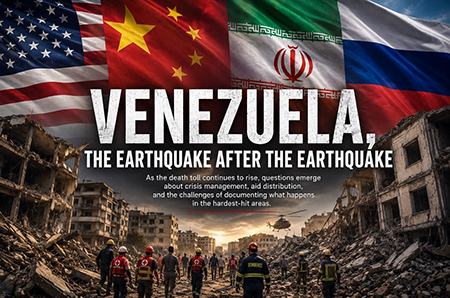
As the death toll continues to rise, questions are emerging about the handling of the emergency, the distribution of aid, and the difficulties in documenting what is happening in the hardest-hit areas.
An investigation based on documents, international sources, open-source analysis, and eyewitness accounts gathered in the days following the quake
“Earthquakes last only a few seconds. Their consequences can last for years”.
Some disasters end when the earth stops shaking. Others, however, begin at that very moment. That is when a nation’s ability to respond is put to the test: rescuing those trapped, treating the injured, recovering the victims, distributing aid, restoring essential services, and providing citizens with an accurate account of what is happening.
In Venezuela, the earthquake has opened a wound that goes far beyond material destruction. Alongside collapsed buildings, damaged infrastructure, and a death toll that is bound to rise as search efforts continue, a second crisis has emerged – less visible but no less critical: that of the emergency response and the ability to report on it.
The first official figure released by the authorities puts the death toll at approximately 1,430. This is the figure that has dominated the headlines of news programs and press agencies.
But, as is often the case with major disasters, the numbers capture only part of the reality. They tell us how many people lost their lives. They do not explain how quickly rescue teams arrived, what obstacles they encountered, how aid was distributed, or what price the survivors are paying.
It is in this space – suspended between news reporting and reconstruction – that this investigation takes shape.
In the days following the earthquake, the narrative of the tragedy followed two paths that only partially overlapped. On the one hand, there were the official statements, press conferences, and updates released by the authorities.
On the other, a continuous stream of images, videos, and eyewitness accounts shared directly by citizens, volunteers, healthcare workers, and rescue workers via digital platforms.
These are not two opposing truths, but two perspectives that, in the early stages of a major emergency, rarely align. It is precisely in the gap between them that the most difficult questions lie.
La Guaira has become a symbol of this divide. Cited by numerous sources as one of the hardest-hit areas, it is also the place where, from the very beginning, the greatest difficulties in gaining access have been concentrated. While authorities restricted access for operational and security reasons, news began to spread through alternative channels.
Appeals from family members searching for their loved ones began to appear, along with requests for help, geotagged photographs, videos shot amid the rubble, and eyewitness accounts describing a reality that was often impossible to verify immediately.
Among these, one stands out more than any other. Messages appeared on various digital platforms in which citizens offered money to experienced rescue workers in order to speed up search and rescue operations.
It is not the monetary value of those offers that is significant, but what they reveal: the perception that time was becoming the most precious commodity and that any delay could result in the loss of another life.
And perhaps time is the true protagonist of this story.
Because an earthquake doesn’t end with the last tremor. It continues for as long as it takes to reach an isolated area, to pull a survivor from the rubble, to transport an injured person to the hospital, to get a humanitarian convoy to the scene, to identify a victim, to restore the power grid, or to verify a witness account.
Every hour that passes changes the face of the emergency and can transform a natural disaster into a humanitarian crisis of a far greater magnitude.
It is through this lens that today’s Venezuela must be observed and recounted—also to draw the necessary lessons to prevent the dramatic emergence of the many other “Venezuelas” currently taking shape in the contemporary world.
The First 72 Hours
The first seventy-two hours after an earthquake are the decisive moment. This is the window of opportunity during which the most lives are saved. It is also the period during which the response capacity of a civil protection system becomes apparent.
In Venezuela, these hours served as an immediate test. Rescue operations were hampered by the vastness of the affected areas, already fragile infrastructure, and access difficulties that made mobilizing aid a complex challenge.
While authorities restricted access to certain areas for operational reasons, the flow of information quickly shifted to informal channels. It is within this dynamic that a narrative divide emerged between official communications and firsthand accounts.
La Guaira and Grassroots Reporting
La Guaira has become one of the symbolic focal points of the crisis. Access difficulties have contributed to turning it into an area where news coverage has unfolded primarily through firsthand accounts.
Messages requesting help, geotagged images, videos recorded amid the rubble, and appeals from family members searching for missing persons began to appear. In some cases, citizens directly sought out specialized rescue teams, even offering money to speed up the response.
It is not the exceptional nature of the gesture that is central, but what it indicates: the perception that time was the decisive factor in the emergency.
Digital Testimonies
As the hours passed, the flow of accounts from digital platforms took on a central role in the narrative of the crisis.
Videos, images, and accounts have depicted complex rescue operations, hospitals under strain, logistical challenges, and situations of isolation in some affected areas. In this context, the distinction between verified information and firsthand accounts has become one of the most sensitive aspects of the entire emergency.
When official information slows down, eyewitness accounts pick up the pace.
International Aid
On the international front, the response took shape rapidly.
The U.S. Department of the Treasury temporarily authorized transactions related to humanitarian aid through the Office of Foreign Assets Control to facilitate the arrival of logistical and financial support.
Several countries in the region have launched relief operations, including Colombia, which has coordinated the deployment of rescue teams. In this context, the mayor of Medellín publicly denounced difficulties in granting access to the emergency teams sent from Colombia.
Managing the distribution of aid remains one of the most sensitive issues in the post-earthquake phase.
The Healthcare System Before the Earthquake
The earthquake struck a healthcare system that was already under strain.
According to various news reports, including those published by El País, Venezuela’s hospital system was already facing structural challenges before the earthquake, with a significant number of operating rooms out of service and shortages of basic medical supplies.
Against this backdrop, the impact of the earthquake exacerbated a pre-existing situation, increasing the strain on the hospitals that remained operational.
Crisis Management and Protests
The handling of the emergency has generated tensions in some affected areas.
In several incidents documented by the media and digital platforms, the presence of authorities was met with protests from the public. In particular, Delcy Rodríguez was the target of criticism during a visit to an affected area.
At the same time, reports circulated regarding operational difficulties in managing relief efforts and coordinating the teams on the ground.
The Issue of the Bodies
One of the most sensitive aspects of the post-earthquake phase concerns the handling of the victims.
In any major earthquake, the recovery of bodies is not merely a rescue operation but an essential phase in the overall management of the emergency. It serves to ensure identification, prevent further health risks, and give families the opportunity to grieve.
The accounts gathered in recent hours describe difficult conditions in some affected areas. This information remains part of the emergency flow and requires further verification over time.
Time as the Key to the Crisis
More than individual images, it is time that defines this phase of the emergency.
The timing of rescue efforts.
The time it takes to gain access.
The timing of international aid.
The time of assessments.
The time of testimonies.
Every aspect of the Venezuelan crisis seems to be measured against this variable.
The Information Vacuum
When a catastrophe unfolds in a complex context, the production of verifiable information becomes part of the emergency itself.
The gap between what is happening on the ground and what is being documented inevitably creates a space of uncertainty that is filled by diverse information flows from institutional sources, international media, and firsthand accounts.
It is within this space that an initial understanding of the crisis is formed.
Conclusion
The tremors have stopped. But the time of the earthquake is not over.
Because there comes a moment in every major catastrophe when saving lives, rebuilding cities, and reconstructing the truth become part of the same endeavor.
That is the moment Venezuela is going through today.
And it is that moment that, perhaps, the rest of the world should observe more closely.