
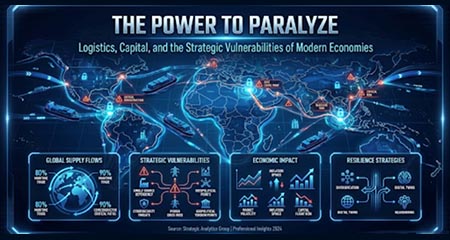
Logistics, Capital, and the Strategic Vulnerabilities of Modern Economies
The full essay is available in the accompanying attachments.
Modern capitalism is built on a promise of uninterrupted movement. Goods must travel, energy must flow, production must continue, and markets must remain connected.
Behind the apparent normality of everyday economic life lies an immense logistical system whose efficiency depends on the coordination of infrastructure, labor, energy, transportation, and financial capital.
Yet this system contains a fundamental contradiction: the more an economy depends on the continuous movement of goods, the more vulnerable it becomes to those capable of interrupting that movement.
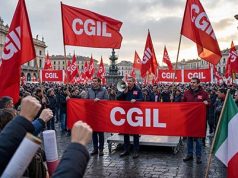
Disruptions to freight transportation offer a particularly revealing illustration of this paradox. What may initially appear to be a labor dispute, a localized protest, or a temporary interruption of commercial activity can expose a much deeper question concerning the distribution of economic power.
Who actually controls the functioning of an interconnected economy?
Those who own capital, or those whose work makes its circulation possible?
This question is at the center of a broader geopolitical argument: the power to interrupt economic flows can become a strategic resource in its own right.
The accompanying essay, The Power to Stop Movement: From Trucking Protests to the Geopolitics of Demand – Logistics, Capital Accumulation, and the Strategic Vulnerability of Economies, examines this relationship in greater depth. Its starting point is a concrete episode, but its analytical ambitions extend well beyond the immediate circumstances of the event.
The objective is not simply to explain a protest. It is to understand what such a protest can reveal about the structures of power underpinning contemporary capitalism.
The Infrastructure Behind Economic Power
Economic power is commonly associated with ownership: capital, companies, financial assets, productive facilities, and access to markets. These remain essential dimensions of the modern economy. However, ownership alone does not guarantee that economic resources can be used effectively.
Capital must circulate. Raw materials must reach factories. Manufactured products must reach distribution centers and consumers. Energy must be available when and where it is needed. Financial transactions must be translated into material operations.
In other words, capital accumulation depends on a network of relationships that extends far beyond the boundaries of individual companies.
Logistics is one of the principal mechanisms through which these relationships are maintained.
Road transportation, ports, warehouses, distribution networks, fuel supplies, and transport workers form part of an infrastructure that is often most visible when it stops functioning.
Under normal circumstances, its success is measured by its ability to remain largely unnoticed. Deliveries arrive, production continues, shelves remain stocked, and the movement of goods appears almost automatic.
But this apparent normality conceals a structural dependency.
The modern economy does not simply require goods to exist. It requires them to be available at particular locations, within particular time frames, and in quantities consistent with the organization of production and consumption.
A product that cannot reach its destination may retain its nominal value while losing much of its immediate economic usefulness. A factory deprived of essential inputs may possess machinery, workers, and orders while being unable to continue production. A distribution network can remain physically intact yet fail to deliver the commercial results for which it was designed.
The distinction between possessing resources and being able to mobilize them is therefore crucial.
The capacity to move goods is not merely a technical function of the economy. It is one of the conditions that make economic power effective.
When Disruption Becomes Leverage
The strategic significance of logistical disruption lies in the relationship between localized action and system-wide consequences.
A disruption does not need to affect an entire national economy to expose its vulnerabilities. In tightly interconnected production and distribution systems, a relatively limited interruption can generate consequences beyond the immediate location where it occurs.
The effects depend on the structure of the network, the availability of alternative routes, the nature of the goods involved, the size of inventories, and the time required to restore normal operations.
Some disruptions can be absorbed with limited consequences. Others can propagate through multiple stages of production and distribution.
The essential point is not that every transport protest threatens economic stability. Such a claim would be exaggerated. Rather, the consequences of an interruption depend on the position occupied by the affected activity within the broader economic system.
A seemingly ordinary service can acquire strategic importance when other activities depend on its uninterrupted operation.
This is where the relationship between logistics and power becomes particularly significant.
Actors who control financial resources may possess considerable influence over investment, production, and employment. Yet their ability to exercise that influence depends, in part, on the continued operation of infrastructures and services that they do not necessarily control directly.
The result is an asymmetry. Ownership and operational leverage are not always concentrated in the same hands.
Those who occupy a critical position within a logistical network may possess the ability to impose costs, delay decisions, and force other actors to respond.
Their influence may be temporary, geographically limited, or dependent on particular circumstances. Nevertheless, it can become consequential when the costs of interruption exceed the costs of negotiation.
The capacity to stop movement does not automatically translate into lasting political or economic power. It can, however, create a bargaining position that would otherwise be unavailable.
The Geopolitics of Dependence
Geopolitics is often understood through the relationships among states, military capabilities, territorial control, and access to strategic resources. These remain central concerns, but they do not exhaust the geography of power.
Power also emerges from the organization of economic dependencies.
An economy may possess substantial financial resources and advanced productive capabilities while remaining dependent on transportation corridors, imported energy, specialized components, or a limited number of logistical connections. Its strength may therefore coexist with vulnerabilities that become visible only under conditions of disruption.
This is not a contradiction unique to any single country. It is a general characteristic of interconnected economic systems.
The greater the degree of integration, the more opportunities an economy may have to exploit specialization, scale, and efficiency. At the same time, integration can create dependencies that are difficult to replace quickly.
Efficiency and resilience are not necessarily identical.
A system optimized for continuous movement may operate effectively under normal conditions but prove less adaptable when its assumptions are challenged. Limited inventories, tightly coordinated deliveries, and reliance on specific routes can reduce certain operating costs while increasing exposure to interruptions.
From a geopolitical perspective, the relevant question is not simply whether a country possesses infrastructure, but how dependent its economic activity is on the uninterrupted functioning of that infrastructure.
The same principle applies within states, across regions, and inside individual supply chains.
A road network, a port, a distribution hub, or a transport workforce can become strategically significant because of the relationships that depend on it. Its importance derives not only from its physical characteristics but also from the consequences of its unavailability.
This perspective broadens the meaning of strategic vulnerability. Vulnerability is not necessarily a sign of technological backwardness or insufficient economic development. It can emerge precisely because an economy has become highly integrated and efficient.
The more extensively an economic system relies on continuous coordination, the more carefully its points of dependence must be understood.
From the Power of Ownership to the Power of Interruption
The distinction between ownership and interruption provides a useful way to reconsider the distribution of power in contemporary capitalism.
Ownership gives actors access to assets and the capacity to make decisions about their use. But the value of those assets depends on a wider environment that enables production, circulation, and exchange.
The power of interruption operates differently. It derives from the ability to interfere with the relationships through which economic activity is sustained.
These two forms of power are neither equivalent nor mutually exclusive. They can reinforce one another, compete, or be distributed among different actors.
A company may own vehicles, warehouses, or production facilities without possessing complete control over the labor, energy, roads, or commercial relationships required to keep them operating.
Conversely, workers or other actors may lack ownership of productive assets while occupying positions from which they can temporarily influence the functioning of the system.
This does not mean that workers automatically possess greater power than employers, or that every interruption produces meaningful leverage.
Employers may have financial reserves, alternative suppliers, legal remedies, technological solutions, or the ability to absorb short-term losses. Governments may intervene, and transport routes may be reorganized.
The balance of power depends on the specific conditions of each case.
Nevertheless, the underlying analytical distinction remains important: the ownership of an economic system does not necessarily imply complete control over the conditions of its operation.
This is particularly relevant when the organization of production leaves little room for delay or substitution.
The ability to interrupt a flow can become consequential when the affected actors cannot easily replace the service, redirect the goods, or postpone the activity without incurring significant costs.
In such circumstances, operational dependence becomes a source of bargaining power.
The Limits of the Logistics Weapon
It would be misleading to interpret every logistical disruption as a form of strategic coercion. The capacity to interrupt movement is not an unlimited resource, and its effectiveness depends on the circumstances in which it is exercised.
A disruption may impose costs on the actors it is intended to influence, but it can also harm workers, consumers, small businesses, and communities that have little control over the dispute.
Its economic effects may generate solidarity, but they may also generate opposition. The ability to cause disruption does not guarantee the ability to determine its political outcome.
Moreover, economic systems are capable of adapting. Businesses may search for alternative suppliers, reorganize delivery schedules, build inventories, invest in automation, or develop alternative transportation routes. Public authorities may introduce emergency measures or negotiate settlements.
These responses can reduce the leverage associated with a particular point of vulnerability.
Yet adaptation is neither instantaneous nor costless. Alternative arrangements require resources, time, coordination, and sometimes substantial investment.
The existence of a possible substitute does not mean that it can be deployed quickly enough to prevent significant disruption.
The strategic significance of logistical power therefore lies not in the assumption that a system can be stopped indefinitely, but in the possibility that it can be interrupted at a moment when interruption is costly.
This distinction matters for both economic analysis and public policy.
It prevents the argument from becoming an exaggerated celebration of disruption while preserving its central insight: the organization of economic life creates dependencies, and those dependencies can become politically consequential.
Beyond the Immediate Event
The value of examining a transport protest through this framework lies in the possibility of moving from a specific episode to a more general understanding of economic power.
The immediate event remains important, but it does not need to contain the entire argument. It can serve as an analytical starting point from which broader structural relationships become visible.
This is a familiar method of political and geopolitical interpretation. A localized event can reveal a general mechanism without being representative of every possible case.
The task is to identify what the event makes observable, establish the limits of the inference, and connect the findings to a wider theoretical framework.
In the case of logistics, the broader mechanism concerns the relationship between accumulation and continuity.
Capital accumulation requires more than the possession of resources. It depends on the ability to mobilize those resources through a network of material and institutional relationships.
When those relationships are disrupted, the vulnerability of the system becomes visible.
The episode therefore matters not simply because goods may stop moving, but because the interruption exposes the conditions under which economic activity can continue.
That is the difference between describing a logistical problem and analyzing its geopolitical significance.
The former concerns the immediate disruption. The latter asks what the disruption reveals about the distribution of power, the structure of dependencies, and the capacity of different actors to influence the functioning of the economic system.
The Strategic Question: Who Can Afford to Stop?
The central question is ultimately not whether movement can be interrupted. In a complex economy, interruptions are inevitable.
The more consequential question is who has the capacity to interrupt movement, under what conditions, and at whose expense.
Who can absorb the cost of a prolonged disruption?
Who can replace a supplier or redirect a route?
Who controls the infrastructure, and who performs the work that keeps it functioning?
Who has the resources to wait, and who is forced to negotiate?
These questions reveal that economic power is not distributed solely through ownership, income, or formal authority. It is also shaped by the organization of dependence.
Some actors possess the resources to withstand disruption. Others possess the capacity to create it. Still others bear its consequences without controlling either its origin or its resolution.
Understanding these differences is essential to a more complete analysis of contemporary capitalism.
Logistics is therefore more than the background infrastructure of economic activity. It is one of the arenas in which power is exercised, contested, and redistributed.
The ability to keep goods moving is a source of economic strength. The ability to interrupt that movement can become a source of leverage. And the dependence that connects the two is a potential source of strategic vulnerability.
The implications extend beyond trucking, labor disputes, or any single episode of protest. They concern the resilience of supply chains, the organization of production, the relationship between infrastructure and authority, and the limits of economic control in systems built on interdependence.
The full accompanying essay develops this argument in greater detail, situating the relationship between logistical disruption and capital accumulation within a broader geopolitical framework.
Its central proposition is worth considering beyond the immediate event: in an interconnected economy, power belongs not only to those who own the system, but also – under specific conditions – to those who can make its movement stop.
Attached
The Power to Stop the Movement