
Beyond the Genocide narrative: the geopolitics of October 7, Hamas, and Israel’s response. Why strategy, regional power politics, and information warfare matter more than simplistic moral narratives
Methodological Framework
This article adopts a stratified strategic–geopolitical analytical framework that explicitly distinguishes between different levels of causality in international and regional conflict systems.
Its purpose is not to reconstruct deterministic historical sequences, but to identify how structural conditions, strategic interactions, and operational decisions co-evolve within a single but hierarchically differentiated system.
The analysis is based on the assumption that contemporary conflicts, particularly in the Middle East, cannot be adequately explained through linear causality or single-factor models. Instead, they must be understood as the outcome of interacting but asymmetrically weighted layers of structure and agency.
Accordingly, the framework is organized into three analytically distinct but interconnected levels:
(1) Systemic Structural Level
This level refers to long-duration geopolitical configurations that shape the boundaries of possible action for all regional actors. It includes the legacy of the post-Ottoman settlement, the architecture of the Cold War regional order, and the subsequent fragmentation of the post-bipolar Middle Eastern system.
These structures do not determine specific events, but they establish durable constraints, recurrent patterns of competition, and persistent forms of instability. Within this hierarchy, systemic structure is assigned analytical primacy.
(2) Strategic Interaction Level
This level concerns the behavior of states, regional powers, and organized non-state actors operating within systemic constraints. It includes alliance formation, deterrence relationships, proxy dynamics, and competitive positioning among actors such as Israel, Iran, Arab states, the United States, and non-state armed movements.
Strategic behavior at this level is shaped by systemic conditions but retains autonomy through perception, ideology, and domestic political structure.
(3) Operational Event Level
This level refers to discrete episodes of decision and action, including military operations, escalations, and political crises. Events such as the October 7 attack and subsequent military responses are treated not as independent causal origins, but as trigger mechanisms that activate and reconfigure pre-existing strategic tensions embedded in higher structural layers.
A key assumption of this framework is that causality in international conflict is hierarchical rather than flat. While all three levels interact continuously, systemic structure conditions strategic interaction, and strategic interaction in turn shapes the range and probability of operational events. However, reverse causality is limited and typically non-deterministic.
In addition, the analysis introduces the concept of structural irreversibility of regional fragmentation, referring to the fact that the collapse of imperial, colonial, and bipolar ordering systems has produced a regional environment in which no single actor or coalition is capable of reconstituting a stable and comprehensive equilibrium.
As a result, instability is not treated as a transitional phase, but as a structural condition of the system itself.
Finally, the framework emphasizes that this study does not aim to produce predictive certainty. Instead, it advances structured interpretative hypotheses designed to clarify the logic of interaction across different levels of analysis in real time. The objective is not to replace historical explanation, but to complement it with a model capable of capturing the layered and non-linear nature of contemporary geopolitical conflict
Abstract
This article offers a geopolitical analysis of the October 7 attack and the subsequent Israel – Gaza war, arguing that dominant moral narratives – particularly those centered on accusations of premeditated genocide or, conversely, claims of unquestionable self-defense – are insufficient to explain the structural dynamics of the conflict.
Rather than focusing exclusively on recent events, the analysis situates the current war within a broader historical and strategic continuum stretching from the collapse of the Ottoman Empire and the post-First World War settlement to the Cold War, the evolution of Palestinian political movements, and the contemporary regional balance of power.
The article argues that the Israeli–Palestinian conflict cannot be fully understood without examining how local grievances, competing national projects, great-power rivalries, and regional ambitions have interacted over more than a century.
The study examines Hamas’s October 7 operation under conditions of extreme military asymmetry and explores competing strategic explanations related to deterrence, agenda-setting, regional realignment, and the disruption of normalization processes.
It further argues that Israel’s response must be analyzed within a multi-layered decision-making environment shaped by domestic politics, security doctrine, regional deterrence imperatives, and the structured yet often ambivalent relationship with Washington.
Particular attention is devoted to the evolution of the Palestinian question from a local national dispute into a broader geopolitical arena through which regional and international actors have repeatedly sought to project influence, challenge rivals, and pursue strategic objectives that frequently extend beyond Palestinian interests themselves.
The article also highlights the fragmentation of the contemporary Arab regional system and the persistent gap between rhetorical support for the Palestinian cause and actual political behavior. It argues that contemporary conflicts are increasingly shaped by the interaction of military realities, political incentives, historical memory, and information warfare.
The central claim is that the current war should not be interpreted as an isolated event nor reduced to binary moral categories. Rather, it represents the latest phase of a geopolitical structure whose roots extend from the collapse of the Ottoman order through the imperial settlements of the twentieth century, the Cold War competition for influence in the Middle East, and the subsequent fragmentation of the regional system. Understanding the conflict therefore requires moving beyond singular narratives and examining the overlapping systems of incentives, constraints, and strategic calculations that continue to shape its evolution
Article
To those who argue that Israel has pursued a premeditated genocide from the very beginning, it must be pointed out that a geopolitical analysis of the conflict requires placing recent events within a broader historical and strategic context.
The Israeli-Palestinian conflict did not arise in a vacuum, but is embedded in a regional history marked by competition among national movements, state and non-state actors, and power dynamics that have evolved over time.
However, in a geopolitical analysis, reference to the past does not serve to construct identity-based narratives, but to clarify continuities and breaks in the behavioral patterns of the actors involved.
The aim of this paper is not to reconstruct a moral history of the conflict, but to analyze how strategic dynamics, political constraints, and international incentives have contributed to the current phase of escalation.
Historical Context Often Absent from Contemporary Narratives
A geopolitical analysis of the conflict also requires us to remember that tensions between Jewish communities and parts of the Arab world did not begin with the establishment of the State of Israel in 1948.
Long before the creation of the Jewish state, the Middle East and North Africa were the scene of recurring episodes of anti-Jewish violence, legal discrimination, and persecution affecting Jewish communities that had been present in the region for centuries.
Between the late 19th century and the first half of the 20th century, numerous episodes of collective hostility against Jewish populations occurred in various areas of the Ottoman Empire and subsequently in territories under European mandate.
Events such as the 1920 and 1929 Jerusalem riots, the 1929 Hebron massacre, and the 1941 Baghdad pogrom represent historically documented moments preceding the birth of the State of Israel and demonstrate how the conflict between emerging nationalisms, religious identities, and geopolitical transformations was already underway long before 1948 (Morris 2001; Tessler 2009).
Recalling these events does not mean denying Palestinian suffering or attributing collective responsibility to the Arab world. It simply means recognizing that regional history cannot be reduced to a linear sequence that began with the founding of Israel.
The perceptions of threat, security logic, and identity narratives that still influence the political decisions of the actors involved today are rooted in a much longer and more complex history.
The strategic origins of the contemporary conflict cannot be fully understood without considering the broader context of the collapse of the Ottoman Empire and the post-First World War settlement imposed by the victorious powers.
The Balfour Declaration of 1917 should not be analyzed in isolation from the geopolitical realities of the time. Britain was simultaneously encouraging Arab revolts against Ottoman rule while laying the foundations for a post-war regional order designed to preserve British influence throughout the Eastern Mediterranean and the Middle East.
The same authorities that supported Arab aspirations against Constantinople had little intention of allowing the newly liberated territories to develop into fully autonomous centers of regional power beyond British strategic supervision.
The events that followed the Arab Revolt illustrated the contradictions inherent in this approach. Arab forces that had fought alongside Britain against the Ottoman Empire often discovered that the political order emerging after the war reflected imperial priorities more than the expectations generated during the conflict itself.
The resulting tensions contributed to the development of competing national projects and rival political narratives that would shape the region for decades.
Whether intended or not, British policies helped create a regional environment in which Arab nationalism, Zionism, and later Palestinian nationalism evolved in constant interaction and competition.
The conflict that emerged was therefore not merely the product of local antagonisms, but also a consequence of the manner in which the post-Ottoman order was constructed and managed by external powers.
This broader historical perspective is important because it suggests that the Palestinian question gradually became more than a local territorial dispute. Over time it evolved into one of the principal arenas through which regional and international actors sought to project influence, build alliances, challenge rivals, and shape the balance of power in the Middle East.
The internationalization of the conflict that became evident during the Cold War had therefore deeper roots in the strategic architecture established after the First World War.
Hamas and the strategic logic of October 7
The October 7 operation was not an improvised act of violence, but the culmination of a multi-year process of planning, training, and operational preparation, as evidenced by both intelligence assessments and material later released by Hamas itself.
Hamas cannot be understood as an isolated phenomenon that suddenly emerged in 1987. Rather, it represents the outcome of a long evolution within both Palestinian and regional politics.
The gradual decline of Pan-Arabism following the military defeats suffered by the Arab states led by Nasser’s Egypt, the growing loss of credibility affecting parts of the PLO leadership, and the broader rise of political Islam across the Middle East created the conditions under which Hamas could establish itself as an ideological and organizational alternative.
In this sense, the movement can also be viewed as one of the long-term consequences of the strategic transformations generated by the Middle Eastern Cold War.
The Arab-Israeli conflict of the 1950s and 1960s must itself be understood within the broader framework of superpower competition. While maintaining a degree of political autonomy, Nasser’s Egypt became one of the principal regional partners of the Soviet Union and a key vehicle through which Moscow sought to expand its influence throughout the Arab world.
From this perspective, the confrontation with Israel also acquired some of the characteristics of a proxy conflict, in which pre-existing local tensions were amplified by external powers seeking strategic advantage in a region of growing geopolitical importance.
The defeat of Pan-Arabism did not bring an end to the internationalization of the Palestinian question. On the contrary, it contributed to making the Palestinian cause an increasingly important arena of geopolitical competition.
As the PLO emerged as the principal representative of Palestinian national aspirations, Soviet attention progressively shifted toward Palestinian organizations and their networks of regional and international relationships.
Over time, these connections developed through political, diplomatic, and intelligence channels involving not only Moscow but also several Eastern Bloc states, including Romania under Ceaușescu and its security apparatus.
From this perspective, Hamas cannot be separated from the longer succession of actors, ideologies, and external sponsors that have shaped the Arab-Israeli conflict since the end of the Second World War.
The movement represents one of the most recent manifestations of a political question that has repeatedly been influenced by the interaction between local grievances and broader geopolitical rivalries.
It is also important to recognize that the centrality of the Palestinian question does not necessarily coincide with the centrality of Palestinian interests. Throughout the decades, regional and international actors have repeatedly used the conflict as a tool within broader strategies aimed at achieving power, deterrence, prestige, influence, or regional leadership.
In this sense, the Palestinian cause has often functioned as a geopolitical instrument, at times leaving the concrete interests of the Palestinian population subordinate to the strategic priorities of external actors.
From a military perspective, the operation occurred under conditions of extreme asymmetry. Hamas lacked the capability to defeat Israel in conventional warfare, to sustain territorial control over captured areas, or to convert tactical incursions into a durable strategic victory.
Any traditional theory of military success therefore appears insufficient to fully account for the design of the operation.
This analytical gap raises a central question: what strategic logic can explain the decision to launch an operation of this scale under such conditions?
Several hypotheses are discussed in strategic literature and policy analysis. These include the disruption of a perceived status quo in Gaza, the re-centering of the Palestinian issue within global diplomacy, the strengthening of Hamas within the broader regional axis of resistance, the attempt to trigger an Israeli response capable of reshaping regional alignments, and the interruption of normalization processes between Israel and Arab states.
What is not in dispute is that the operation generated a highly predictable escalation environment. Given Israel’s established security doctrine and historical response patterns, a large-scale military retaliation was not only likely but structurally expected.
The central analytical problem therefore remains: which alternative strategic objective better explains the operational scale, timing, and risk exposure of October 7?
Israel, Washington, and strategic decision-making
Israeli strategic behavior cannot be reduced to a single external variable, including its relationship with Washington. While the United States remains the most significant external actor shaping Israel’s strategic environment, its influence operates through multiple and sometimes contradictory channels.
U.S. support provides Israel with critical military, diplomatic, and logistical backing, but also introduces constraints, expectations, and periodic attempts at operational moderation. The result is not linear directionality, but a structured interaction between alignment and friction.
The Biden administration has combined sustained security support with efforts to limit the scope and intensity of Israeli military operations in Gaza. This creates a signaling environment in which Israeli decision-makers must interpret both the level of support and its potential conditionality over time.
However, Israeli operational behavior cannot be reduced to U.S. political cycles alone. It is simultaneously shaped by internal political dynamics, civil-military relations, strategic doctrine, and regional deterrence considerations involving multiple actors, including Iran and its network of aligned groups.
American political dynamics therefore function not as a single causal driver, but as one layer within a broader matrix of constraints and opportunities.
The Arab regional system: fragmentation beneath rhetorical unity
Western discourse often treats the Arab world as a relatively coherent political bloc regarding the Palestinian issue. Empirical evidence suggests instead a fragmented and strategically differentiated regional system.
While public rhetoric frequently emphasizes support for Palestinian statehood, actual political behavior varies significantly across states and reflects different strategic priorities, constraints, and threat perceptions.
If a unified Palestinian state were a uniformly overriding strategic objective, one would expect more consistent coordination in diplomatic pressure and policy alignment. In practice, such coordination remains limited.
Arab state behavior is better understood through the lens of regime stability, economic transformation agendas, and regional security competition, particularly in relation to Iran and non-state armed actors.
Hamas, in particular, is perceived differently across the region, and in several cases as a destabilizing actor rather than a conventional liberation movement. This contributes to cautious and often ambivalent regional positioning.
The result is a persistent gap between rhetorical alignment with the Palestinian cause and operational political behavior.
Conclusion: overlapping strategic systems, not singular narratives
The current conflict should not be understood as a linear confrontation driven by a single cause or explanatory logic. Rather, it emerges from the interaction of multiple overlapping strategic systems, each operating according to its own incentives, constraints, and risk perceptions.
These include Israeli security doctrine shaped by existential threat perception, Palestinian armed resistance strategies developed under asymmetrical conditions, regional state actors balancing domestic stability with external positioning, and global information dynamics that increasingly shape the interpretation of battlefield events in real time.
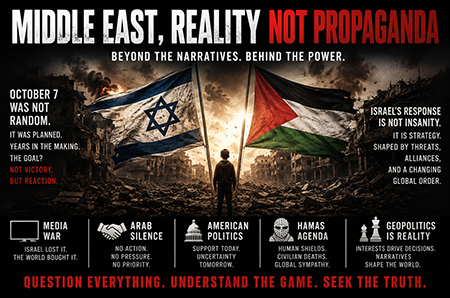
Within this structure, narratives do not merely describe the conflict, but actively participate in it, influencing diplomatic space, public perception, and strategic calculation.
This does not imply moral equivalence between actors, nor does it require the suspension of ethical judgment. However, it does suggest that moral categories alone are insufficient to explain the sequencing of actions and reactions observed after October 7.
A more analytically robust approach requires distinguishing between normative evaluation and strategic explanation: the former concerns legitimacy and responsibility, the latter concerns the logic of behavior under conditions of asymmetry, uncertainty, and escalation.
Reducing the conflict to genocide or legitimate self-defense compresses a multi-layered strategic environment into a binary moral frame. While this may offer rhetorical clarity, it comes at the cost of analytical depth.
A geopolitical understanding of the conflict must therefore remain open to complexity—not to dilute judgment, but to better approximate the structure of incentives and constraints that continues to shape its evolution.
Methodological Note
This article reflects the author’s analysis and interpretation of publicly available historical, strategic, and geopolitical literature. The following works were consulted in the preparation of this essay.
Selected Bibliography
I Strategic Theory and International Relations
- These works provide the theoretical foundation for interpreting conflict, power distribution, deterrence, and systemic interaction in international politics.
- Bull, Hedley. The Anarchical Society: A Study of Order in World Politics. New York: Columbia University Press, 2012.
- Clausewitz, Carl von. On War. Princeton: Princeton University Press, 1984.
- Freedman, Lawrence. Strategy: A History. New York: Oxford University Press, 2013.
- Mearsheimer, John J. The Tragedy of Great Power Politics. New York: W.W. Norton & Company, 2014.
- Smith, Rupert. The Utility of Force: The Art of War in the Modern World. New York: Vintage Books, 2008.
- Waltz, Kenneth N. Theory of International Politics. Reading, MA: Addison-Wesley, 1979.
II. Historical Foundations of the Israeli–Arab and Israeli–Palestinian Conflict
- These works provide long-term historical context on state formation, nationalism, imperial legacy, and regional transformation.
- Morris, Benny. Righteous Victims: A History of the Zionist-Arab Conflict, 1881–2001. New York: Vintage Books, 2001.
- Morris, Benny. 1948: A History of the First Arab-Israeli War. New Haven: Yale University Press, 2008.
- Shlaim, Avi. The Iron Wall: Israel and the Arab World. New York: W.W. Norton & Company, 2014.
- Tessler, Mark. A History of the Israeli-Palestinian Conflict. Bloomington: Indiana University Press, 2009.
- Gelvin, James L. The New Middle East: What Everyone Needs to Know. New York: Oxford University Press, 2018.
- Stillman, Norman A. The Jews of Arab Lands in Modern Times. Philadelphia: Jewish Publication Society, 1991.
- Black, Edwin. The Farhud: Roots of the Arab-Nazi Alliance in the Holocaust. Washington, DC: Dialog Press, 2010.
III. Middle Eastern Regional Order and Geopolitical Competition
- These works analyze state behavior, sectarian dynamics, regional rivalries, and structural transformation of the Middle East.
- Ghattas, Kim. Black Wave: Saudi Arabia, Iran, and the Forty-Year Rivalry That Unraveled Culture, Religion, and Collective Memory in the Middle East. New York: Henry Holt and Company, 2020.
- Nasr, Vali. The Shia Revival: How Conflicts Within Islam Will Shape the Future. New York: W.W. Norton & Company, 2006.
- Gelvin, James L. The New Middle East: What Everyone Needs to Know. New York: Oxford University Press, 2018.
IV. Non-State Actors and Political Islam
- This section focuses on Hamas and broader Islamist movements as political-military actors embedded in regional systems.
- Baconi, Tareq. Hamas Contained: The Rise and Pacification of Palestinian Resistance. Stanford: Stanford University Press, 2018.
- Milton-Edwards, Beverley, and Stephen Farrell. Hamas: The Islamic Resistance Movement. Cambridge: Polity Press, 2010.
VI. Case Studies and Conflict History (Israel-Palestine Specific Literature)
- These works provide empirical grounding for the evolution of the conflict and its key turning points.
- Morris, Benny. Righteous Victims: A History of the Zionist-Arab Conflict, 1881–2001. New York: Vintage Books, 2001.
- Morris, Benny. 1948: A History of the First Arab-Israeli War. New Haven: Yale University Press, 2008.
- Shlaim, Avi. The Iron Wall: Israel and the Arab World. New York: W.W. Norton & Company, 2014.
- Tessler, Mark. A History of the Israeli-Palestinian Conflict. Bloomington: Indiana University Press, 2009.
VII. Methodological and Strategic Synthesis
- These works support the analytical approach linking war, strategy, and systemic behavior.
- Freedman, Lawrence. Strategy: A History. New York: Oxford University Press, 2013.
- Smith, Rupert. The Utility of Force: The Art of War in the Modern World. New York: Vintage Books, 2008.
- Clausewitz, Carl von. On War. Princeton: Princeton University Press, 1984.