

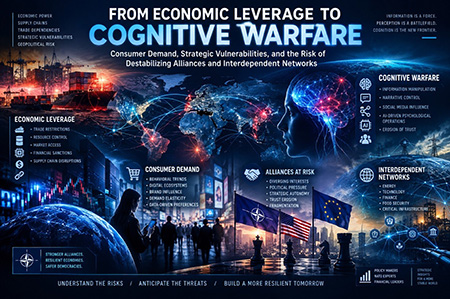
Consumer Demand, Strategic Vulnerabilities, and the Risk of Destabilizing Alliances and Interdependent Networks
There is a question that emerges when economic analysis moves beyond the relationship between consumers and companies and begins to examine the vulnerabilities of interconnected economies: what happens when a potential source of economic leverage becomes relevant to the strategic stability of an entire system?
The question is not whether consumers can influence markets, whether logistics can become a source of pressure, or whether economic disruptions can produce political consequences. Each of these phenomena is already familiar in different contexts.
The more unsettling question is whether a mechanism that appears limited at the commercial level could, under certain conditions, acquire consequences far beyond its original economic purpose.
This question has guided a research path developed through three articles and three essays, culminating in a preliminary feasibility study on selective fuel boycotts.
The progression has been deliberate: from the withdrawal of demand as a potential source of bargaining power, to the vulnerabilities created by dependence on logistical networks, and finally to the conditions under which a specific economic hypothesis might be examined empirically.
Yet this progression raises an additional question that cannot be answered by economic analysis alone. If a mechanism of economic pressure were shown to be feasible, measurable, and sufficiently predictable, what might happen if someone sought to use it not merely to influence a company’s behavior, but to exploit the vulnerabilities of a strategic sector and weaken the cohesion of an alliance?
The question deserves serious consideration precisely because it is not yet a conclusion.
1. The First Discovery: Demand Is Not Just Consumption
The starting point was The Power of Withdrawing Demand[1], which examined the possibility that consumers, by redirecting their purchases, could influence the economic incentives facing companies.
In ordinary market conditions, individual purchasing decisions are dispersed, and their effects may be difficult to distinguish from the continuous fluctuations of supply, demand, and competition. When purchasing decisions become sufficiently concentrated, however, the relationship may change.
Demand is no longer merely the aggregate outcome of individual preferences; it may become a potential source of bargaining power.
That possibility must not be confused with a guarantee of success. A company may lose sales without changing its behavior, recover lost volume through other customers, or absorb the initial impact without suffering a lasting economic disadvantage.
The result depends on market concentration, the availability of substitutes, the duration of the demand shift, and the company’s ability to withstand or offset the pressure.
The first lesson was therefore methodological as much as economic: a possible source of leverage is not proof of effective leverage. Before making claims about its consequences, one must identify the conditions under which the mechanism could work and the evidence required to establish that it actually did.
2. When the Vulnerability Lies in the Network
The second article, The Power to Paralyze: Logistics, Capital, and the Strategic Vulnerabilities of Modern Economies[2], expanded the analysis from purchasing decisions to the movement of goods and the organization of economic activity.
Modern economies depend on interconnected systems in which production, transportation, distribution, energy, and consumption are mutually dependent. The value of an asset may remain intact on paper while its practical usefulness is reduced by an interruption elsewhere in the network.
Economic power therefore cannot be understood solely by examining ownership; it must also account for the infrastructure and relationships that allow resources to move and economic activity to continue.
This perspective introduces a more difficult problem. A system can be vulnerable without being easy to control, and an interruption can impose costs without producing the concessions sought by those responsible.
The consequences depend on alternatives, recovery time, inventories, contractual arrangements, and the unequal capacity of different actors to absorb disruption.
Yet interconnectedness creates a condition that deserves attention: a disturbance originating in one part of a network may generate consequences elsewhere, sometimes far beyond the initial point of disruption.
The strategic significance lies not in assuming that an economy can be stopped indefinitely, but in understanding how dependencies may amplify an interruption and redistribute its costs.
3. From Economic Pressure to Strategic Exposure
The essays that followed developed these ideas along two complementary lines. When Demand Becomes a Weapon: Fuel Boycotts and the Limits of Corporate Power examined the possibility of a selective shift in fuel purchases and the conditions under which it might affect a company’s sales and commercial incentives.
The Power to Stop the Movement: From Truckers’ Protests to the Geopolitics of Demand: Logistics, Capital Accumulation, and the Strategic Vulnerability of Economies broadened the perspective to include logistical dependence, bargaining power, capital accumulation, and the relationship between economic vulnerability and strategic resilience.
Together, these contributions established an important distinction between the ability to impose costs and the ability to obtain a desired outcome. A disruption may be economically significant without changing corporate behavior; a change in corporate behavior may occur without altering public policy; and an economic disturbance may have no meaningful effect on the cohesion of an alliance.
Every transition introduces additional conditions and uncertainties. Nevertheless, the relationship between economic pressure and strategic exposure raises a question that cannot simply be dismissed: what if an economic mechanism were evaluated not only for its commercial effects, but also for its potential to influence the political environment in which those effects unfold?
4. The Cognitive Dimension: When Economic Events Acquire Political Meaning
Economic disruptions do not operate exclusively through prices, volumes, and financial losses. They also occur in a public environment in which events are interpreted, attributed, contested, and incorporated into broader narratives about institutional competence, political legitimacy, and national security.
A shortage, a price increase, or a disruption affecting a strategic sector may therefore have consequences beyond its immediate economic cost. Public perceptions of responsibility, fairness, and the ability of institutions to respond can influence how an event is understood and what political significance it acquires.
This is where the relationship with cognitive warfare becomes a legitimate subject of analysis. Cognitive warfare, broadly understood, concerns efforts to influence how people interpret information, assess events, and form judgments, often in ways that may affect collective behavior and political decision-making.
An economic disturbance and a cognitive operation are not the same thing, and the existence of the former does not establish the presence of the latter. But if economic vulnerabilities and information environments interact, the consequences may extend beyond the original market relationship.
A disruption could become a focus of competing interpretations, deepen existing disagreements, or undermine confidence in institutions. Whether this happens, who might benefit, and whether any such outcome was deliberately sought are separate questions that require evidence.
The concern, therefore, is not that every boycott is a form of cognitive warfare. Nor is it that every economic crisis represents an attempt to destabilize a country.
The concern is more precise: could an otherwise recognizable economic mechanism become one component of a broader effort to exploit existing vulnerabilities and intensify political divisions?
That possibility cannot be established merely by describing it. It must be examined through a framework that distinguishes economic effects, information dynamics, intentional activity, and demonstrable strategic outcomes.
5. The Alliance Problem
The implications become more serious when the economic system under consideration extends across national borders and links countries through trade, energy, transportation, finance, and shared security commitments. Alliances depend on more than formal agreements.
Their resilience is also influenced by the capacity of their members to manage economic shocks, maintain public confidence, coordinate responses, and distribute the costs of collective decisions.
A disturbance affecting one strategic sector may therefore become politically sensitive when its consequences are unevenly distributed across countries or when governments disagree about the appropriate response.
This does not mean that an economic disruption can automatically fracture an alliance. The cohesion of an alliance depends on political interests, institutional arrangements, alternative suppliers, fiscal capacity, public attitudes, and the ability of governments to cooperate under pressure.
Yet an economic shock may interact with these factors in ways that complicate collective decision-making. If one member bears a disproportionate cost, if the burden of adjustment becomes politically contentious, or if governments interpret the same event differently, an economic problem may become an additional source of friction.
The strategic question is not whether such consequences are inevitable, but whether particular dependencies could make them more likely under identifiable conditions.
This distinction matters because the potential consequences are serious even when the probability of a particular scenario remains uncertain. It would be irresponsible to claim that a selective consumer boycott could destabilize an alliance simply because a theoretical model identifies a possible economic effect.
It would be equally premature to dismiss every wider implication before examining the relevant dependencies and the evidence. Responsible analysis requires both restraint and attention: restraint in what is claimed, and attention to what may have been overlooked.
6. The Dangerous Gap Between Feasibility and Consequence
The preliminary feasibility study, From Protest to Consumer Bargaining Power: The Selective Fuel Boycott as an Economic Hypothesis: Feasibility Conditions, Theoretical Scenarios, and Prospects for Verification, addresses a specific part of this problem.
It examines whether a selective shift in fuel demand can be formulated as a researchable economic hypothesis, identifies the variables that would matter, explores illustrative scenarios, and considers what evidence would be required for empirical verification.
Its numerical examples are conditional calculations, not estimates of an actual company’s exposure, predictions of a real campaign’s results, or evidence that the proposed mechanism has already been demonstrated.
The distinction is fundamental. A preliminary feasibility study does not establish that an initiative would succeed in practice. It does not prove that demand could be redirected at the scale assumed in a scenario, that a company would respond in a particular way, or that any resulting change in prices or sales could be attributed to the intervention.
These questions require appropriate data, credible counterfactuals, and methods capable of separating the hypothesized effect from ordinary market developments.
A positive feasibility assessment means that a hypothesis may be worth investigating under specified conditions; it does not mean that the hypothesis has been empirically confirmed.
But this is precisely where the broader strategic question becomes difficult to ignore. If further research were eventually to establish that a particular form of economic pressure could produce measurable and sufficiently predictable effects under certain market conditions, the resulting knowledge would have implications beyond the immediate case.
It could improve understanding of economic resilience, help institutions identify vulnerabilities, and inform measures designed to reduce exposure. The same knowledge could also raise questions about how economic dependencies might be interpreted or exploited in a hostile strategic environment.
These are not equivalent uses, and recognizing the distinction is essential. Understanding a vulnerability for the purpose of strengthening resilience is not the same as demonstrating an intention or capacity to exploit it.
The danger lies in confusing the ability to describe a mechanism with the ability to control its consequences. Even when an economic effect is measurable, the wider political outcome may remain uncertain.
Companies can adapt, consumers may not behave as expected, alternative suppliers may absorb demand, governments may intervene, and public reactions may move in directions that no simple model can predict.
Economic feasibility, operational execution, political influence, and strategic destabilization are distinct stages. Evidence at one stage cannot substitute for evidence at the others.
7. If the Hypothesis Were Put Into Practice
Consider, then, the question that gives this research its most unsettling dimension. What if an economic mechanism initially examined as a possible means of consumer bargaining were eventually translated into a real-world initiative and produced effects beyond those anticipated?
The relevant concern would not be limited to the immediate losses or gains of individual companies. Depending on the sector and the surrounding conditions, the consequences might involve market responses, public controversy, pressure on policymakers, and competing interpretations of who was responsible for the disruption.
In a strategic environment already marked by distrust or political tension, such consequences could become part of a wider crisis.
That possibility should not be presented as a forecast, much less as proof that a particular initiative could be used to weaken an alliance. It is a conditional scenario whose likelihood and causal pathways remain to be established.
The outcome would depend on the scale and duration of the economic effect, the ability of the affected system to adapt, the response of public institutions, the distribution of costs, and the broader political context. A measurable commercial effect would not, by itself, establish a cognitive operation, a hostile intention, or a geopolitical result.
Nevertheless, the distinction between a hypothesis and a demonstrated effect does not make the question unimportant. It makes the question more urgent to investigate responsibly.
Strategic resilience requires institutions to understand how economic dependencies operate before a crisis occurs, rather than attempting to reconstruct those dependencies after disruption has already exposed them.
It also requires caution in attributing intent: an economic protest, a market disturbance, or a wave of public criticism should not automatically be interpreted as evidence of hostile interference. Unsupported attribution can itself deepen mistrust and undermine the cooperation that resilience is supposed to protect.
The central concern is therefore not that the mechanism has been proven capable of producing destabilization. It has not. The concern is that research into economic leverage may reveal questions about systemic exposure that deserve attention well before anyone can claim that the full chain of consequences has been demonstrated.
The responsible response is to investigate those questions, strengthen resilience where warranted, and preserve a clear distinction between evidence, inference, and speculation.
8. From a Possible Lever to a Testable Question
The three articles and three essays form a progression, but not a sequence in which each stage automatically proves the next. The first article examined whether the withdrawal of demand could become a source of economic leverage.
The second explored the vulnerabilities created by dependence on logistical networks. The essays developed these ideas through the analysis of fuel boycotts, economic bargaining power, capital accumulation, and strategic vulnerability.
The preliminary feasibility study then translated one specific hypothesis into a framework of variables, theoretical scenarios, assumptions, and conditions for possible empirical verification.
The significance of this progression lies in the discipline it imposes on the argument. It distinguishes vulnerability from leverage, leverage from successful bargaining, and economic consequences from political outcomes.
It also clarifies why the possibility of strategic exploitation must be assessed separately from the economic hypothesis itself. A study of consumer demand cannot, on its own, demonstrate that an alliance could be destabilized.
It can, however, help identify the economic questions that would have to be answered before broader claims could responsibly be evaluated.
The next stage is empirical investigation. That would require evidence capable of measuring actual changes in demand, information about the relevant market structure, and a credible method for estimating what would have happened in the absence of the proposed intervention.
Any assessment of wider strategic implications would require additional evidence about the institutional, political, and informational conditions through which an economic effect might acquire significance beyond the market. The analysis must remain proportionate to the evidence at every stage.
9. Why the Preliminary Study Matters
The third essay, attached to this article, From Protest to Consumer Bargaining Power: The Selective Fuel Boycott as an Economic Hypothesis: Feasibility Conditions, Theoretical Scenarios, and Prospects for Verification, marks the point at which the research moves from conceptual analysis toward a preliminary framework for investigation.
It does not claim that a selective fuel boycott has been shown to work, nor does it establish that such an initiative could destabilize a strategic sector, a state, or an alliance.
Instead, it specifies the variables that matter, examines illustrative scenarios, identifies the limits of available data, and clarifies the conditions under which the economic hypothesis could be tested more rigorously.
Readers are invited to engage with the study for precisely this reason. Its value lies not in presenting a dramatic conclusion, but in making the assumptions visible and the requirements of verification explicit. The numerical scenarios are not forecasts. The identification of a possible economic mechanism is not proof of effectiveness.
And the recognition of a potential strategic vulnerability is not evidence of a deliberate campaign to exploit it. These distinctions are not qualifications added to weaken the argument; they are what make the argument analytically defensible.
The larger question remains open. If a mechanism of economic pressure were eventually shown to be feasible under specified conditions, what additional evidence would be needed to determine whether its effects could extend into the informational and political environment?
Under what circumstances might an economic shock affect confidence in institutions or relations among allies? And what measures could reduce the risk that ordinary economic dependencies become sources of wider strategic exposure?
These questions extend beyond the preliminary study, but they explain why its findings and limitations deserve careful attention.
The purpose of this research is not to turn a theoretical possibility into an alarming certainty. It is to identify a possible mechanism, define the conditions under which it could be examined, and recognize the limits of what can currently be concluded.
That discipline is particularly important when economic analysis intersects with cognitive warfare and geopolitical competition, where the temptation to move too quickly from vulnerability to intention, or from correlation to causation, can be especially strong.
The most serious question is not whether an economic lever has already been proven capable of destabilizing an alliance.
It is whether we understand the dependencies that could make such a scenario conceivable, possess the evidence needed to assess its likelihood, and have taken the necessary steps to strengthen resilience before a crisis exposes the cost of not knowing.
That is why the preliminary feasibility study matters. It is not the end of the argument, and it is not proof of the most alarming scenario. It is a step toward determining what can be established, what remains uncertain, and which questions must be answered before economic leverage can be discussed responsibly in strategic terms.
[1] https://www.nuovogiornalenazionale.com/the-power-of-withdrawing-demand/
[2] https://www.nuovogiornalenazionale.com/the-power-to-paralyze/
Attached
From Economic Leverage to Cognitive Warfare