

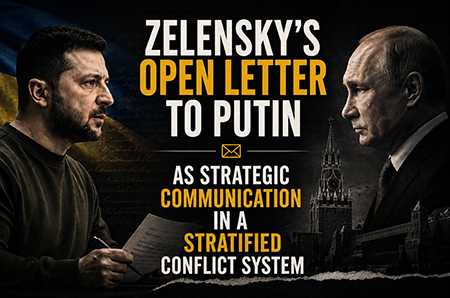
A Strategic Communication in a Stratified Conflict System
Abstract
This paper analyzes the open letter sent by Volodymyr Zelensky to Vladimir Putin on June 4, 2026, not as a mere diplomatic initiative, but as a multi-level strategic communication tool.
Through a qualitative analysis of the text, the argument demonstrates how the letter simultaneously addresses multiple audiences: the formal interlocutor (the Russian leadership), domestic public opinion, Western allies, and non-aligned international actors.
The study interprets the document’s structure in light of the literature on strategic communication, signaling, and the construction of strategic narratives, highlighting how the content is not exclusively oriented toward negotiation but also toward the preemptive definition of the interpretive frameworks for the Russian response.
Particular attention is devoted to the personalization of political responsibility, the management of the conflict’s strategic timing, and the framing of the negotiation choice as a politically observable act.
The analysis suggests that the letter should be read as a tool for narrative positioning within an international system characterized by competition among crises, growing multipolarity, and limited political attention from the great powers.
In this context, the document does not merely propose a possible channel for dialogue, but helps to preemptively shape the international perception of responsibilities and available options for the actors involved.
Methodological Note
This study adopts a stratified analytical approach based on the distinction between different levels of causality in geopolitical phenomena. This approach is situated within a broader tradition of strategic studies and international relations that includes structural realism, systemic theories, and multi-level approaches to conflict analysis.
The objective of the framework is not to reduce the complexity of the political phenomenon to a single explanatory variable, but rather to preserve its multilevel structure, analytically distinguishing between the structural, strategic, and operational dimensions.
The structural level concerns the long-term configurations of the international order, including historical legacies, security architectures, and established power distributions. These elements define the range of possibilities within which political actors operate, without mechanically determining individual outcomes.
The strategic level concerns the interaction between political and military actors, both state and non-state, who operate within structural constraints while pursuing objectives of security, influence, deterrence, and legitimacy. In this dimension, decisions are the result of mutual perceptions, incentives, and constraints within a context of continuous competition.
The operational level encompasses concrete and observable events, including military actions, political statements, and communicative acts. These events are not interpreted as autonomous sources of causality, but as temporary manifestations of deeper dynamics unfolding at the structural and strategic levels.
A central principle of this approach is that causality in geopolitical systems is not linear, but layered. Operational events do not generate systemic processes on their own, but rather function as accelerators, signals, or condensations of pre-existing tensions.
At the same time, structures do not rigidly determine outcomes, but rather delimit and orient the field of strategic possibilities.
The adopted model also differs from exclusively descriptive or monocausal approaches in that it requires constant integration across distinct analytical levels. An explanation is considered complete only when it maintains coherence between the structural, strategic, and operational dimensions without reducing one of them to the others.
Finally, the work maintains a clear separation between explanatory analysis and normative evaluation. The interpretation of the actors’ rationales for action does not imply any position on their political or moral legitimacy, which remains outside the scope of the analysis
Text
The open letter that Volodymyr Zelensky addressed to Vladimir Putin on June 4, 2026, deserves to be read carefully not only for its political content, but above all for the way it is structured.
At first glance, it might seem like a proposal for negotiations from the Ukrainian president to the Russian president. However, upon closer inspection, a more complex reality emerges.
The form is that of a direct communication between two heads of state; the function appears to be different. Rather than a diplomatic letter in the traditional sense of the term, the document appears to be a strategic communication effort designed to reach a variety of audiences simultaneously.
This is likely the first element to grasp in order to correctly interpret the text.
Formally, the addressee is Putin. In substance, the audience is much broader.
In the literature on strategic communication, this phenomenon is often described as communication to multiple audiences: the formal recipient of the message does not necessarily coincide with the audience intended to be influenced.
The letter, in fact, addresses the Ukrainian public, the Russian public, the political and economic elites in Moscow, Western allies, and those countries that in recent years have chosen to maintain a relatively independent stance vis-à-vis the major international blocs.
In other words, the document seems less interested in convincing Putin than in influencing how his eventual response will be interpreted.
In terms of political signaling, the central point is not only the content of the message but the interpretive framework within which the recipient’s reactions will be assessed.
This is the language of high-level international relations: a characteristic that emerges clearly from the very structure of the text.
The narrative follows a carefully constructed progression. Zelensky does not begin with the war, military responsibilities, or the conditions for a ceasefire. He begins with the past.
In fact, it is no coincidence that he recalls a period that tends to be forgotten today: the years when a significant portion of the Ukrainian population viewed Putin’s political rise favorably.
This is not a marginal detail. On the contrary, it is one of the most important elements of the entire narrative structure.
Through this reference, the Ukrainian president avoids presenting the conflict as the inevitable result of a permanent historical rivalry between two peoples. The war is not described as the natural outcome of a centuries-old rivalry nor as the product of an irreconcilable cultural incompatibility. The implicit message is different: an alternative history would have been possible.
Relations between Ukraine and Russia could have taken a different course. The choices that led to the war were not predetermined.
This premise sets the stage for one of the central themes of the entire letter: the personalization of political responsibility.
In fact, for most of the document, Zelensky avoids attributing the war to Russia
as a collective entity. The recurring subject is not the Russian people, nor is it, nor even the Russian state in a general sense. It is Putin.
This is a choice that evokes a familiar dynamic in the construction of strategic narratives: separating leadership from the nation’s body politic to keep open the possibility of a
future diplomatic reintegration. This distinction is significant.
Attributing primary responsibility to a single leader has very different political and communicative effects than attributing it to an entire nation. On the one hand, it allows one to delegitimize the adversary. On the other hand, it avoids completely closing the door on the possibility of future normalization of relations with the country he governs.
For this reason, the letter can also be read as an attempt to symbolically separate Russia’s fate from that of its current leader.
Of course, it is impossible to know to what extent this distinction reflects a genuine conviction and to what extent it responds to the demands of political communication. However, from a strategic standpoint, the choice appears consistent.
If the goal is to construct a narrative capable of speaking to segments of Russian society as well, attributing all responsibility to Russia as a whole would likely be counterproductive.
From this perspective, the document does not seem to speak only of the ongoing war. It also seems to speak of the Russia that might exist after the war.
This aspect becomes even more evident in the central part of the letter, where Zelensky develops a second line of argument that runs through much of the text: that of decline.
In this regard, it is interesting to note what the Ukrainian president chooses not to do.
He does not insist on the prospect of an imminent military defeat for Russia. He does not describe an imminent collapse of the Russian political system. He does not construct a narrative based on the idea that Moscow is nearing a breaking point.
His argument takes a different – and, in some ways, more sophisticated – path.
The problem is not presented as something that will happen suddenly. It is portrayed as a process already underway.
Military losses, the erosion of economic resources, difficulties in achieving stated objectives, growing dependence on North Korea and China, social discontent, and internal tensions are all placed within the same interpretive framework.
Considered individually, these elements can be debated, contested, or evaluated differently. Taken together, however, they paint a clear picture: that of a system which, in order to continue waging war, is forced to progressively deplete its own political, economic, and strategic capital.
And the difference is not trivial.
The letter does not argue that Russia is about to lose. It argues that the cost of continuing the conflict is rising steadily and that this process may, in the long run, become more significant than immediate developments on the battlefield.
From this perspective, the true protagonist of the narrative is not victory. It is time – that strategic element on which the Kremlin has staked so much and which now risks working against Moscow. And it is in this sense that the implicit message running through much of the text is that time is no longer working in the Kremlin’s favor.
Precisely for this reason, the unsparing reference to Putin’s age and the length of his time in power takes on particular significance.
From a strictly negotiating standpoint, this is an almost superfluous passage. It adds nothing to the conditions for a potential dialogue and can hardly be considered an incentive for negotiation. However, on a symbolic level, it plays an important role in that, for the first time, the conflict is placed within a broader historical perspective.
War ceases to be seen merely as a conflict between states and is linked to the duration of a political cycle.
When Zelensky refers to the twenty-six years Putin has spent in power, he is not simply recounting a timeline. He is suggesting that the war can be interpreted as a manifestation of the gradual exhaustion of a political model built around a particularly long-standing personal leadership.
This is an important nuance because it shifts the focus from war as an event to war as a symptom.
From this perspective, the issue is not limited to what is happening in Ukraine. It also concerns a political system’s ability to renew itself, adapt, and envision its own future.
Some of the most interesting passages in the letter seem to move precisely in this direction.
When Zelensky states that officials, businesspeople, and even propagandists now view the Russian leader with growing weariness, it is difficult to determine how much this assessment corresponds to reality.
However, from a communicative standpoint, the most important factor is not its absolute verifiability, but the audience to which it appears to be addressed.
Passages of this kind appear, in fact, less intended for Putin and more directed toward those segments of the Russian apparatus that might, sooner or later, be called upon to manage a subsequent phase of the current leadership.
And it is here that the letter takes on a dimension we might call metapolitical, because it is at this point that the document no longer speaks only of the war, but begins to speak of Russia’s future.
It does not simply attempt to influence the Kremlin’s behavior in the present. It also seeks to intervene in the debate – whether explicit or implicit – about what might come next.
And this is likely one of the reasons why the letter appears far more complex than a standard negotiating proposal.
Its ambition seems to be to act simultaneously on the diplomatic, symbolic, and narrative levels.
Certainly, the war remains the central theme, but as one reads on, it becomes increasingly clear that the true subject of the text is not merely the war itself, but rather the political significance it will assume in the judgment of history and the international community.
Essential Technical Bibliography
“Open Letter to the President of the Russian Federation from the President of Ukraine” original text https://www.president.gov.ua/en/news/vidkritij-list-prezidentu-rosijskoyi-federaciyi-vid-preziden-104769
Key Theoretical References
- Schelling, T. C. (1966). Arms and Influence. Yale University Press. (Essential for coercive diplomacy and signaling strategies)
- Fearon, J. D. (1994). “Domestic Political Audiences and the Escalation of International Disputes”. American Political Science Review. (Theoretical basis for audience costs)
- Putnam, R. D. (1988). “Diplomacy and Domestic Politics: The Logic of Two-Level Games”. International Organization. (A key reference point for triangular negotiation logic).
Strategic communication e narrative warfare
- Miskimmon, A., O’Loughlin, B., & Roselle, L. (2013). Strategic Narratives: Communication Power and the New World Order. (Central to the construction of strategic narratives)
- Entman, R. M. (2004). “Projections of Power: Framing News, Public Opinion, and U.S. Foreign Policy”. University of Chicago Press.;(Frame analysis applied to international politics)
- Nye, J. S. (2004). Soft Power: The Means to Success in World Politics.
- (Basis for non-coercive influence and the perceptual dimension)
Political Communication and Security
- Freedman, L. (2006). The Transformation of Strategic Affairs. Routledge. (The evolution of strategy in contemporary political communication)
- Betz, D. (2008). The Virtual Dimension of Contemporary Insurgency and Counterinsurgency. (Useful for understanding the informational dimension of conflict)
Background readings (optional but relevant)
- Allison, G. (2017). Destined for War: Can America and China Escape Thucydides’s Trap? (Systemic competition and multipolar order)
- Waltz, K. (1979). Theory of International Politics. (Structure of the international system)