

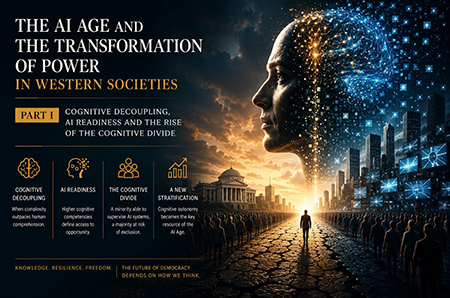
Cognitive Decoupling, Functional Literacy and the Rise of a Cognitive Supervisory Class
Abstract
This paper analyzes the cognitive, technological, and political transformation of Western societies in the AI Age, advancing a unified interpretive framework based on four interdependent theses.
The first thesis argues that contemporary Western societies are experiencing a structural cognitive decoupling: the complexity of technological, informational, economic, and geopolitical systems is increasing at a significantly faster pace than the average population’s capacity to understand, evaluate, and govern them through analytical reasoning. This gap is not marginal or temporary, but systemic.
It produces a progressive redefinition of what counts as functional literacy and drives an observable stratification of cognitive competencies across populations.
The second thesis holds that this decoupling is already reshaping democratic structures. Political conflict is gradually shifting away from disagreements over shared facts toward competition between incompatible perceptual realities.
In such a context, democratic stability depends less on access to information and more on the existence of shared epistemic validation mechanisms – mechanisms that are weakening under conditions of informational overload, algorithmic mediation, and declining critical literacy.
The third thesis identifies the hyper-psychologization of public discourse as a key amplifying force. As social, political, and economic phenomena are increasingly interpreted through psychological and emotional categories, public reasoning shifts from verification (“what is true”) to perception (“what feels true”).
This transformation does not eliminate rationality, but it displaces it, favoring identity-based interpretation over analytical reconstruction of reality, thereby intensifying polarization and epistemic fragmentation.
The fourth thesis – central to the argument – proposes that the AI Age introduces a new and more structurally consequential form of stratification within advanced societies. As artificial intelligence raises the effective cognitive threshold required for participation in economic, institutional, and political life, a new divide emerges: not primarily between income groups or educational levels, but between individuals capable of supervising AI systems and individuals who become increasingly dependent on them.
In this framework, cognitive autonomy becomes the decisive scarce resource of the AI Age.
Preliminary theoretical models based on OECD PIAAC distributions suggest that under a Level-3 functional threshold, only approximately 20–30% of the adult population in advanced economies may retain sufficient cognitive autonomy to reliably supervise AI systems.
Under a stricter Level-4 equivalence, this proportion may fall to approximately 10 – 20%, implying that in no advanced Western society would cognitive autonomy remain a majority condition.
This implies a structural inversion: cognitive capability ceases to be normally distributed around a broadly competent middle class and instead becomes increasingly concentrated in a minority segment that functions as a cognitive supervisory class.
The paper further advances the hypothesis that the decisive cleavage of the coming decades may no longer be between social classes in the traditional economic sense, but between cognitive roles: those who use AI to extend and enhance their reasoning, and those who increasingly use AI as a substitute for reasoning itself.
Under this scenario, cognitive autonomy becomes a form of power comparable to – and in some contexts more decisive than – wealth, formal education, or institutional status.
It is important to emphasize that these dynamics are not presented as deterministic outcomes, but as structural tendencies emerging from the interaction between cognitive constraints, technological acceleration, and institutional adaptation lags.
However, their directional force, once established, may significantly reshape both democratic competition and social hierarchy within advanced societies.
Ultimately, the AI Age may be defined less by the diffusion of artificial intelligence itself than by the unequal distribution of the capacity to critically govern it.
Methodological Note
This paper does not aim to produce statistical predictions or econometric estimates of cognitive performance across populations. Its objective is interpretive and structural: to identify macro-level trajectories emerging from the interaction between cognitive constraints, technological acceleration, and delays in institutional adaptation in advanced societies.
Where quantitative data are used (including OECD–PIAAC distributions and related international assessments), they serve as structural proxies, not as direct measures of individual cognitive ability or deterministic predictors of behavior.
In particular, literacy, numeracy, and adaptive problem-solving scores are used as operational indicators of functional cognitive capacity, understood as the ability to process information, evaluate uncertainty, and act effectively in complex environments.
Any thresholds discussed (e.g., Level 2, Level 3, Level 4 equivalences) should therefore be interpreted as analytical constructs, used to model shifts in the minimum cognitive requirements imposed by increasingly AI-mediated environments, rather than as rigid psychological or clinical categories.
Similarly, all percentage ranges presented in the paper are theoretical extrapolations derived from observed distributional patterns, not direct empirical measurements of “AI readiness” or cognitive autonomy in the strict sense. Their purpose is to illustrate the structural implications of uneven cognitive distributions under changing technological conditions.
The framework adopted is explicitly non-deterministic. It does not claim that the described dynamics will unfold uniformly across countries or social groups, nor that they are immune to institutional, cultural, or political mediation. Instead, it proposes that once certain cognitive thresholds become ì binding, they may generate system-level effects that are robust even under heterogeneous local conditions.
In this sense, the paper operates at the intersection of cognitive sociology, political theory, and systems analysis, rather than within the domain of predictive behavioral science.
Even if the estimates were incorrect in their absolute values, the direction of the phenomenon would remain unchanged.
The model is falsifiable in magnitude, not in direction and this means that it should be read as a structural hypothesis about directionally robust transformations in cognitive stratification under AI acceleration, rather than as a point-estimate forecast of their magnitude.
1. Evolution of Cognitive Competencies in Western Societies
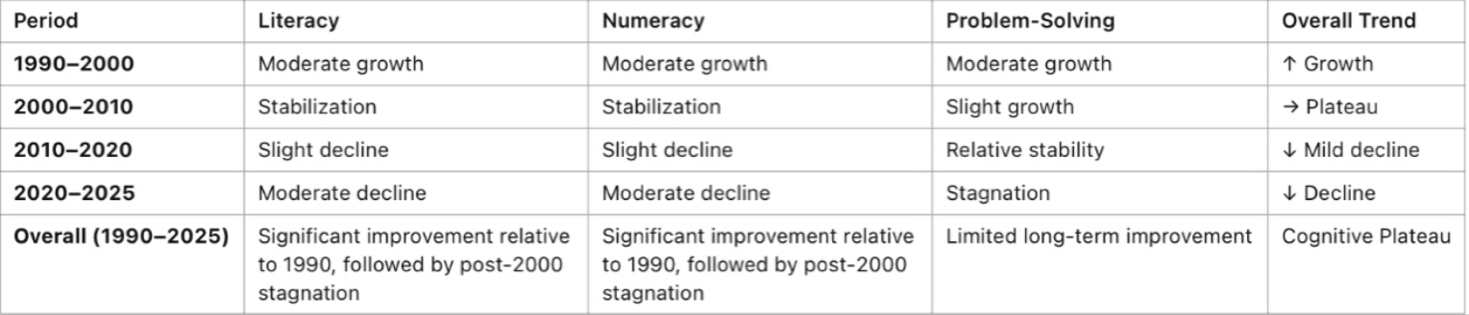
Analyzing trends in the average educational level and analytical-deductive abilities of the Western population aged 16 to 65 requires the use of indirect indicators, since concepts such as “educational level” and “cognitive competencies” cannot be measured directly.
The most authoritative sources are the data from the OECD’s PIAAC program (Programme for the International Assessment of Adult Competencies), which assesses competencies in literacy, numeracy, and adaptive problem-solving.
The most recent results reveal a significant trend: in most developed countries, average competencies are stagnant or in slight decline. This phenomenon primarily affects the less educated segments of the population and is accompanied by an increase in the proportion of adults classified at the lowest levels of the measured competencies.
If one considers the combination of critical text comprehension, quantitative reasoning, and problem-solving as an indicator of analytical-deductive abilities, a general improvement across the West does not emerge; rather, a phase of stagnation or slight regression is evident.
The countries currently ranking highest are Finland, Sweden, Norway, the Netherlands, and Denmark, with Japan joining them at the global level. Conversely, Italy, Spain, Portugal, and parts of Eastern Europe remain below the average of the most advanced economies.
The historical trajectory appears particularly significant:
• 1950 – 1990: strong growth in competencies;
• 1990 – 2005: slowed growth;
• 2005 – 2015: substantial stagnation;
• 2015 – 2025: slight average decline.
At the same time, there has been a widening gap between the most competent and the least competent segments of the population. In many countries, the top 10% continues to improve, while the bottom 10% shows a decline.
An important point is that the data do not appear to indicate a reduction in average intelligence in the strict sense, but rather a decline in the skills used on a daily basis: in-depth reading, quantitative reasoning, and critical analysis.
2. The raising of the threshold in the AI Age
The advent of artificial intelligence has radically changed the concept of functional literacy.
In the twentieth century, it was generally sufficient to be able to read texts of moderate complexity, understand instructions, perform simple calculations, and retrieve information.
In the AI Age, however, skills such as the following are becoming increasingly important:
• evaluating the reliability of information;
• formulating precise requests to intelligent systems;
• verifying the outputs generated by AI;
• integrating different sources;
• dealing with unstructured problems;
• recognizing logical errors and hallucinations;
• continuously learning new procedures.
Functional literacy therefore tends to shift from simple comprehension to cognitive supervision.
If we assume that the minimum threshold shifts from level 2 to level 3 on the PIAAC scales, many citizens currently considered fully competent would no longer meet the requirements necessary to effectively use tools based on artificial intelligence.
In this scenario, the Nordic countries would likely remain the most resilient, thanks to the high quality of their educational systems, strong digitalization, and the widespread development of problem-solving skills.
A possible ranking of cognitive resilience in the AI Age would place Finland, Denmark, Sweden, the Netherlands, Norway, Switzerland, and Germany at the top.
Mediterranean countries – and in particular Italy, Portugal, and Greece – could instead see a sharp increase in the proportion of their populations falling below the new threshold for functional literacy.
Table 1: Comparative analysis based on PIAAC data, OECD series, international education surveys, and historical trends in cognitive skills (1990/2025)
3. The Great Cognitive Divide: The Rise of an AI-Ready Minorit
If a more demanding definition of functional literacy is adopted – one comparable to the competencies currently associated with PIAAC Level 4 – a substantially different and more radical picture emerges.
Under this framework, the critical question is no longer whether individuals can use artificial intelligence, but whether they can supervise it effectively. The distinction becomes one between using AI as a cognitive amplifier and using AI as a cognitive substitute.
Competencies associated with this threshold include the ability to:
- evaluate the reliability of multiple sources;
- integrate contradictory information;
- detect logical inconsistencies and AI hallucinations;
- monitor complex cognitive processes;
- adapt to changing informational environments;
- solve non-routine and poorly structured problems.
These abilities correspond closely to what the OECD identifies as advanced adaptive problem-solving competencies and represent a substantially higher threshold than the one traditionally associated with functional literacy.
Although current PIAAC surveys were not designed specifically to measure AI readiness, their competency distributions allow the construction of a theoretical model of cognitive resilience in the AI Age.
Scenario A: Functional Literacy Redefined
If the minimum threshold for effective participation in an AI-mediated society shifts from approximately PIAAC Level 2 to Level 3, the proportion of adults considered functionally competent would decline significantly in most advanced economies.
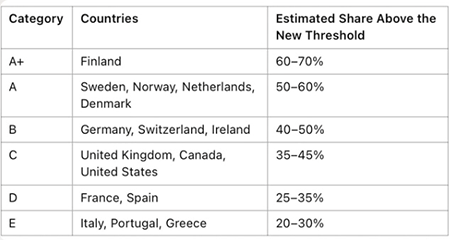
A theoretical AI Cognitive Resilience Index, combining literacy, numeracy, adaptive problem solving, the proportion of high-performing adults, and overall educational quality, suggests the distribution showed in the table.
These figures are not directly observed data but theoretical estimates derived from current PIAAC competency distributions.
The implications are substantial. Many countries that currently appear adequately prepared for technological transformation would see a large share of their population fall below the new functional threshold required for effective AI supervision.
The American Paradox
One particularly noteworthy case is the United States.
The United States hosts what is arguably the world’s most powerful technological ecosystem and some of the strongest scientific and entrepreneurial elites. However, OECD data indicate a highly polarized distribution of competencies.
While the upper segment of the population performs at world-class levels, average literacy, numeracy, and problem-solving results are considerably less exceptional. The primary vulnerability is therefore not the top of the distribution, but the relative weakness of the middle segment.
As a result, if the threshold of functional literacy were raised to Level 3, the United States could experience a larger proportional decline in functionally competent adults than several Nordic countries despite maintaining leadership in technological innovation.
The Italian Case
Italy represents one of the most fragile cases among advanced economies.
The issue is not the absence of highly capable individuals. Italian researchers, engineers, professionals, managers, and STEM graduates routinely compete successfully at the international level.
The challenge lies in the distribution of competencies across the broader population.
Italy already performs below the OECD average in literacy, numeracy, and adaptive problem solving. If the definition of functional literacy evolves from the ability to understand information toward the ability to critically supervise AI-generated outputs, it is plausible that more than half of the adult population could fall below the new threshold.
Scenario B: The Level-4 Threshold
An even more demanding scenario emerges if true AI readiness is defined according to competencies roughly equivalent to current PIAAC Level 4.
Under this definition, individuals would need to demonstrate the capacity to manage highly complex information environments, reconcile contradictory evidence, operate under uncertainty, and continuously adapt to changing contexts.
Current OECD evidence suggests that only a small minority of adults reach such levels of performance.
Based on existing competency distributions, a theoretical estimate would place the proportion of genuinely AI-ready adults at approximately:
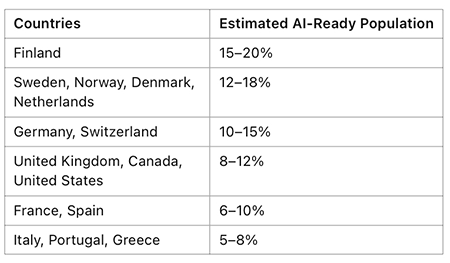
Even under optimistic assumptions, no Western country would possess a majority of citizens capable of using AI primarily as a cognitive amplifier.
In most advanced democracies, between 80% and 95% of the adult population would remain below this more demanding threshold.
The Emerging Cognitive Divide
The most consequential divide of the AI Age may therefore not emerge between countries but within countries.
A growing distinction could develop between:
- approximately 10–20% of the population that uses AI to think better;
- approximately 80–90% that primarily uses AI to avoid thinking.
Under a less demanding Level-3 threshold, the division might instead approximate:
- 20 – 30% using AI as a cognitive amplifier;
- 70 – 80% using AI primarily as a cognitive substitute.
If this interpretation is correct, the principal social fracture of the coming decades may no longer be defined primarily by income, formal education, occupation, or social class.
Rather, it may be defined by the capacity to maintain cognitive autonomy in environments increasingly mediated by artificial intelligence.
By 2035, the difference between cognitively augmented minorities and cognitively dependent majorities could become more politically, economically, and socially significant than many of the traditional cleavages that shaped industrial societies.
Even the highest-performing countries, including Finland and Sweden, could experience a growing separation between a cognitively empowered minority and a majority that delegates an increasing share of its analytical functions to intelligent systems.
The Emergence of a New Cognitive Stratification
If these trends continue, the most important social divide of the AI Age may not be economic, educational, or even technological.
It may be cognitive.
The decisive distinction would separate those capable of supervising intelligent systems from those increasingly dependent on them; those who use AI to expand their reasoning from those who use it to replace reasoning altogether.
Under such conditions, cognitive autonomy may become a strategic resource comparable to wealth, political influence, or access to technology.
The emergence of this divide would not simply produce differences in productivity or income. It could progressively generate a new form of social stratification based on the unequal distribution of advanced cognitive competencies.
In this sense, the AI Age may not merely transform labor markets, institutions, or geopolitical competition. It may also redefine the very structure of social hierarchy within advanced societies.
If the central divide of industrial societies was the distribution of wealth, the central divide of the AI Age may increasingly become the distribution of cognitive autonomy. The consequences of this transformation extend far beyond economics or technology, reaching the very foundations of democratic governance, social cohesion, and political power.
Essential bibliography
Cognitive skills and PIAAC
- Organisation for Economic Co-operation and Development (OECD)
- (2024). Do Adults Have the Skills They Need to Thrive in a Changing World? Survey of Adult Skills 2023. Paris: OECD Publishing.
- (2019). Skills Matter: Additional Results from the Survey of Adult Skills. Paris: OECD Publishing.
- (2016). The Survey of Adult Skills: Reader’s Companion (Second Edition). Paris: OECD Publishing.
Complexity, knowledge and cognitive limits
- Simon, H. A. (1971). Designing Organizations for an Information-Rich World. In M. Greenberger (Ed.), Computers, Communication and the Public Interest.
- Simon, H. A. (1996). The Sciences of the Artificial (3rd ed.). MIT Press.
- Polanyi, M. (1966). The Tacit Dimension. University of Chicago Press.
Rationality, bias and decision
- Kahneman, D. (2011). Thinking, Fast and Slow. Farrar, Straus and Giroux.
- Tetlock, P. E., & Gardner, D. (2015). Superforecasting: The Art and Science of Prediction. Crown Publishing.
Democracy, public sphere and validation of knowledge
- Habermas, J. (1984). The Theory of Communicative Action. 1. Beacon Press.
- Habermas, J. (1987). The Theory of Communicative Action. 2. Beacon Press.
- Sunstein, C. R. (2017). #Republic: Divided Democracy in the Age of Social Media. Princeton University Press.
Polarization, identity and cognitive fragmentation
- Haidt, J. (2012). The Righteous Mind: Why Good People Are Divided by Politics and Religion.
- Haidt, J. (2024). The Anxious Generation. Penguin Press.
- Mason, L. (2018). Uncivil Agreement: How Politics Became Our Identity. University of Chicago Press.
Technology, algorithms and society
- Zuboff, S. (2019). The Age of Surveillance Capitalism.
- Postman, N. (1985). Amusing Ourselves to Death. Penguin Books.
- Postman, N. (1992). Technopoly: The Surrender of Culture to Technology.
Cognitive warfare and informational competition
- NATO Innovation Hub. (2021). Cognitive Warfare.
- Paul, C., & Matthews, M. (2016). The Russian “Firehose of Falsehood” Propaganda Model. RAND Corporation.
Artificial intelligence and cognitive transformation
- Brynjolfsson, E., & McAfee, A. (2014). The Second Machine Age. W.W. Norton.
- Bengio, Y., Hinton, G., & LeCun, Y. (2021–2025). Articles and public interventions on cognitive transformation induced by AI systems.