
The Predictive Frontier: AI in International Analysis
Artificial intelligence is rapidly becoming an increasingly important tool for those who need to navigate the growing mass of information that fuels political and international analysis.
But just as we’re learning to use it more effectively, another, perhaps even more important question arises: can we use it not only to better understand what has happened, but also to anticipate what might happen?
This question also arises from reading the recent set of guidelines developed by Professor Marco Mayer for using AI in the analysis of international events.
His “Slow AI International Monitor” offers a set of very useful rules for avoiding some of the most common mistakes in applying these models: do not delegate judgment to AI, ask precise questions, verify sources, use original languages, subject responses to stress tests, look for omissions, distinguish between facts and conjecture, verify the difference between prior knowledge and online research, and compare different platforms.
It’s an approach I consider particularly important because it addresses a problem that has now become critical: AI can vastly increase our ability to process information, but it can also amplify our errors, our biases, and those built into the models.
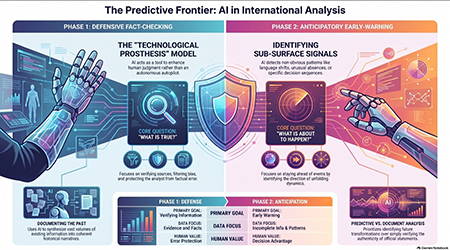
The idea of AI as a “technological prosthesis” – rather than an autopilot – is probably the right starting point. The goal should not be to delegate our judgment to the machine, but to use it to subject our judgment to broader and more rigorous scrutiny.
However, in my view, there is a further issue that deserves to be addressed. A method based primarily on verifying sources and testing hypotheses is particularly effective for determining what we know, how reliable a piece of information is, and which interpretations are tenable.
But prediction belongs to a different realm. When the goal becomes understanding what might happen, it is no longer enough to ask whether a piece of information is true, nor how authoritative the source conveying it is.
The problem becomes much more difficult: which elements of the present can foreshadow the future?
Here, a fundamental difference between document analysis and predictive analysis becomes apparent. The information that is easiest to verify is not necessarily the most useful for predicting an event.
An official statement may be perfectly authentic yet have very limited predictive value. Conversely, seemingly minor behavior, an unusual choice, a shift in language, a discreet meeting, an appointment, a postponement, an absence, or a particular sequence of decisions can take on much greater significance when observed in context.
This is not, of course, about legitimizing speculation or substituting assumptions for evidence. It is a matter of recognizing that forecasting, by its very nature, must also work with incomplete information.
The future event has not yet been documented. If it were, it would no longer be a prediction. The analyst’s task, therefore, necessarily consists of formulating hypotheses based on elements that, taken individually, may not constitute evidence but which, when considered as a whole, may indicate a possible course of events.
This is probably where AI presents one of its most interesting challenges. These models are extraordinarily effective at collecting, organizing, comparing, and synthesizing a volume of information that no single analyst could process with the same speed.
But it is precisely this ability that can produce a paradoxical effect: they tend to construct a coherent narrative based on the available information. The coherence of this reconstruction, however, does not necessarily equate to predictive ability.
An analysis can be flawless from a factual standpoint yet completely wrong in terms of prediction. It can explain very well why something happened without being able to tell us what will happen next.
And this difference is anything but theoretical. In international politics, crises, power transitions, and conflicts, understanding a dynamic after it has unfolded may be far less valuable than the ability to identify its possible direction in advance.
From this perspective, the real challenge may be to transform AI from a fact-checking tool into an early-warning tool. No longer just a machine to which we ask, “Is this news reliable?” or “What are the different interpretations of this event?”, but also a tool to which we can pose much more difficult questions.
What developments are consistent with what we are observing?
Which hypotheses are most plausible?
What future behaviors should we expect if a particular interpretation were correct?
And above all: what signs should we look for to understand in advance that a certain dynamic is taking shape?
This is a frontier that remains entirely to be explored. And precisely for this reason, it would likely be a mistake to expect to resolve it simply by expanding the protocols currently used to verify information. Prediction requires a different way of analyzing data, assessing uncertainty, and testing hypotheses.
This issue takes on particular significance when shifted from the individual level to the institutional level. Governments, security agencies, diplomatic missions, large corporations, and international organizations already possess enormous amounts of information.
The problem is not merely gathering more information, but being able to promptly identify which pieces of information may indicate an ongoing transformation.
In this sense, AI could be more than just a powerful search engine or an advanced system for verifying sources. It could become a tool capable of assisting analysts in identifying dynamics that are not yet fully visible.
But it would be a mistake to assume that this capability is already available. It must be studied, tested, and, above all, verified.
In my view, therefore, we should launch a second phase of research on the use of artificial intelligence in international analysis.
The first phase concerns defense: how to avoid fake news, bias, manipulation, errors in sources, and superficial interpretations.
The second phase should focus on anticipation: understanding whether and to what extent AI can help to promptly identify the evolution of a crisis, a political transition, a conflict, or an international strategy.
This is an important distinction.
The first question is: “What is true?” The second is: “What is about to happen?”
The first protects the analyst from error. The second could help a decision-maker stay one step ahead of events.
Perhaps this is precisely the next frontier of artificial intelligence applied to geopolitical analysis. Not to replace the analyst, as Mayer rightly points out, but to equip him or her with a tool capable not only of looking further into the past and present, but also of helping him or her see, as far as possible, what has not yet become evident.
To achieve this result, however, a more powerful algorithm alone is not enough. It requires research, experimentation, interdisciplinary collaboration, and above all, a method. And this is perhaps the area worth investing in right now.