

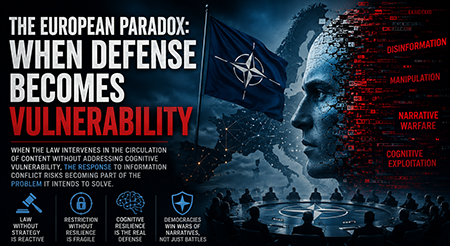
When the law regulates the circulation of content without addressing cognitive vulnerability, the response to information conflict risks becoming part of the problem it aims to solve
On July 2, 2026, the Court of Justice of the European Union issued its ruling in Case C-67/25, which is likely to mark a turning point in the relationship between the law, freedom of information, and cognitive warfare.
The decision stems from proceedings initiated in Germany against individuals accused of reposting content from Russia Today (RT), a broadcaster subject to the European sanctions regime adopted following Russia’s invasion of Ukraine.
The Court upheld a broad interpretation of European law, holding that the ban on dissemination may also apply to private individuals who make the content of a sanctioned media outlet accessible to the public once again.
This is a legally significant decision that has immediately reignited the debate on the delicate balance between combating propaganda, freedom of expression, and the effectiveness of European strategies against cognitive warfare.
And it is precisely this last aspect that is worth examining in more detail.
The German ruling c-67/25 and the European paradox: when defense becomes a weakness
While the decision appears consistent with the European sanctions framework from a legal standpoint, it raises far more complex questions from a strategic perspective.
The European Court of Justice’s ruling in Case C-67/25 marks a turning point that cannot be dismissed as a mere technical detail of sanctions law.
On the contrary, it represents a prime example of how Europe is addressing cognitive warfare by resorting to legal instruments designed for an information ecosystem that has long since ceased to be the traditional one.
The context is that of the European sanctions regime imposed on certain media outlets linked to the Russian Federation, including RT (Russia Today), as part of the measures introduced following the invasion of Ukraine.
With this decision, the Court confirms a broad interpretation of the dissemination ban, holding that it may also apply to non-professionals who make content from sanctioned media outlets accessible to the public again.
From a legal standpoint, the framework appears consistent: if an entity is subject to sanctions, it is logical to also limit its ability to disseminate content. But this is precisely where the crucial question arises.
The crux of the matter is not the legal consistency of the decision, but rather its strategic effectiveness in a radically transformed information ecosystem, in which information no longer follows traditional distribution channels and narratives outlive their very carriers.
The first effect: the logic of the block in the economy of attention
In the analog world, restricting a channel meant actually limiting access to information.
In the digital world, the dynamics are radically different:
• content is no longer tied to the source;
• the source is no longer necessary for the message to circulate;
• replication is instantaneous and decentralized;
• the narrative survives the platform.
In this context, a formal ban has an ambiguous effect:
• it does not necessarily suppress the content, but can displace it, fragment;
• it, and sometimes amplify its symbolic significance.
This is not an automatic process, but a structural risk inherent in the contemporary information ecosystem.
The second level: cognitive warfare is not a matter of sources, but of interpretation
The most significant strategic flaw in the purely restrictive approach is conceptual rather than operational.
Cognitive warfare is not based solely on the dissemination of false or manipulative content.
It is based on the management of:
• interpretive frames;
• political emotions;
• selection of evidence;
• building trust in or distrust of institutions;
• information saturation.
In this scenario, blocking a source does not eliminate the narrative. At most, it eliminates a vector.
But the channel isn’t the main problem: the recipient’s mental framework is the real battleground.
The third level: the paradoxical effect of the ban
In a polarized environment, measures perceived as restrictive can have three unintended consequences:
1. increased curiosity about the banned content;
2. reinforcement of the narrative of censorship;
3. deepening mistrust of regulatory institutions.
This is not a universal rule, but a recurring risk in highly polarized communication dynamics.
The key point is that legal measures alone do not address the cognitive mechanism that makes the content effective.
The real issue: a defense based solely on restriction is incomplete
This is where the real strategic problem arises.
If the goal is to reduce the effectiveness of influence operations, then a strategy based almost exclusively on:
• bans;
• removals;
• dissemination sanctions;
is structurally incomplete.
Not because it is illegitimate, but because it fails to address the decisive factor: citizens’ ability to recognize, interpret, and neutralize persuasive techniques.
The real alternative: systemic cognitive resilience
The most robust response to cognitive warfare is not exclusively repressive. It is educational and structural.
This means:
• advanced media literacy;
• recognition of manipulation techniques;
• understanding of cognitive biases;
• logical and inferential skills applied to political content;
• proactive exposure to disinformation strategies (prebunking).
In other words: do not prevent citizens from seeing the content, but rather equip them to recognize its structure.
A democracy is truly resilient not when it bases its defense on preventing citizens from accessing propaganda, but when it invests in their ability to recognize, understand, and critically evaluate it.
The European paradox
And this is where the most sensitive issue comes into play.
A society that invests little in the structural cognitive education of its citizens and prioritizes regulatory measures aimed at containment risks finding itself in a fragile position:
• reactive rather than preventive;
• regulatory rather than cognitive;
• defensive rather than resilient.
The result is not necessarily the failure of these measures, but their potential partial ineffectiveness in an adaptive information environment.
Conclusion: between law and strategy
Judgment C-67/25 is legally consistent with the framework of European sanctions. This point is not in dispute.
The question is another: Does legal consistency coincide with strategic effectiveness in a complex cognitive environment?
This is where the real debate begins. Not the debate over the legitimacy of the measures, but over their ability to truly influence the dynamics they aim to counter.
Because in a saturated, interconnected, and highly adaptive information ecosystem, the risk is not merely that the problem will remain unsolved.
The risk is that the solution itself becomes part of the very dynamic it is meant to govern.
But perhaps the decisive point is yet another.
The Court’s ruling is not the problem. It is a symptom of a much deeper problem.
The problem the ruling overlooks
So far, we have discussed the ruling of the Court of Justice of the European Union and the strategic effectiveness of the regulatory tools used to counter propaganda and influence operations.
But, on closer inspection, the ruling is only the visible part of a much deeper problem.
The question then becomes unavoidable. If the problem is the cognitive vulnerability of the audience – and not merely the circulation of content – we must ask ourselves where that vulnerability stems from. This is where the discussion takes a completely different turn.
The true battlefield of cognitive warfare is not, in fact, the platforms, algorithms, or individual pieces of content. All of these are merely the vectors through which influence manifests itself.
The real battlefield is society’s cognitive structure.
This is why I continue to believe that any strategy based primarily on controlling the flow of information is insufficient. Such an approach addresses the symptoms, not the causes.
The perspective proposed here does not stem from a casual reflection, but rather represents the culmination of a research project dedicated to the systemic effects of the hyperpsychologization of Western societies and its impact on the cognitive resilience of democracies.
My thesis is that Western societies are undergoing a process of progressive hyperpsychologization of social life.
I do not intend to discuss the importance of psychology as a scientific discipline, nor do I intend to question the value of psychological treatment.
The problem lies elsewhere.
Psychological culture has gradually moved beyond the clinical sphere to become a full-fledged cultural force capable of shaping the way millions of people interpret reality.
Increasingly, social, political, and even geopolitical phenomena are interpreted through eminently psychological categories: emotions, perceptions, individual vulnerabilities, identity needs, subjective well-being, and personal narratives.
This transformation yields undoubted benefits in many respects, but it also generates a largely underestimated side effect.
The focus is gradually shifting from the analysis of structures to lived experiences; from systemic processes to individual experiences; from collective dynamics to the emotions of individuals.
It is precisely in this space that cognitive warfare finds particularly fertile ground.
A population educated primarily to interpret reality through individual psychological categories risks, in fact, becoming less equipped to recognize far more complex phenomena such as:
• the strategic construction of narratives;
• the manipulation of interpretive frames;
• coordinated influence operations;
• the artificial creation of consensus;
• cognitive saturation techniques;
• planned polarization dynamics.
Paradoxically, as awareness of how the individual psyche functions grows, the ability to understand the cognitive functioning of social systems may diminish.
This, in my view, is the most significant strategic vulnerability of the contemporary West.
And this is why I view the European ruling not so much as a legal error as a symptom of a much deeper problem.
When a society comes to believe that the problem can be addressed primarily by restricting the circulation of certain content, it means that it has already shifted its focus from building cognitive resilience to the administrative management of information.
The difference is enormous.
In the first case, citizens are shaped in such a way that they become progressively more difficult to manipulate.
In the second, attempts are made to manage an information environment populated by citizens who remain vulnerable to the very cognitive mechanisms that we would like to counteract.
And this is precisely where the real transnational security problem emerges.
Cognitive warfare is not primarily fought on servers, on platforms, or in courtrooms.
It is fought, long before that, within the cultural fabric of democratic societies.
And it is this structure that, today, should become the true focus of political, educational, and strategic reflection.
As long as we continue to fight cognitive warfare by focusing primarily on content rather than on citizens’ cognitive abilities, we will continue to chase the effects while neglecting the causes.
And no society can truly consider itself secure if it fails to build its resilience in the very place where every cognitive war is won or lost: the minds of its people.