
Debt, Rearmament, Finance, and the Economic Cost of Peace
War is not merely the destruction of capital, infrastructure, human lives, and productive capacity.
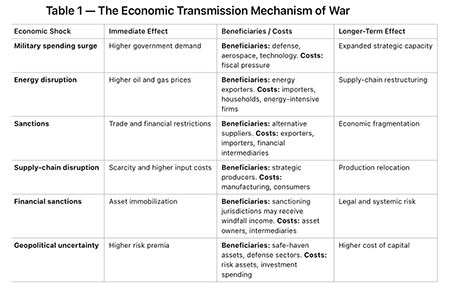
It is also a massive machine for reallocating demand, capital, investment, technology, energy, labor, risk, and power. It destroys wealth, but at the same time creates new demand, new markets, new investments, new debt, and new economic interests.
That is why it is not enough to ask who profits from war. The most important question is to understand what economic structure war builds while destroying the previous one.
Because a war can impoverish a system as a whole and, at the same time, create sectoral winners – companies that see an increase in orders, states that increase spending, intermediaries that collect commissions, investors who find new opportunities, and financial assets that take on a different value. Destruction can thus simultaneously be a transfer of value.
1. War as a demand shock
A war primarily produces a demand shock. The government becomes the primary purchaser of a range of goods and services: weapons, ammunition, electronic systems, satellites, software, cybersecurity, logistics, energy, transportation, and infrastructure.
Public spending enters the economy, generating revenue, employment, investment, and – through the multiplier effect – further consumption. This is why a war can even boost GDP.
But this is where the first misunderstanding arises. GDP measures recorded output, not the net wealth generated by that output. If a government spends 100 to build a weapons system, that 100 enters aggregate demand. But that 100 does not automatically produce 100 in social capital, infrastructure, education, health, or future productivity.
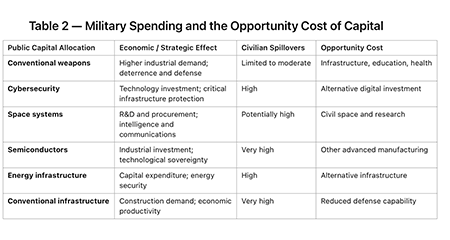
The economic value of that spending depends on the strategic function it serves, the technological capacity it generates, the industrial and civilian returns it produces, and, above all, the opportunity cost of what is not funded.
The International Monetary Fund has recently quantified this very trade-off: during periods of sharp increases in defense spending, economic activity may accelerate in the short term, but inflation, deficits, and debt also rise; during times of war, the increase in debt tends to be even more pronounced.
War, therefore, can be expansionary for certain sectors without necessarily being expansionary for real wealth as a whole. And it is this distinction that we must always keep in mind.
2. The opportunity cost of rearmament
Rearmament is not necessarily a waste. It can be a rational response to an increase in geopolitical risk. It can spur research, innovation, skilled employment, technological infrastructure, industrial capacity, and even civilian benefits.
But it is not economically free. Every euro allocated to security is a euro that cannot simultaneously be allocated to another purpose. The issue, therefore, is not choosing abstractly between defense and growth.
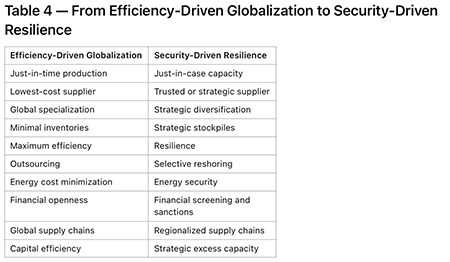
The challenge is to understand which combination of spending, investment, and security maximizes an economic system’s future capacity. This is where the shift from a logic of pure efficiency to one of resilience comes into play.
For decades, globalization has favored just-in-time production, inventory reduction, production specialization, geographic concentration, and the search for the cheapest supplier.
The new paradigm, however, leans toward “just-in-case”: more inventory, more suppliers, more redundant production capacity, more alternative infrastructure, and greater energy and technological autonomy.
The problem is clear: resilience requires redundancy. And redundancy requires capital. What was once considered inefficiency can now be viewed as strategic insurance. But insurance comes at a cost.
3. Europe and the emergence of a new industrial cycle
Europe had built a significant part of its economic model on reducing duplication, trade liberalization, production specialization, the integration of value chains, and the availability of relatively competitive energy.
Geopolitics has gradually transformed security from a predominantly military function into an industrial, energy, technological, fiscal, commercial, and financial variable.
The transition is almost automatic: threat → risk → military spending → government contracts → production capacity → investment → employment → technology → capital. Once set in motion, this chain can continue even as the conflict changes form.
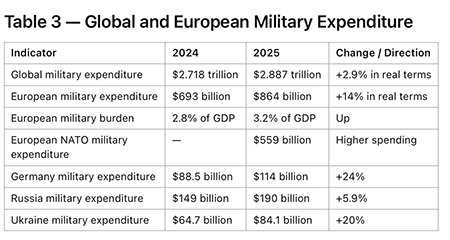
The figures already illustrate the scale of the phenomenon. According to SIPRI, global military spending reached $2,887 billion in 2025, representing a real increase of 2.9%; European military spending grew by 14%, reaching $864 billion.
Spending by European NATO members reached $559 billion. Russia and Ukraine increased their military spending to approximately $190 billion and $84.1 billion, respectively. This is not merely a budget increase.
It marks the beginning of a new industrial cycle. Because increasing military spending means increasing the production capacity needed to support it.
It means expanding facilities, hiring staff, funding research, developing components, building new supply chains, increasing strategic stockpiles, and establishing multi-year contracts. And a multi-year contract is not just a budget line item. It’s an industrial forecast.
4. The security industry complex
This phenomenon no longer concerns only the traditional arms industry. Contemporary warfare involves electronics, artificial intelligence, space, satellites, cybersecurity, communications, drones, sensors, software, semiconductors, the cloud, energy, and digital infrastructure.
The line between the military and civilian sectors is becoming increasingly blurred. Technology developed for defense can have commercial applications. Technology developed for the civilian market can become strategic for national security.
The result is the emergence of what we might call a security-industrial complex, in which defense, technology, and critical infrastructure tend to converge. This does not mean that every military investment automatically leads to civilian innovation.
It means that security is becoming a permanent industrial variable. And when a variable becomes permanent, it generates capital.
5. The United States and the logic of scale
The United States represents the most striking example of integration between the defense industry, technological research, and financial power.
The defense sector fuels an ecosystem in which major contractors, universities, tech startups, public research, semiconductors, space, artificial intelligence, cybersecurity, and digital infrastructure coexist. Scale matters.
An increase in public demand can support investments that an uncertain civilian market would not necessarily have financed as quickly. But here, too, the point is not to determine whether military spending is good or bad.
The point is to understand what happens when a growing portion of strategic innovation is organized around security. Technology accelerates. But technological acceleration does not automatically translate into an increase in collective well-being. It depends on where capital is directed.
6. Russia and the war economy
Russia represents another significant case. The transformation of the economy to support the war effort has increased the share of government demand, military production, and activities directly or indirectly related to the war. An increase in GDP can therefore coexist with a qualitative transformation of the economy.
This is a fundamental point. GDP can grow because the production of military goods is increasing. But the fact that production increases does not automatically mean that the wealth available for civilian consumption or the productive capital earmarked for the future increases to the same extent.
The economy may therefore appear stronger based on aggregate data while becoming more dependent on a particular structure of demand. This is the difference between accounting growth and the accumulation of real wealth.
7. China and the issue of strategic dependence
China is addressing the issue differently. Not through autarky, but by reducing strategic vulnerabilities. Semiconductors, artificial intelligence, batteries, energy, critical materials, space, telecommunications, and digital infrastructure have become part of a broader strategy of technological autonomy.
The principle is simple. If a technology is indispensable, dependence becomes a risk. If the risk becomes strategic, dependence must be reduced. And reducing dependence means investing, even when that investment isn’t immediately profitable.
This is where geopolitics shapes the economy: the criterion for allocating capital is no longer just expected return, but also continued access.
8. Taiwan: the point where economics and geopolitics become one and the same
Taiwan is perhaps the most obvious point where geopolitics and the economy become indistinguishable. The issue is not merely about territory or the military balance in the Indo-Pacific. It concerns the global industrial structure.
A crisis that disrupts or makes trade across the Strait significantly riskier could trigger a much broader chain of events: crisis → risk of a trade blockade → disruption of transportation → semiconductor shortages → rising prices → decline in industrial production → inflation → global slowdown.
The lesson is simple. When a component is strategic and geographically concentrated, its economic value can no longer be separated from geopolitical risk. And this applies not only to semiconductors.
It applies to energy, critical minerals, digital infrastructure, undersea cables, ports, logistics corridors, and payment systems.
9. Energy: the second major lever
The same dynamic plays out with energy. A conflict in a region that is strategic for the production or transport of oil and gas does not necessarily have to physically destroy the supply to have an economic impact.
It is enough to increase the perceived risk. The market prices in this risk through a premium. The premium drives up the price. The price increases transportation costs. Transportation increases industrial costs. Industrial costs drive up prices. Prices reduce real income.
The sequence is: geopolitical risk → oil premium → energy costs → inflation → reduction in real income → slowdown in demand. This is the classic dynamic of a stagflationary shock.
And precisely because energy supply cannot be increased at the same rate as money supply, economic policy has limited tools at its disposal.
10. When bonds no longer protect stocks
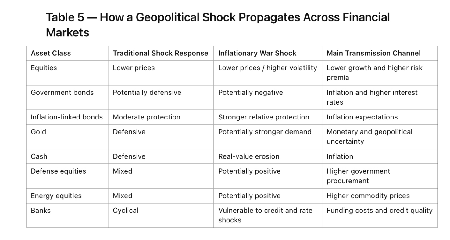
For years, a segment of the global financial industry has built portfolios around the inverse relationship between stocks and bonds. When stocks fell, bonds tended to rise. When risk increased, capital flowed toward instruments considered safer.
But an inflationary geopolitical shock can break this relationship. If war simultaneously triggers an economic slowdown and inflation, central banks face an almost impossible dilemma: supporting the economy without further fueling inflation.
In this scenario, both stocks and bonds could fall at the same time. The problem, therefore, is not just volatility. It’s the correlation. When the correlation between asset classes changes, the very purpose of diversification changes as well.
11. And now we come to the crucial point: Russian money
Here, the war strikes directly at the heart of international finance. The frozen Russian assets are not merely frozen financial assets. They have become a component of a new financial and institutional mechanism.
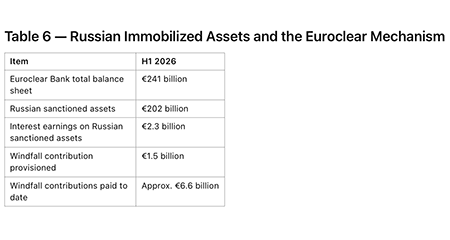
As of June 2026, Euroclear Bank had a balance sheet total of 241 billion euros, of which 202 billion related to Russian assets subject to sanctions.
In the first half of 2026, the interest generated by these assets amounted to 2.3 billion euros; Euroclear had also set aside 1.5 billion for the extraordinary contribution required by European regulations and had already paid out approximately 6.6 billion through this mechanism.
Here, a fundamental distinction must be made. One thing is tied-up capital. It is quite another to consider the income generated by that capital. The capital can remain frozen while the income is subject to a different legal regime and used in accordance with the political and regulatory decisions adopted.
And it is precisely this distinction that makes the problem extremely complex. Because the capital hasn’t disappeared. It exists. It has an owner. It is accounted for. It generates a return.
And precisely for this reason, it raises a legal, financial, and political issue that cannot be resolved simply by transforming that return into a source of financing. War, therefore, has not only created a new category of geopolitical risk. It has created a new category of financial risk.
 12. Euroclear: the risk is not just financial
The Euroclear case shows that the problem isn’t just how much money is tied up. The problem is the institutional precedent that is set. When an international financial intermediary becomes the place where large amounts of assets belonging to a sanctioned state are concentrated, its exposure is no longer merely financial.
It becomes legal. It becomes political. It becomes systemic. International law, European law, national law, the immunity of sovereign assets, claims for compensation, lawsuits, liquidity risks, and, above all, investor confidence in the stability of financial infrastructures all come into play.
The point is not to claim that Euroclear is financially compromised. It is not. The point is that the war has brought into the financial infrastructure a part of the conflict that previously belonged almost exclusively to the geopolitical sphere. And when conflict enters balance sheets, contracts, and courtrooms, it can outlive the conflict itself.
13. War as the creation of future liabilities
This is one of the least considered aspects of war. Every decision made during an emergency creates consequences that can outlive the emergency.
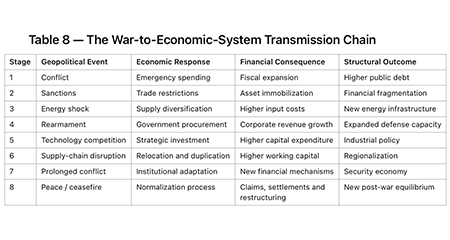
The sequence is: war → sanctions → asset freeze → extraordinary revenues → new financing → new commitments → new budget structures. War, therefore, does not merely produce immediate costs. It generates future liabilities. Debt. Contracts. Guarantees. Investments. Litigation.
Infrastructure. Production capacity. Dependencies. And when these liabilities become large enough, returning to the previous situation is no longer straightforward.
14. The paradox of peace
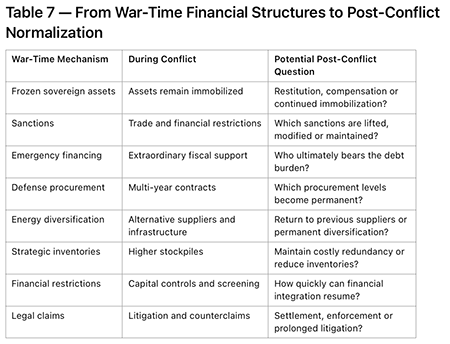
This is where what we might call the “peace premium” in this article comes into play: not a codified economic concept, but an analytical term to describe the cost of the transition from the economic structure of war to that of peace.
Because peace is not simply the moment when fighting ceases. It is the moment when all the questions that war had put on hold resurface.
What happens to frozen assets?
Which sanctions are maintained?
Which ones are lifted?
Who pays the accumulated debts?
What happens to multi-year military contracts?
What energy infrastructure remains?
Which supply chains are being rebuilt?
Which legal cases need to be resolved?
Which guarantees must be honored?
Peace does not automatically restore the economy to its February 2022 state. Peace ushers in a new phase of economic negotiations. And this phase can be costly.
15. The strongest argument is not that war is “in their interest”
The strongest argument is not that war is in anyone’s interest. And above all, it is not that someone has necessarily devised a system to perpetuate it. The most interesting argument is different.
A protracted war can create incentives, investments, contracts, dependencies, and financial structures that acquire their own momentum and become partially independent of the event that generated them.
The sequence is: conflict → adaptation → investment → institutionalization → dependence on the new equilibrium. At that point, the problem is no longer just the war. It is the economic structure built around the war.
16. Resilience capitalism
This is what we might call, in analytical terms, “resilience capitalism.” It is not a codified economic category. It is the transformation of a system in which security becomes a direct part of the production function.
Before: efficiency → minimum cost → maximum specialization. Now, increasingly: safety → redundancy → resilience → operational continuity.
The difference is enormous.
A company that previously had only one supplier may now have three.
A country that previously purchased energy from the cheapest supplier may build alternative terminals.
An industry that previously maintained minimal inventory may now stockpile months’ worth of components.
A government that previously viewed certain infrastructure as purely economic may now treat it as strategic infrastructure. All of this comes at a cost.
But that cost is now viewed as a form of insurance. Security thus becomes an economic variable. And when security becomes an economic variable, it enters corporate balance sheets, investor decisions, public budgets, and capital valuations.
17. Oil, semiconductors, and weapons are all part of the same story
Oil, semiconductors, and weapons seem to belong to three different worlds. In reality, they are all part of the same story. They are pillars of national security. Oil determines the ability to drive the economy. Semiconductors determine the ability to make the digital and industrial economies function.
Weapons determine our ability to protect the space in which the economy operates. This is why contemporary geopolitical competition revolves around energy, technology, trade, sanctions, banks, infrastructure, data, semiconductors, logistics, and capital. Modern warfare is not merely military. It is economic. It is industrial. It is financial. It is technological. And it is increasingly institutional.
18. Four economic scenarios
The first scenario is that of a frozen conflict accompanied by permanent European rearmament. It would not be true normalization, but neither would it be total war. It would be a new state of equilibrium characterized by high military spending, industrial investment, increased demand for technology, and pressure on public budgets.
The second scenario is that of a new energy crisis linked to the Middle East. It is not necessary to assume widespread physical destruction of supply: a significant increase in the risk premium on oil is sufficient to trigger inflation, a reduction in real income, and pressure on industrial margins.
The third scenario is a crisis in the Taiwan Strait. Here, the problem would immediately become global because energy, maritime trade, semiconductors, and industrial supply chains would all be intertwined. The fourth scenario involves a simultaneous crisis across multiple theaters.
In this case, the problem would no longer be merely the sum of the shocks. It would be their interaction. And it is precisely the interaction between shocks that can destabilize a financial system.
These scenarios are not predictions. They are stress tests. They help us understand which vulnerabilities emerge when multiple variables move simultaneously in the same direction.
19. The portfolio that must survive, not guess
If the defining characteristic of the new environment is uncertainty, then the investor’s challenge is not to guess which scenario will unfold. It is to build a structure that does not depend on a single forecast.
A purely illustrative example of a stress test on 100,000 euros might be: 35% global stocks, 20% eurozone government bonds, 10% inflation-indexed bonds, 10% gold, 10% cash, 10% defense and aerospace, 5% energy. This is not an investment recommendation.
It is a conceptual exercise. The logic is not to predict the winner. It is to diversify risk. Because if you don’t know what shock is coming, you must prevent a single shock from jeopardizing the entire portfolio.
20. Gold and the end of the zero-risk illusion
Gold is becoming attractive again not because it’s necessarily destined to rise. But because it has no issuer. It is not a government’s debt. It is not a bank’s credit.
It does not depend on a company’s creditworthiness. In a system characterized by geopolitical risk, financial fragmentation, and rising public debt, this characteristic takes on particular significance.
Gold does not generate a cash flow. But it can serve a different purpose: that of a diversifier against systemic risk. That is the difference between a return and insurance.
21. What about BTPs?
The problem with BTPs isn’t just the risk of default. It is primarily the market risk. If public spending increases, the deficit grows, debt rises, and the market demands a higher yield, the price of existing bonds falls.
The problem, therefore, can arise long before a solvency crisis. All it takes is for the cost of capital to rise. In a phase of European rearmament, this dynamic takes on particular importance because many countries must increase defense spending at the very same time, they must finance social welfare, the energy transition, infrastructure, and debt service. This constraint is not infinite. Capital comes at a price.
22. The Central Bank becomes part of the problem
When the shock is both geopolitical and inflationary, the central bank finds itself in a difficult position. It can reduce demand. It can influence the cost of money. It can try to anchor expectations. But it cannot produce oil.
It cannot manufacture semiconductors. It cannot reopen a port. It cannot lift a sanction. It cannot rebuild a supply chain. Monetary policy can therefore mitigate the second-round effects of inflation, but it cannot eliminate the physical cause of the shock.
This is a fundamental difference. Because in a purely financial crisis, money can often solve part of the problem. In a supply-side crisis, money does not automatically generate supply.
23. The real winner is not the arms industry
At this point, we can return to the initial question. Who wins? The most accurate answer is that there isn’t necessarily a single winner. There are winners within specific sectors.
There are companies that see an increase in orders. There are countries that become strategic suppliers. There are financial assets that increase in value.
On the other hand, there are consumers paying higher prices, governments accumulating debt, civilian businesses facing higher energy and financial costs, importers losing competitiveness, and economic systems forfeiting some of the economies of scale offered by globalization.
War, therefore, does not necessarily create wealth. It redistributes it. And it often redistributes it asymmetrically.
24. The final paradox: war can become an economic system
And here we come to the central point. A war can begin as a geopolitical event. Then it becomes an emergency. The emergency becomes spending. Spending becomes production. Production becomes investment.
Investment becomes capacity. Capacity becomes employment. Employment becomes income. Income becomes economic consensus. Consensus makes it harder to cut spending. Spending creates industrial interests. Industrial interests help make the new equilibrium permanent.
The sequence becomes: war → sanctions → immobilization → financial flows → rearmament → industrial investments → new supply chains → debt → new dependencies → new economic interests → new financial architecture.
At that point, war is no longer just an event. It has become a system. And when an economic system is built around the permanent possibility of conflict, the end of the war does not automatically mean the end of the war economy. It means the beginning of the next problem. The transition.
 But, when it’s all said and done, who pays?
The hardest question isn’t how much a war costs. It’s who pays the bill. Because a war can be expansionary in accounting terms. It destroys physical wealth, but at the same time creates public demand.
The government orders weapons, ammunition, satellites, software, energy, and logistics. Companies produce, hire, and invest. Banks provide financing. Workers receive income. Income generates consumption. Consumption generates further production.
GDP can therefore grow even as part of real wealth is destroyed or redirected to other uses.
Such destruction can be expansionary in accounting terms.
This is the paradox.
But money is not wealth. The monetary circuit and the circuit of real wealth do not coincide. Money can be created through debt, credit, or monetary expansion. Real capital cannot. An industrial plant, an electrical grid, a port, a road, a school, a hospital, or a production technology all require real resources.
If those resources are allocated to war, they cannot simultaneously be used for another investment. War can therefore be interpreted as a gigantic machine for anticipating future income: the state anticipates demand, financing it with current revenues, debt, credit, or, in some cases, monetary expansion; the economy receives demand today; the bill is spread out over time.
And who pays for it? Taxpayers pay for it through public debt. Consumers pay for it through higher prices. Savers pay for it through inflation and volatility. Workers pay for it when nominal income grows at a slower rate than prices.
Private businesses pay for it through higher energy costs, capital costs, and financing costs. Governments pay for it through tighter budget constraints. Future generations pay for it through accumulated debt and liabilities. And the system as a whole pay for it through a potential loss of efficiency.
This last point is the most difficult to measure. Duplicating infrastructure is costly. Maintaining strategic reserves is costly. Paying more for energy to reduce dependence costs money. Creating redundant production capacity is costly. Reducing specialization is costly.
Fragmenting financial markets is costly. Reducing economies of scale is costly. The IMF has highlighted how growing geopolitical fragmentation is altering trade and investment flows and how a further increase in tensions could reduce the size of economic networks and weaken the positive externalities of interconnection.
The problem, therefore, runs deeper than mere military spending. It is the potential transformation of the global economy from a system designed to maximize efficiency to one designed to maximize security.
And this is where the “guns versus butter” metaphor comes into play again. For decades, globalization has sought to maximize production through specialization, integration, and cost reduction.
War introduces another objective. It’s no longer just about producing as efficiently as possible. But being able to continue producing even when the system is subjected to a shock. It’s a rational choice.
But it is a costly choice. The problem arises when security ceases to be a temporary feature and becomes a permanent characteristic of the economy.
At that point, something different from a simple war economy may emerge: a war-dependent economy. It is not an established academic category, but a useful definition for describing a system in which a growing share of demand, employment, investment, and industrial capacity depends on maintaining a high level of security spending.
The sequence is almost inevitable: war creates capacity → capacity creates employment → employment creates income → income creates consensus → consensus makes it harder to reduce spending → spending creates industrial interests → industrial interests reinforce the demand for continuity.
No conspiracy is needed. No one needs to decide that the war must continue forever. It is enough that individually rational behaviors produce a collective equilibrium that is difficult to change.
And this is where politics risks becoming subservient to the economy. Not because businesses necessarily control governments. But because the incentives created by the new equilibrium can become so strong that they progressively narrow the scope for political decision-making.
This is the real risk of the never-ending war. Not merely a war that never ends. But an economic system that gradually can no longer function without the economic conditions created by the war.
The problem becomes even more evident when we look at the structure of the contemporary world. We are no longer dealing with perfectly separate blocs. We are faced with a network of networks.
The same companies, the same banks, the same ports, the same payment systems, the same suppliers, and the same investors belong to multiple networks at the same time.
A company can be Western and rely on Asian components. A bank can be European and have global exposures. A country may be a military ally of one state and, at the same time, economically dependent on another.
An investment may pass through different jurisdictions before it translates into productive capacity.
This makes it much more difficult to identify an absolute winner and an absolute loser. And this is where contemporary warfare differs economically from wars in which the victor could directly seize the loser’s resources.
History offers numerous examples of wars concluded through territorial transfers, reparations, the seizure of resources, or the imposition of economic conditions. In the contemporary global system, however, the situation is more complex.
The victor may not be able to seize enough of the loser’s wealth to offset the costs incurred. The loser may not be completely defeated. Supply chains may continue to span multiple countries. Capital may be tied up but not eliminated. Contracts may be suspended but not necessarily terminated. Infrastructure may be destroyed but take years to rebuild.
And so, the question becomes: Who bears the loss?
In 2025, global military spending reached $2,887 billion, the highest level ever recorded by SIPRI, marking the eleventh consecutive annual increase. This does not mean that all this money is “wasted”. It means that an increasing amount of real resources is being allocated to security.
And every time a larger share of capital, labor, technology, and energy is directed toward security, a different share is not directed toward other uses. This is the real “guns versus butter” issue on a global scale.
The problem isn’t just how much we spend.
It’s what we give up in order to spend it.
And this is where the notion of an “inflated economy” must be used with caution. It does not mean a fake economy. It means an economy in which a growing share of demand can be sustained by an extraordinary mobilization of public and private resources, while a portion of capital is diverted from civilian uses.
GDP may rise. Real wealth may not increase in the same proportion. Industrial capacity may increase. Consumption capacity may decrease. Employment may increase. Debt may rise even more rapidly. That is the fundamental contradiction.
And it becomes even more pronounced when the war lasts long enough to create a dependency on military spending. Because if military spending supports a significant portion of demand, reducing it too quickly can lead to a contraction. If industry has invested based on multi-year contracts, terminating them can create unused capacity.
If workers were hired to meet that demand, cutting it means creating unemployment. If governments have financed rearmament through debt, cutting spending does not erase the accumulated debt. If energy infrastructure has been rebuilt around new suppliers, returning to the old balance comes at a cost.
If financial systems have been organized around sanctions, removing the sanctions in turn creates a transition problem.
This is where war can become an economic structure. Not because anyone necessarily wants it. But because the system adapts to it. And once it has adapted, it must bear the cost of returning to normal.
Peace thus becomes a restructuring of the global budget.
This does not mean that peace is economically detrimental. It means that peace isn’t free. We must rebuild. We must renegotiate. We must reallocate. We must decide what to do about debts, assets, contracts, sanctions, infrastructure, guarantees, industrial capacity, and new dependencies. And above all, we must decide what economic balance to build next.
This is where the concept of the “peace premium” takes on its deepest meaning. It is not the price of peace. It is the cost of the transition. And the cost of the transition depends on how much the economy has adapted to war. The longer the war lasts, the more specific investments increase.
The more these specific investments increase, the higher the cost of divestment becomes. The higher the cost of divestment, the greater the resistance to returning to the previous equilibrium. This is classic path dependency. A decision made today alters tomorrow’s possibilities.
And this is perhaps the true economic legacy of war. Not just what it destroys. But what it builds. Factories. Contracts. Debts. Infrastructure. Dependencies. Interests. Institutions. New markets. New risks.
Ultimately, then, the question “Who pays?” has no single answer. Many people pay. In different ways. At different times. And precisely because the cost is spread out, it can be difficult to recognize it.
The taxpayer sees the debt. The consumer sees the price. The saver sees inflation. The business sees the cost of capital. The retiree sees purchasing power. The government sees the budget constraint. The central bank sees inflation. The investor sees volatility. Future generations see the bill when today’s decisions become tomorrow’s liabilities.
It is this distribution of costs that makes a war economically different from a simple recession. A recession destroys demand. A war can simultaneously destroy demand, create demand, destroy capital, create capital, increase debt, accelerate innovation, fragment markets, and rebuild supply chains. It is a far more complex phenomenon.
And precisely for this reason, it cannot be analyzed solely through GDP. We must look at the composition of growth, the quality of capital, the sustainability of debt, productivity, income distribution, the structure of supply chains, the concentration of risks, the nature of assets, the stability of financial institutions, and the ability to return to a state of peace.
Because the real problem isn’t that war can produce winners. It is that it can produce sectoral winners while the overall cost is progressively distributed across the system.
This is the point at which the economics of war becomes political economy.
And political economy becomes institutional architecture.
The ultimate question, then, is not: Who profits from war?
It is: Who finances the war, who bears its cost, and who decides which economic system will remain once the war is over?
Conclusion
War does not necessarily end when the fighting stops. It may end militarily but continue economically: in public budgets, contracts, debts, infrastructure, sanctions, lawsuits, supply chains, industrial capacity built up during the conflict, and new dependencies created to survive the risk.
War is therefore not merely a parenthesis in economic history. It can become a structural feature. First comes the conflict. Then comes the emergency. Then rearmament. Then investment. Then new production capacity. Then come the multi-year contracts. Then came new debt.
Then new infrastructure. Then the new dependencies. Then the economic interests that have formed around that new equilibrium.
At that point, the war no longer needs to continue in the same forms to keep producing economic effects. It is enough for the system built around its potential to remain in place.
This is the true nature of resilience capitalism. It doesn’t mean that someone has designed a machine to perpetuate war. It means that the risk of war, preparation for war, and the need to be ready for war become permanent economic factors in their own right.
Security becomes a price variable. Redundancy becomes an investment. Inventories become capital. Diversification becomes a cost. Unused production capacity becomes insurance. Geopolitical risk enters corporate balance sheets, investor decisions, and national budgets. And when risk becomes structural, its cost also becomes structural.
This brings us back to the initial question: Who pays?
There isn’t necessarily a single party. Many pay. In different ways. At different times. The taxpayer sees the debt. The consumer sees the price. The saver sees inflation and volatility.
The business sees the cost of capital and energy. The government sees the budget constraint. The investor sees the risk. Future generations see the accumulated liabilities.
It is this distribution of costs that makes a war economically different from a simple recession. A recession destroys demand. A war can simultaneously destroy demand, create demand, destroy capital, create productive capacity, increase debt, accelerate innovation, fragment markets, and rebuild supply chains. GDP can therefore grow while real wealth follows a different trajectory.
The bottom line, then, is not that war “benefits” anyone. It is that a prolonged war can become beneficial for individual sectors while becoming costly for the system as a whole. A company that receives orders produces.
A bank that sees demand for credit provides financing. An investor who sees an opportunity invests. A worker who finds a job accepts it. None of these behaviors is necessarily irrational. But the sum of rational behaviors does not automatically produce a strategy.
A strategy exists only when someone decides what equilibrium should be achieved, what costs are acceptable, what capacities should be maintained, what debts can be sustained, what dependencies should be reduced, and what kind of economic system we want to have once the emergency is over.
This is where politics comes back into play. Not politics as the administration of war, but politics as the ability to govern the transformation that war brings about.
Because if politics limits itself to following the incentives generated by the emergency, the risk is that those incentives themselves will determine the direction of the system.
And so politics becomes a mere follower of the economy: it no longer decides what structure to build, but merely finances the one that has already taken shape.
This is the true risk of the never-ending war. Not merely a war that never ends. But an economy that, gradually, can no longer function without the economic conditions created by war.
At that point, the question would no longer be merely how much it costs to continue the war.
It would be: How much does it cost to stop?
And that is a much more difficult question. Because stopping means terminating contracts, retooling capacity, managing debt, renegotiating assets, rebuilding supply chains, redefining sanctions, resolving disputes, and finding a new balance between security and efficiency.
Peace, therefore, is not a return to square one. It is a new phase of capital allocation.
This is where the true economic cost of war is measured. Not when we count the weapons produced. Not when counting the profits made. Not when you count the GDP generated by military spending.
But when a decision must be made about who will pay to bring the system back from an emergency economy to an economy capable of producing wealth once again.
Because money can finance a war. It can sustain debt. It can bring forward future income. It can shift resources over time. But it cannot create real wealth out of thin air.
And so, in the end, the bill comes due.
War can be financed. It can be accounted for. It can be converted into GDP. It can be distributed among government budgets, businesses, banks, consumers, and investors.
But the final bill – the real one – cannot be printed.
It can only be paid with real wealth.
And that is why the war does not end when the war ends.