

Knowledge, Uncertainty, and Reflexivity: Why Understanding Complexity Has Become a Strategic Imperative
The ability to interpret the world depends not only on the amount of information available, but also on an awareness of the limitations of the tools through which we observe it.
In geopolitical and military systems, reality also changes in response to our analyses and decisions.
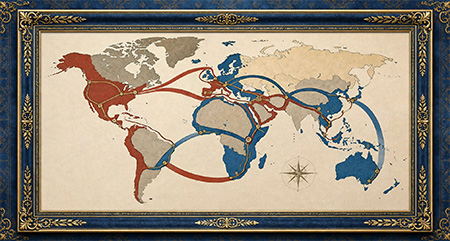
One of the most celebrated maxims in twentieth-century epistemological thought states that “the map is not the territory.” The representation of reality, however accurate, never coincides with reality itself.
It is a simplification: it selects certain elements, overlooks others, and organizes information according to criteria that depend on the knowledge, purposes, and beliefs of those who construct it.
This distinction takes on decisive importance when addressing the major geopolitical and military issues of our time. Wars, regional crises, competition among great powers, economic instability, and technological transformations unfold within complex systems in which numerous actors interact, adapt, and respond to one another’s decisions.
In this context, knowing does not simply mean gathering information: it means interpreting a changing reality, recognizing what we do not know, and understanding how our own interpretations may alter it.
This is the starting point of the bilingual essay, attached at this article, Knowledge, Uncertainty, and Reflexivity in Complex Geopolitical and Military Systems, which proposes an epistemological and methodological examination of strategic analysis in open, adaptive, and perturbable systems.
The Problem Is Not Merely a Lack of Information
In the age of data, satellite imagery, artificial intelligence, and digital surveillance, one might think that uncertainty is bound to diminish progressively.
The availability of information has certainly increased dramatically. Yet a greater quantity of data does not automatically guarantee a better understanding of events.
Uncertainty, in fact, does not arise solely from the absence of information. It may result from incomplete data, measurement inaccuracies, ambiguity in interpretation, the unpredictability of interactions, and even the limitations of the models used to describe reality.
It is therefore necessary to distinguish between different forms of uncertainty: epistemic uncertainty, related to the limits of knowledge; aleatory uncertainty, associated with the variability of phenomena; structural uncertainty, concerning the inadequacy or incompleteness of models; interpretive uncertainty, arising from the plurality of meanings that can be attributed to the same events; and reflexive uncertainty, generated by the fact that actors may react to the analyses and forecasts concerning them.
These dimensions are not independent. They overlap, reinforce one another, and can amplify each other in the course of a crisis.
A military movement, for example, may be interpreted as a defensive measure, a show of force, or the preparation for an offensive operation.
A decision based on one of these interpretations may prompt the adversary to react, thereby changing precisely the situation the analyst intended to understand.
In other words, a forecast can contribute to changing the phenomenon being forecast.
Geopolitical Systems Are Open and Adaptive
A complex system is not a machine made up of independent elements, whose behavior can be reconstructed by examining each component separately. It is a network of relationships, interactions, and feedback loops.
Geopolitical actors do not merely undergo events: they interpret them, learn from them, modify their strategies, and respond to the initiatives of others. Decisions produce consequences that, in turn, influence subsequent decisions.
In such an environment, even a sophisticated analytical model can quickly become obsolete. Not necessarily because it was poorly constructed, but because the system it describes has changed, perhaps precisely as a consequence of actions taken on the basis of that model.
Strategic planning must therefore abandon the illusion that a definitive representation of reality can be achieved. Models are indispensable tools, but they must be regarded as provisional, subjected to verification, and updated when new evidence emerges.
Their usefulness is measured not only by their ability to formulate forecasts, but also by their capacity to make assumptions explicit, identify weaknesses, and assess alternative scenarios.
Reflexivity: When the Observer Becomes Part of the System
The concept of reflexivity introduces a further element of complexity. The analyst does not always observe, from the outside, a system that is independent of their own activities.
Their assessments may influence the decisions of political and military decision-makers; these decisions may alter the behavior of other actors and, consequently, the reality the analyst is studying.
A feedback loop is thus created between observation, interpretation, decision, and response.
This phenomenon is particularly evident in strategic competition. A forecast of escalation may lead a government to adopt preventive measures; the adversary may interpret them as a threat and respond with its own mobilization.
The initial forecast, although formulated as a mere assessment, may contribute to producing the conditions that make it plausible.
Reflexivity therefore raises an essential question: what effect may our analysis have on the system we intend to understand?
The point is not to abandon forecasting, but to recognize its conditional and potentially performative nature. Strategic analysis must consider not only what might happen, but also how decisions based on its conclusions may influence what will happen.
From the Illusion of Certainty to the Discipline of Uncertainty
Good strategic analysis is not analysis that artificially eliminates uncertainty, but analysis that makes it visible, understandable, and manageable.
This requires making initial assumptions explicit, distinguishing facts from interpretations, acknowledging the limitations of available information, and assessing the soundness of conclusions.
It also requires considering alternative scenarios, identifying indicators that may signal a change, and determining what new evidence would make it necessary to revise an assessment.
From this perspective, analytical disagreement also has positive value. Different opinions, provided they are reasoned and verifiable, can reveal blind spots that an overly homogeneous group might otherwise overlook.
Artificial intelligence and quantitative tools can greatly expand analytical capabilities, but they do not eliminate the responsibility for interpretation.
An algorithm can identify correlations, classify signals, and generate scenarios; it cannot automatically transform a statistical representation into a complete understanding of the political, cultural, and strategic context.
Technology enhances analysis, but it does not replace judgment.
The Responsibility to Decide Without Absolute Certainty
The issue is not merely methodological. It is also political, institutional, and ethical.
Those who make strategic decisions must be able to understand not only the conclusions of an analysis, but also the degree of reliability, the assumptions, and the uncertainties accompanying them.
The decision-maker’s responsibility cannot be transferred to the model, the algorithm, or the analyst.
In the military domain, this principle is particularly important. The speed of operations, the automation of processes, and the growing interdependence of systems may reduce the time available to assess the consequences of decisions.
For this very reason, meaningful human control, the traceability of assessments, and the ability to correct errors promptly become essential elements of command responsibility.
Ultimately, strategic maturity consists in being able to make decisions without confusing the need to act with the claim to know everything.
A New Culture of Strategic Analysis
The central lesson is simple, yet demanding: in complex geopolitical and military systems, knowledge cannot be regarded as a definitive snapshot of reality. It is an ongoing process, subject to verification and transformation.
The map remains indispensable. Without models, data, and representations, it would be impossible to find one’s way through complexity.
But we must remember that every map is selective, every model is incomplete, and every forecast is liable to be disproved or altered by events.
A mature strategic culture does not promise certainties it cannot guarantee. Instead, it develops tools to recognize uncertainty, learn from change, and correct its own interpretations.
Because the real risk is not merely making an inaccurate forecast. It is forgetting that the representation of the world we have constructed does not coincide with the world itself.
Attached
Knowledge, Uncertainty, and Reflexivity in Complex Geopolitical and Military Systems