

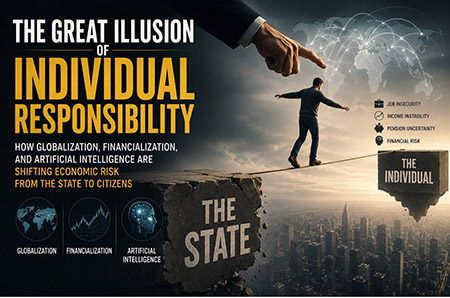
How Globalization, Financialization, and Artificial Intelligence Are Shifting Economic Risk from the State to Citizens
Recently I published an analysis of the Italian TFR Reform of 2026, focusing on its legal structure and its implications for occupational pension funds.
At first glance, it appeared to be a study devoted to a specific national reform. Yet, as the research progressed, it became increasingly clear that the Italian case was only the visible manifestation of a much broader transformation taking place across Europe.
The reform itself is not the real story.
The real story is the gradual redefinition of the relationship between citizens, markets, and the welfare state.
Across Europe, responsibility for retirement security is being progressively transferred from collective institutions to individual workers.
Public pension systems are increasingly complemented – or replaced – by privately accumulated savings invested in financial markets. This transition is often presented as a natural evolution toward greater freedom, personal responsibility, and financial awareness.
These are undoubtedly valuable principles.
But they also conceal a fundamental question that is rarely addressed.
Can individual responsibility exist without the economic, cultural, and financial conditions that make genuine choice possible?
That question became the starting point of the broader research presented in my latest paper. What initially appeared to be an examination of pension reform gradually evolved into an investigation of something much larger: the structural transformation of the European economic model itself.
Because pensions are never just about pensions.
They are the final outcome of demographic trends, labor markets, industrial policy, productivity, education, technological innovation, financial markets, and ultimately the distribution of economic risk within society.
For decades Europe relied on a social contract in which major life risks were collectively shared.
Today that contract is being rewritten.
The problem is not that citizens are asked to assume greater responsibility for their future.
The problem is that this responsibility is expanding precisely while many of the conditions that make it sustainable are progressively disappearing
What follows is therefore not another article about pension reform. It is an attempt to understand how Europe is quietly redesigning the social contract that has shaped the continent since the end of the Second World War.
Europe is quietly creating the first generation expected to work harder, save more, assume greater risks, and ultimately receive less security in return.
And it continues to portray this transformation as if it were a triumph of individual freedom. There is talk of empowerment, financial literacy, supplemental retirement plans, and investing in one’s own future.
But behind this reassuring rhetoric lies a far more radical change: the gradual shift of economic risk from institutions to individual citizens.
For decades, the European welfare system has been based on a simple principle. Certain fundamental risks of life – old age, illness, job loss – were considered collective risks.
Today, however, a different paradigm is taking hold. Citizens are no longer expected to be merely workers. They must simultaneously be savers, investors, financial markets experts, retirement planners, and managers of their own human capital. All this while the economic environment becomes more unstable every year.
The paradox is clear. Increased individual responsibility is demanded precisely at a time in history when individuals have increasingly limited tools to control their own future.
Careers are fragmented, jobs are more precarious, purchasing power is growing much more slowly than productivity, and housing costs are consuming an ever-larger share of disposable income. Yet the argument persists that everyone can independently build their own retirement security.
The question, then, takes on a completely different nature. It is no longer whether supplemental retirement savings is a useful tool. It certainly can be.
The real issue is another: who actually has the financial means to contribute to it?
Who can accumulate capital when an increasing portion of their income is consumed by essential expenses?
Who can invest for the long term when job uncertainty already extends to the very next month?
There is also a second, even more underestimated factor, which concerns economic culture. Talking about individual responsibility implies that citizens are capable of understanding the tools through which that responsibility should be exercised.
But contemporary finance has become vastly more complex than it was when the first pension funds were established.
In the United States, where supplemental retirement savings developed much earlier than in Europe, large pension funds grew alongside the domestic stock markets, benefiting from the expansion of the U.S. economy, the depth of the markets, and the presence of companies capable of generating value over the long term.
The logic was relatively straightforward: investing in one’s country’s productive capital meant participating in the growth of the real economy.
The result could be a highly polarized society: a highly skilled minority that owns the technological and financial capital, and a progressively marginalized majority with less bargaining power, more unstable incomes, and reduced opportunities to accumulate wealth.
But there is an even more disturbing consequence.
In industrial society, labor also represented a form of political power. Those who produced could go on strike, halt production, and exert pressure on institutions. Labor served as a collective lever.
In a society where a growing portion of production depends on automated systems, the political weight of labor risks being drastically reduced. Those who become economically replaceable also risk becoming politically irrelevant.
And this is perhaps the most profound transformation we should begin to discuss.
Because the real problem of the future will not be merely how to fund pensions. It will be understanding what role millions of people will play in an economic system that may no longer need their labor.
And if this question is not addressed today, the social security crisis could turn out to be merely the first symptom of a much broader transformation: that of the very relationship between the economy, democracy, and citizenship.
The debate on pensions may therefore prove to be only the beginning. The real question is the future of the European social contract itself.
This article represents the starting point of a broader research project. The complete analysis, developed in three installments, will examine how globalization, the transformation of work, financialization, and artificial intelligence are reshaping the foundations of European social security and redefining the distribution of economic risk between institutions, markets, and citizens.
The central question is no longer simply how future pensions will be financed. The deeper question is who will bear the risks of a profoundly transformed economic system.