
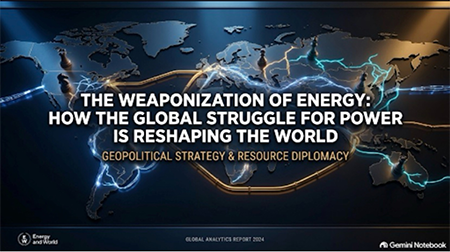

How the global struggle for power is reshaping the world
Who will really benefit from the new geopolitical competition? And who risks losing ground without even realizing it?
When people talk about an energy crisis, attention almost always focuses on its immediate consequences: oil, natural gas, utility bills, inflation, industrial costs, and the financial pressures facing households.
But there is a far more important question, one that too often remains in the background: Who is turning this crisis into a strategic opportunity?
Energy is not merely an economic resource. It is power. It is industrial capacity. It is national security. It is diplomatic influence. Above all, it is one of the instruments through which the international balance of power is reshaped.
The 2026 crisis therefore forces us to look beyond energy markets and examine what is unfolding behind the scenes of the competition among the world’s major powers.
This is the perspective behind the essay “The Energy Crisis as a Multiplier of Geopolitical Competition – The United States, the European Union, China, India and Turkey in the New International Balance”, a strategic analysis addressing a fundamental question: How can an energy shock reshape the balance of power among nations?
The starting point is simple, but its implications are far-reaching: not every country experiences a crisis in the same way. Some are more exposed than others. Some have the resources to absorb its impact. Still others may be able to exploit it to strengthen their economic, industrial, and diplomatic positions.
China is one of the most compelling cases. Its manufacturing strength, control over key segments of technology supply chains, and investments in electrification could enable it to turn part of the energy shock into a competitive advantage.
That advantage, however, is far from unlimited. China must still contend with its dependence on energy imports and an economy deeply integrated into international markets.
The United States possesses energy resources, financial strength, and military capabilities that give it a privileged position. But leadership also carries responsibilities and costs, particularly when national interests do not perfectly align with those of its allies.
The European Union, meanwhile, faces a challenge that goes beyond energy dependence. Its real test is whether it can transform its economic, technological, and political resources into a coherent common strategy.
Twenty-seven governments, differing priorities, and sometimes conflicting interests can make a timely response difficult precisely when the speed of decision-making matters most.
Then there are Turkey and India, two players that deserve particular attention.
Turkey’s strategic location between Europe, the Black Sea, the Caucasus, and the Middle East gives it the potential to increase its bargaining power through energy and trade corridors.
India, despite its exposure to foreign energy supplies, could become one of the main destinations for international industrial diversification, gradually strengthening its position in the competition with China.
But the essay goes beyond comparing the major powers. It also examines Italy, Russia, the asymmetric economic relationships between Beijing and some of its strategic partners, energy infrastructure, and possible scenarios for the crisis’s future evolution.
The most consequential argument emerges in the conclusions: China could become the main relative beneficiary of this crisis – not necessarily because it caused it, but because its economic and industrial position may allow it to capitalize on its consequences.
This is a crucial distinction. Benefiting from a crisis does not mean causing it. Identifying a strategic advantage does not justify assigning responsibility without evidence.
That is why, at least presently, the analysis consistently distinguishes among documented facts, estimates, interpretations, and scenarios, seeking to separate what can be demonstrated from what remains a possibility requiring further verification.
This is not a simplistic forecast of which country will win the global competition. Rather, it is an attempt to understand what conditions could favor certain players, what vulnerabilities could weaken others, and which decisions will shape the future.
Because the real stakes go far beyond the price of a barrel of oil or a megawatt-hour of natural gas.
They concern the ability of nations to keep producing, investing, innovating, defending their interests, and preserving their freedom to make strategic choices.
The next redistribution of global power may not come through a war or a new treaty, but through the gradual loss of competitiveness in some countries and the industrial strengthening of others.
That is the central theme of this essay.
A bilingual geopolitical analysis designed for readers who want to move beyond the headlines, understand the deeper dynamics of the energy crisis, and examine the emerging international balance of power.
Because understanding who is gaining ground today may be the key to understanding who will hold greater influence tomorrow.
The energy crisis is much more than an emergency. It is a test of strength among nations. And its outcome could reshape the world.
Attached
The energy crisis as a multiplier of geopolitical competition