

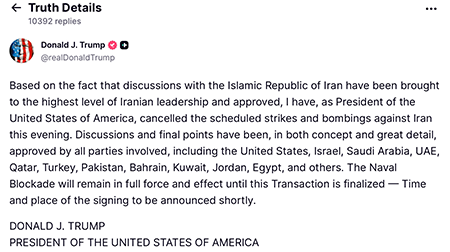
Trump’s Communication on Iran and the Structural Convergence of Contemporary War Messaging
Abstract
This article analyzes a recent public communication attributed to Donald J. Trump concerning the suspension of planned military strikes against Iran, interpreting it not as an isolated policy announcement but as an instance of strategic signaling embedded within a stratified and highly interconnected conflict system.
The central argument is that contemporary geopolitical communication cannot be reduced to informational content or intentional messaging alone, but must be understood as a multi-layered process operating across operational, strategic, and systemic levels simultaneously.
Within this framework, political announcements function as performative acts that structure perceptions of alignment, manage uncertainty, and coordinate heterogeneous audiences across domestic, regional, and global domains.
The analysis further suggests that escalation dynamics in the contemporary Middle Eastern system are increasingly shaped by interactions between military action, informational legitimacy, and coalition stability.
In this context, the distinction between kinetic and communicative domains becomes progressively blurred, giving rise to hybrid forms of strategic interaction in which signaling acquires quasi-operational significance.
A parallel interpretative dimension is developed through comparison with contemporary war communication styles, particularly those associated with high-visibility leadership in asymmetric conflicts.
Without assuming causal influence, the article identifies structural homologies emerging from shared systemic constraints, including fragmented authority, media saturation, and accelerated escalation cycles.
Finally, the paper situates these dynamics within a broader tension between domestic political narratives of strategic retrenchment and the systemic role of the United States as a stabilizing node within a multipolar but interdependent security architecture.
This tension produces a persistent gap between ideological positioning and functional imperatives, in which leadership communication becomes a key mechanism of mediation.
Overall, the article proposes a shift from actor-centered interpretations of foreign policy toward a systemic reading of communication as governance within stratified conflict environments
Text
The following analysis examines the recent public communication attributed to Donald J. Trump regarding the suspension of planned strikes against Iran, interpreted not as a discrete policy announcement but as an instance of strategic signaling within a multilayered geopolitical environment.
The objective is not to assess the veracity of the operational content of the message, but to situate its structure, language, and implied audience architecture within a broader framework of stratified conflict communication.
This reading remains interpretative and doesn’t imply intentional design by the actors involved.
Operational Form: Announcement as Performative Decision
At the operational level, the message presents itself as a high-impact executive declaration combining military de-escalation, diplomatic coordination, and multilateral referencing.
Its structure is not purely informational. It is performative in nature: it does not only describe a decision but constructs the perception of coordinated systemic alignment across multiple regional and extra-regional actors.
The inclusion of a wide set of states (including regional rivals and partners) may functions less as a factual negotiation record and more as an architecture of implied consensus, a typical feature of high-visibility strategic communication in contested environments.
Strategic Layer: Multi-Audience Calibration
At the strategic level, the communication can be interpreted as partially directed simultaneously toward multiple audiences:
• domestic political constituencies (demonstrating control and decisiveness)
• regional allies and partners (signaling coordination capacity)
• adversarial actors (signaling calibrated restraint rather than escalation)
• global markets and security observers (reducing uncertainty through narrative closure)
This multi-audience structure is broadly consistent with what in stratified systemic terms can be defined as distributed strategic signaling, where a single message is optimized to produce differentiated effects across heterogeneous interpretive communities.
In this sense, the operational content of the announcement is less relevant than its systemic function: the management of uncertainty through controlled narrative compression.
Systemic Layer: Constraint Environment and Escalation Management
At the systemic level, the communication must be interpreted within a broader environment characterized by:
• high deterrence sensitivity in the US – Iran – Israel triangle
• fragmented regional authority structures
• elevated risk of unintended escalation through proxy networks
• increased informational velocity and interpretive volatility
Within such a structure, decisions regarding military action or suspension of action are rarely binary. They are embedded in continuous escalation management systems, where signaling often becomes as important as kinetic capability.
The reference to a “Naval Blockade remaining in force” while strikes are cancelled illustrates this dual-layer logic: de-escalation at one level, sustained pressure at another.
Escalation Management, Strategic Dependence, and the Limits of Military Success
A further interpretative dimension concerns the relationship between military action, strategic dependence, and informational legitimacy within the contemporary Middle Eastern system.
From a conventional military perspective, neither Iran nor its aligned regional networks appear positioned to achieve decisive victory against either Israel or the United States. This observation raises an analytical question regarding the strategic purpose of repeated escalation cycles.
One possible interpretation is that at least part of the strategic utility of such actions lies not in military victory, but in the continuous production of pressure across multiple interconnected domains – operational, informational, and diplomatic – thereby shaping the adversary’s decision-making environment, testing coalition resilience, and forcing external actors into a persistent cycle of escalation management rather than resolution.
Within this logic, military operations function not only as instruments of destruction but also as mechanisms of strategic signaling, deterrence testing, and coalition stress generation.
This perspective becomes particularly relevant when examining the Israeli dimension of the conflict.
While Israel has demonstrated substantial military superiority across multiple operational theaters, military effectiveness does not automatically translate into informational or diplomatic advantage. Contemporary conflicts increasingly unfold across interconnected operational, political, and communicative arenas.
Several highly publicized statements made by prominent Israeli political figures generated significant international controversy and were rapidly incorporated into competing narratives surrounding the conflict. Regardless of their original intent, such episodes contributed to growing tension between operational objectives and international perception.
From a stratified perspective, this suggests the emergence of a legitimacy gap: a condition in which operational success and narrative sustainability evolve according to different logics and temporal rhythms.
This dynamic is strategically significant because Israel’s capacity to sustain prolonged regional confrontation remains deeply connected to continued American political, diplomatic, and military support.
Consequently, any deterioration in the broader informational environment potentially acquires systemic relevance, not merely reputational significance.
In this context, Washington’s interest may increasingly lie not only in supporting allies, but also in regulating the pace and scope of escalation itself.
Regional Ambiguity and the Multipolar Constraint Environment
A second consideration concerns the position of key Gulf actors.
The regional system is frequently portrayed through simplified alliance structures. In practice, however, states such as Saudi Arabia and the United Arab Emirates operate within a far more complex strategic environment characterized by overlapping security, economic, and geopolitical interests.
Historically, Gulf actors have maintained relationships with a wide range of regional forces and networks, often balancing ideological, security, and economic considerations simultaneously.
The UAE presents a particularly interesting case. As one of the principal commercial and financial hubs of the region, its strategic priorities are closely linked to the preservation of economic connectivity and regional stability.
Within such an environment, military signaling directed toward economically critical nodes may carry significance beyond immediate operational effects.
If strategic actors seek to include financial or logistical centers within their signaling architecture, such actions may be understood less as attempts at direct material disruption and more as calibrated demonstrations of systemic reach, aimed at influencing risk perception, reinforcing deterrence credibility, and shaping the confidence structures that underpin regional economic and political stability
From this perspective, escalation becomes not merely a military process but a multidimensional contest involving deterrence, financial confidence, political legitimacy, and coalition cohesion.
This broader environment helps explain why contemporary crisis management increasingly emphasizes communication, signaling, and coalition coordination alongside traditional military instruments.
Interpretative Parallel: Convergence with Contemporary War Communication
A relevant analytical question concerns the communicative form of the message itself.
Without assuming direct influence or causal transmission, it is observable that contemporary high-intensity conflicts increasingly generate homologous communication structures, characterized by:
• personalization of geopolitical messaging
• direct leader-to-leader address formats (explicit or implicit)
• blending of operational decisions with narrative framing
• expansion of intended audience beyond formal diplomatic channels
In this sense, the communicative architecture resembles patterns already visible in other conflict theaters, including the Ukrainian case, where public-facing strategic communication plays an increasingly central role in shaping both domestic resilience and international alignment.
However, from a methodological perspective, it is more precise to interpret this not as imitation or transfer, but as convergence under shared systemic constraints: fragmented legitimacy, media-saturated escalation environments, and high-stakes signaling competition.
Zelensky Parallel: Not Causation, but Structural Homology
Within this interpretative frame, the comparison with Zelensky’s strategic communication style should not be understood as a causal lineage.
A more rigorous formulation is the following:
• both cases operate within high-visibility asymmetric conflict environments
• both rely on leader-centered narrative condensation of strategic intent
• both function under conditions where traditional diplomatic opacity is partially replaced by public signaling
• both transform communication into a tool of strategic stabilization rather than mere information transmission
What emerges is not influence, but structural homology within stratified conflict systems. This does not suggest direct influence, imitation, or diffusion between cases, but rather structural convergence under comparable systemic pressures.
Nevertheless, the Ukrainian case remains analytically significant insofar as it anticipated, in a particularly visible form, communicative patterns that appear increasingly recurrent across contemporary conflict systems
Systemic Implication: Communication as Governance Under Fragmentation
The broader implication is that in contemporary conflict systems, especially those involving nuclear or near-peer escalation thresholds, communication itself becomes a form of governance.
Announcements such as the one analyzed do not simply report decisions; they actively:
• shape escalation expectations
• pre-structure adversarial responses
• stabilize allied coordination
• and manage internal political constraints
In this sense, the boundary between “decision” and “signal” becomes analytically unstable.
Why the Shift? Trump, MAGA, and the Structural Limits of Strategic Retrenchment
A final analytical question concerns the apparent tension between the rhetorical architecture of strategic retrenchment associated with segments of the MAGA coalition and the continued operational involvement of the United States in external escalation management systems.
At the level of political discourse, MAGA-aligned narratives have often emphasized a reorientation of American grand strategy toward domestic consolidation, selective disengagement, and a reduction of exposure to prolonged external conflicts. Within this framing, retrenchment is not only a policy preference but also a broader critique of post-
Cold War liberal interventionism and its distributive costs.
However, when situated within a stratified systemic framework, this orientation encounters structural constraints that limit its full translation into consistent strategic practice.
The contemporary international environment is characterized by tightly coupled security subsystems, where regional crises are rarely contained within their immediate geographic boundaries and tend instead to propagate through alliance structures, energy markets, and proxy networks.
Within such a configuration, the United States functions less as a unitary retrenching actor and more as a systemic stabilization node embedded within overlapping regimes of deterrence, alliance dependency, and escalation control. These structural roles generate inertia that is not easily reducible to domestic ideological preference.
From this perspective, the observed tension is not primarily a contradiction between rhetoric and action, but rather a translation gap between political narrative regimes and systemic functional imperatives.
Strategic retrenchment remains politically legible and electorally mobilizing, but becomes operationally constrained when confronted with the requirements of maintaining credibility across multiple interdependent security theaters.
This produces a condition of asymmetric adaptation, in which political messaging may oscillate between signals of disengagement and interventions aimed at stabilizing external escalation dynamics. Such oscillation should not be read as inconsistency, but as a structural response to multi-layered constraint environments.
A further implication is that leadership communication itself acquires a dual function: it becomes simultaneously a vehicle for domestic political alignment and a mechanism for managing the perception of continuity within the broader architecture of deterrence.
In this sense, strategic messaging does not merely reflect policy shifts; it actively mediates the tension between ideological positioning and systemic necessity
Provisional Conclusion
The Trump communication on Iran can be most coherently interpreted as an instance of stratified strategic signaling operating across overlapping systemic layers.
Its significance does not lie solely in its operational content (strike cancellation), but in its function as a multi-audience stabilization mechanism within a high-fragmentation geopolitical environment.
While superficial parallels with other contemporary war communications may appear evident, a more rigorous interpretation suggests not imitation but convergence: similar systemic pressures tend to generate similar communicative architectures, even in structurally distinct conflicts.
Bibliography
I. Systemic Theory and Strategic Order
• Bull, Hedley. The Anarchical Society. Columbia University Press, 2012.
• Waltz, Kenneth N. Theory of International Politics. Addison-Wesley, 1979.
• Mearsheimer, John J. The Tragedy of Great Power Politics. W.W. Norton, 2014.
• Buzan, Barry. People, States and Fear. ECPR Press, 2007.
• Acharya, Amitav. The End of American World Order. Polity Press, 2014.
II. Strategy, Force, and Conflict Dynamics
• Clausewitz, Carl von. On War. Princeton University Press, 1984.
• Freedman, Lawrence. Strategy: A History. Oxford University Press, 2013.
• Smith, Rupert. The Utility of Force. Vintage, 2008.
• Coker, Christopher. War in an Age of Risk. Polity Press, 2009.
III. Communication, Signaling, and Information Conflict
• Rid, Thomas. Active Measures. Farrar, Straus and Giroux, 2020.
• Pomerantsev, Peter. This Is Not Propaganda. PublicAffairs, 2019.
• Seib, Philip. Strategic Communication and Public Diplomacy. Palgrave Macmillan, 2012.
• Arceneaux, Phillip. Social Media and Strategic Communication in War (selected articles).
IV. Middle East Systemic Dynamics
• Fawcett, Louise (ed.). International Relations of the Middle East. Oxford University Press, 2016.
• Ghattas, Kim. Black Wave. Henry Holt, 2020.
• Gelvin, James L. The New Middle East. Oxford University Press, 2018.
• Nasr, Vali. The Shia Revival. W.W. Norton, 2006.
V. Israel-Arab Conflict System
• Shlaim, Avi. The Iron Wall. W.W. Norton, 2014.
• Morris, Benny. Righteous Victims. Vintage, 2001.
• Tessler, Mark. A History of the Israeli-Palestinian Conflict. Indiana University Press, 2009.
• Baconi, Tareq. Hamas Contained. Stanford University Press, 2018.
VI. Methodological Foundations (optional, ma coerente)
• Wendt, Alexander. Social Theory of International Politics. Cambridge University Press, 1999.
• Gaddis, John Lewis. The Landscape of History. Oxford University Press, 2002.
• Hoffmann, Stanley. “An American Social Science: International Relations.” Daedalus, 1977.