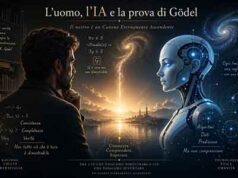


Nothingness, Human Consciousness, and Artificial Intelligence
An Editorial on the Questions We Have Yet to Answer
Humanity’s history can be understood as an enduring attempt to define the unknown.
We have sought to explain the universe, decipher the origins of life, understand the workings of the mind, and establish the boundaries of what can be known.
Yet every discovery has opened new questions, revealing that the expansion of knowledge does not necessarily bring us closer to a complete understanding of reality.
At the heart of this inquiry lies a deceptively simple concept: nothingness.
What does it mean for something not to exist?
Can nothingness be conceived without turning it into something within our minds?
Is it a physical condition, a philosophical abstraction, a limit of language, or a name for what escapes our conceptual frameworks?
Perhaps the difficulty of defining nothingness reveals something fundamental about the limits of definition itself.
These questions become even more compelling when we turn to human consciousness. We can observe behavior, study neural activity, investigate cognitive development, and examine the relationship between language and thought.
Yet the relationship between the mechanisms of the mind and the subjective experience of being remains deeply contested.
We can describe many of the processes associated with consciousness without necessarily resolving why experience exists or what it means to experience anything at all.
Artificial intelligence brings this unresolved problem into sharper focus. Machines can process information, identify patterns, generate sophisticated language, and perform tasks that once seemed to require distinctly human abilities.
Their capabilities challenge our assumptions about intelligence, reasoning, creativity, and understanding. But they also force us to confront a crucial distinction: the ability to produce an intelligent response is not, by itself, proof of conscious experience or genuine comprehension.
The question is not simply whether machines can think like humans. It is whether we adequately understand what thinking entails, how understanding differs from information processing, and which aspects of intelligence can be measured without reducing the phenomenon to what is measurable.
This distinction has consequences far beyond philosophy. As artificial intelligence becomes increasingly influential, the gap between technological capability and human understanding may become a central challenge of our time.
Systems can be powerful without being fully interpretable; their outputs can be convincing without being reliable; and their consequences can extend beyond what their designers anticipated.
The issue is therefore not only what artificial intelligence can do, but also what we can responsibly claim to know about its operation, limitations, and implications.
The inquiry also turns back toward ourselves. Human beings do not acquire knowledge in a vacuum. Our understanding develops through perception, interaction, memory, language, and social experience.
We use concepts to organize reality, yet those same concepts may constrain what we are able to recognize.
Language allows us to communicate and reason, but it may also conceal the difference between naming a phenomenon and understanding it. What remains outside our vocabulary is not necessarily beyond reality; it may simply lie beyond the distinctions we currently know how to make.
Nor should the limits of knowledge be confused with proof that knowledge is impossible. Uncertainty is not an invitation to abandon scientific rigor, and the existence of unanswered questions does not validate every proposed explanation.
On the contrary, recognizing the limits of our understanding requires greater intellectual discipline: a willingness to distinguish evidence from interpretation, established findings from open hypotheses, and meaningful questions from conclusions that the available evidence cannot support.
AI: The Boundaries of Understanding begins from this tension between the extraordinary power of human inquiry and the possibility that some of its deepest questions remain unresolved.
It brings philosophy, logic, cognitive science, and artificial intelligence into a shared investigation – not to claim that these fields offer a single answer, but to examine where their explanations succeed, where they encounter difficulties, and what those difficulties reveal.
The purpose is not to define the indefinable by force, nor to transform uncertainty into mysticism. It is to investigate the boundaries between what exists, what can be known, what can be expressed, and what can be understood. These boundaries may not be permanent, but neither should we assume that every one of them will disappear as knowledge advances.
Perhaps the most important question is not whether humanity or artificial intelligence will eventually know everything. It is whether intelligence, in its pursuit of ever-greater power, can recognize the difference between possessing information and understanding its meaning – and whether that recognition can guide the responsible use of what we discover.
Before we ask how far intelligence can go, we must ask what it means to understand. And before we claim to have overcome the unknown, we must consider whether we have truly understood the limits of what we know.